How to Buy Property in Georgia Remotely as a Foreigner
Video viewings, power of attorney, transfers and registration. How a foreigner can complete a Georgian property deal entirely online, safely.
You can buy property in Georgia remotely, from start to finish, without ever boarding a plane, and do so entirely within the law. Buying property in Georgia online has become routine for foreign buyers. The real barrier is not the law or the technology; it is trust: you are moving a large sum into a foreign jurisdiction without shaking anyone's hand. So the honest answer is this. Yes, the whole transaction can be completed from home, from the first video viewing to registered title, but it requires sensible protection at every step. Below, we set out how a remote deal works and where the control points sit that turn it from a risk into a calm, ordinary procedure.
Can you really buy without visiting Georgia?
You can. Title is registered on the basis of a notarised power of attorney that you grant to a trusted representative in Georgia, and your physical presence in the country is not required for the deal (lawfirmgeorgia.com, buyer guide, verified June 2026). Foreigners own apartments in Georgia on the same freehold basis as citizens; the only material restriction concerns agricultural land, not apartments or residential units.
That removes the first fear, but not the need for common sense. Distance raises the cost of a mistake: you are not seeing the property firsthand or signing in person. So protection shifts from "I went and checked" to other, equally reliable mechanisms: a limited power of attorney, a vetted independent lawyer, registration of the preliminary contract, and staged payments. Each is covered below.
The remote deal, step by step
A remote purchase follows the same logic as an in-person one; some actions simply take place online, and others through your representative. We cover the full procedure in our guide to buying a new-build in Georgia; here, the focus is on what changes remotely.
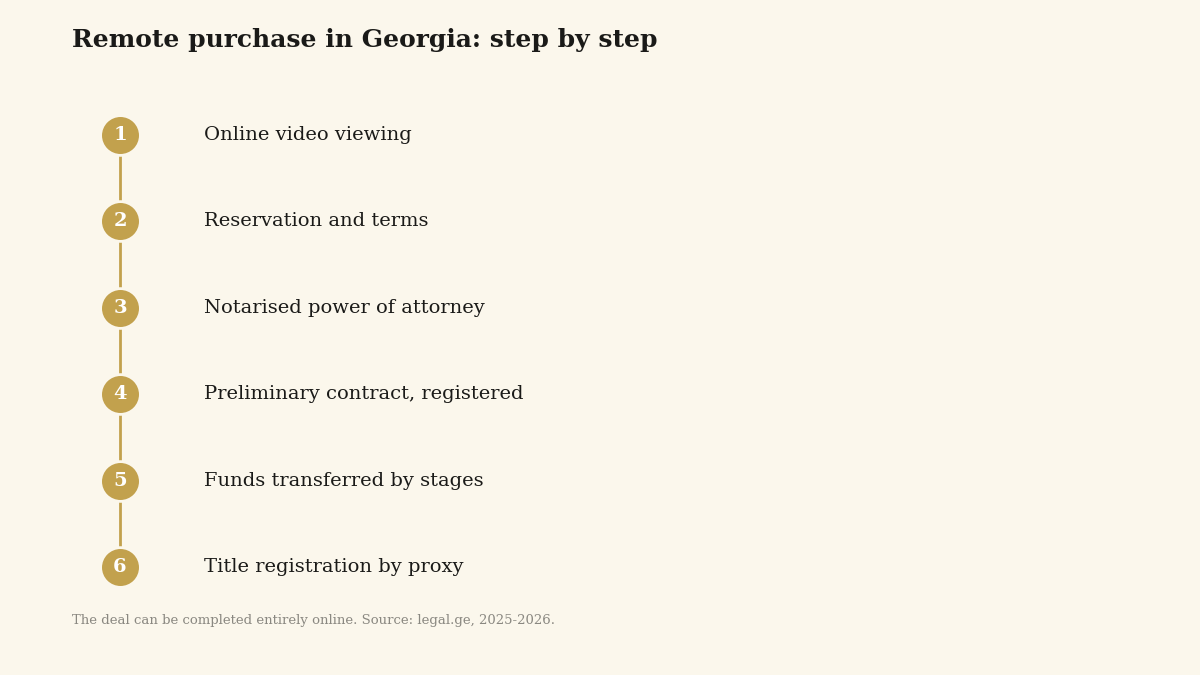
1. Selection and video viewings
You shortlist by floor plans, renders, and documents, and the viewing happens by live video: your representative or the sales manager walks you through the unit, the floor, the view, the construction stage, and the surroundings in real time, not as a polished image. For an off-plan unit, it helps to see the current state of the building; for a finished one, the real condition of the finish.
2. Reservation
The chosen unit is taken off the market for an agreed-upon period, subject to a small reservation payment, while the contract is prepared, locking in the price and terms.
3. Preliminary contract
It sets out the price, the handover date, the finish standard (black, white, green frame, or turnkey), the payment schedule, and penalties for delay. The contract can be signed remotely, through a notary, or by power of attorney, depending on whether the developer supports digital signing (legal.ge, verified June 2026).
4. Power of attorney
You issue a notarised power of attorney to a trusted person in Georgia, your lawyer, who signs the contracts and files the registration on your behalf.
5. Staged payments
Funds move not as a single upfront sum but on a schedule: a down payment, then payments tied to construction milestones. This is your main financial lever.
6. Title registration at NAPR
After full payment and the handover act, ownership is registered by the National Agency of Public Registry through the House of Justice, and your presence is not needed for this.

How a power of attorney works and how to stay protected
The power of attorney is the heart of a remote deal and, at the same time, where the main risk concentrates: you are giving another person the right to act in your name. It is therefore treated not as a formality but as a protection tool.
First rule: the power of attorney should be limited, not general. It names the specific property and the specific actions you authorize: sign the contract for this address, file for registration, obtain the extract. The narrower the wording, the less room for misuse. A correctly drafted power of attorney specifies the particular property and the particular powers (lawfirmgeorgia.com, buyer guide, verified June 2026).
Second rule: the representative should be an independent, vetted lawyer, not a casual middleman, and ideally not an employee of the developer itself. The power of attorney is notarised and legalized for use in Georgia (apostille or consular legalization, depending on the issuing country), and translated by a sworn translator where required.
Third rule, drawn straight from practice: agree on the payment process in advance and make sure the property has been inspected before any money is transferred (worldestate.homes, foreign buyer guide, verified June 2026). Do not pay for what has not been shown on video and checked against the documents.
This is precisely where our work removes risk from your side. We help structure a limited power of attorney, verify the powers granted, and make sure the representative acts strictly in your interest, not the seller's.
Money: accounts and transfers, with stricter KYC in 2026
The financial side of a remote deal needs preparation ahead of time because banking checks in Georgia tightened noticeably in 2026. Opening an account is no longer the "walk in with a passport" formality that older guides describe: banks are aligning their procedures with FATF standards and assessing each client far more closely (easyglobalbanking.com, non-resident account guide 2026, verified June 2026).
In practice, that means two things. First, you will be asked for the source of funds: several months of bank statements, contracts, proof of income. Second, time. A resident with a simple profile may open an account in a single visit, while a non-resident should allow for several business days to two weeks, depending on the bank and your profile (easyglobalbanking.com, 2026). The purchase itself and a residency application, incidentally, strengthen the application by showing a link to the country.
One nuance: a Georgian account is not always required for the purchase, since payment to the developer can be made by international transfer, but an account is almost always needed afterward to receive rental income and run your affairs. So prepare it in parallel rather than leave it for later. Rental income, if you intend to let, is taxed in Georgia at a flat 5 percent on the gross amount as a separately elected regime (PwC, tax summary, 21 January 2026).
Remote due diligence on the property and the developer
The strongest objection sounds like this: "I cannot see what I am buying." The answer is that the key checks are never really done by eyes on site but by documents and a lawyer, and that works the same whether you flew in or not.
Before the first payment, the developer is checked: financial standing, the status of the land (whether it is pledged to a bank), a valid construction permit, and a delivery history. The property itself is checked too: clean title, no encumbrances, documents that match the project. Although the process is straightforward, working with a licensed lawyer is essential, especially for those unfamiliar with Georgian law and language: the lawyer drafts the contract, verifies title, arranges translation and files for registration on your behalf (lawfirmgeorgia.com, verified June 2026).
A detailed developer checklist sits in our article on off-plan risks. The point is that distance does not weaken due diligence, because the diligence is documentary to begin with. Our job is to run it for you and show you the result before you transfer a single dollar.
Registering title without a personal visit
The final step, the transfer of ownership, takes place without your travel. Your representative files for registration under the power of attorney through the House of Justice, and the National Agency of Public Registry registers the title.
NAPR timelines and fees as of June 2026 are transparent and depend on the speed you choose: about 150 GEL for 4 business days as standard, about 270 GEL for 1 business day, and about 350 GEL on the day of submission (napr.gov.ge, immovable property registration fees, June 2026). In other words, "registration in one day" is a paid express option, not the default standard. After registration, you receive an electronic extract from the registry confirming your title.
The risks of going remote, and how to close them
Let us name the risks honestly and then close each one, because it is exactly this manageability that separates a calm online deal from a gamble.
The risk of trusting the wrong person
Closed by a limited power of attorney over specific actions and an independent lawyer as representative, rather than the seller's middleman.
The risk of paying for what is not built
Closed by staged payments tied to construction and by registering the preliminary contract in the Public Registry, which grants priority right and prevents a double sale of the same unit (legal.ge, off-plan page, verified June 2026). Registering the preliminary contract is arguably the single most important technical safeguard in the whole transaction.
The risk of "not what was shown."
Closed by precise wording in the contract (area, finish standard, handover date and penalties for delay) and by a video viewing of the real unit, not just renders.
A separate word on escrow, because it is a common misconception. Georgia has no mandatory escrow and no dedicated shared-construction law. Escrow and bank guarantees exist, but they are optional and apply only when expressly written into the contract (legal.ge, verified June 2026). So in a remote deal you cannot assume that "the money is protected by itself": protection is built by registering the contract, paying in stages, and choosing a sound developer. That is not a reason to avoid buying online; it is a reason to do it with proper support.
When is it still worth visiting?
A remote deal is lawful and complete, yet a visit sometimes adds value, and it is fair to say so. Consider traveling if you are choosing between several finished units and the view, the noise, and the feel of the district matter to you in person; if you want to open a bank account and meet your lawyer face to face; or if you are buying to relocate a family rather than purely for income. In all these cases, a visit is a question of comfort and final confidence, not legal necessity. The deal can be started and completed online, and, where useful, a visit can be planned for a convenient time.
Ready to complete your deal online without leaving anything to chance? Message us on WhatsApp: we will walk you through every step of a remote purchase, help structure the power of attorney, vet the developer, and handle title registration, so that each stage stays under control.
This material is for general information and is not investment, legal, or tax advice. Figures are given as of the date of publication with a cited source and may change. Confirm thresholds, taxes, fees, and rules at the time of your transaction and check with a licensed lawyer and tax adviser in Georgia.
Ready to move from the overview to specifics?
Related reading
Frequently asked questions
Can I buy an apartment in Georgia without visiting at all?
Yes. The deal is done through a notarised power of attorney to a trusted person in Georgia, and your presence is not required to sign the contract or to register the title (lawfirmgeorgia.com, June 2026).
How do I protect myself when buying by power of attorney?
Use a limited power of attorney for the specific property and actions, not a general one; appoint an independent, vetted lawyer as representative; agree on the payment process in advance; and do not transfer money until the property has been inspected and title has been verified.
Do I need a Georgian bank account for the deal?
Not always for paying the developer, since an international transfer is possible. But an account is usually needed afterward, for rental income and day-to-day matters, and is best prepared in parallel. In 2026, opening is stricter: the bank will ask for a source of funds, and it can take from several days to two weeks (easyglobalbanking.com, 2026).
How much does title registration cost, and how long does it take?
Per NAPR tariffs as of June 2026: about 150 GEL for 4 business days, about 270 GEL for 1 day, and about 350 GEL on the day of submission. Your representative files under the power of attorney, so no travel is needed (napr.gov.ge, June 2026).
Does escrow protect my money by default?
No. In Georgia, escrow is not mandatory and applies only if written into the contract. The baseline protection for a remote deal is to register the preliminary contract in the Public Registry and pay in stages tied to construction (legal.ge, June 2026).
Can I obtain residency remotely, too?
The property purchase itself can be completed online, while the residence permit is arranged separately: the right to it on a purchase from US$150,000 by market valuation arises only after the finished unit is delivered, registered, and valued. We cover this in our article on the residence permit through property.