How to Buy a New-Build in Georgia: A Step-by-Step Guide
From reservation to title: the steps, the contract, registration, payment plans and costs of buying off-plan in Georgia as a foreigner.

Learning how to buy property in Georgia is simpler than most foreign buyers expect. Ownership is full and unconditional, the transaction is transparent, and the final title registration takes only a few working days. The real work is not in the bureaucracy. It is in moving through the process deliberately: drafting the contract correctly, protecting yourself during construction, and vetting the developer before the first payment leaves your account. This guide walks you through every step, from reservation to title, and honestly shows you where the genuine points of control lie.
Who can buy: a foreigner owns a flat on the same terms as a citizen
Let us address the first fear and close it immediately. Foreigners in Georgia buy and own apartments on a freehold basis, on the same footing as Georgian citizens. You need neither residency nor a visa: a valid passport is sufficient for the transaction and for registration (legal.ge, verified against current law on 23 June 2026).
The one meaningful restriction concerns agricultural land, which foreign individuals generally cannot buy. It does not apply to apartments, residential units, or commercial space at all. Property ownership in Georgia is freehold, meaning that once you buy, you own the asset indefinitely. This nuance matters for houses on land plots, not for seafront new-builds, so for the overwhelming majority of buyers, it is a non-issue.
The steps: from reservation to title
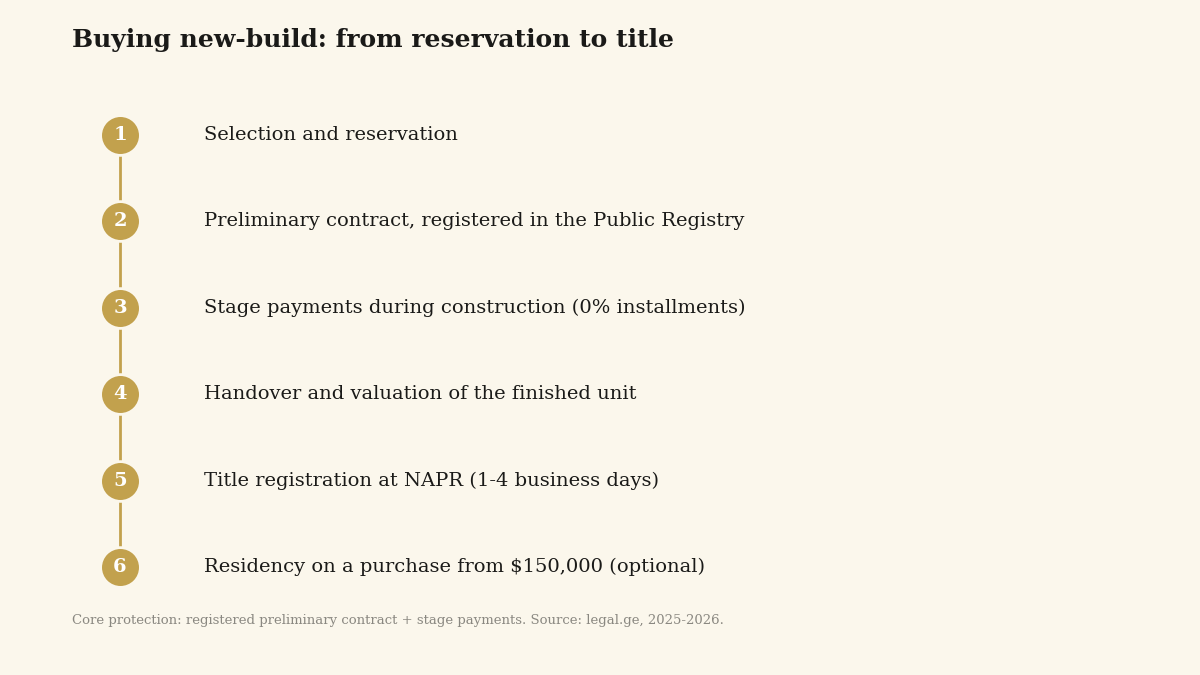
Buying a new-build in Georgia follows a clear sequence. Each step has a purpose, and each one carries something worth checking.
1. Reservation
You select a specific unit, fix the price and terms, and pay a modest reservation fee. The unit is taken off the market for an agreed period while the contract is prepared.
2. Preliminary contract
This is the key document in an off-plan deal. It sets out the price, the payment schedule, the handover deadline, the fit-out condition at handover, and penalties for delay on both sides. The contract must be bilingual, in Georgian and in a language you understand (legal.ge, 23 June 2026). The more precisely the developer's obligations are fixed, the less room there is for dispute later.
3. Registration of the preliminary contract at the Public Registry
This is not a formality. It is your principal protection during construction, and we explain why below.
4. Staged construction payments
Payment is made in stages tied to construction progress, not in a single lump sum. That structure is itself a control mechanism: your money follows real progress on site.
5. Handover and acceptance
When the unit is complete, the developer hands it over and you inspect it against the contract: floor area, fit-out, specification.
6. Title registration at NAPR
After full payment, ownership is registered with the National Agency of Public Registry through the House of Justice. From that moment, you are the legal owner.
Why registering the preliminary contract matters
This deserves separate emphasis, because it is where buyers most often underestimate the risk. Georgia has no dedicated shared-construction law that would automatically protect a buyer of an off-plan unit. You build that protection yourself, through the contract and the registry.
Registering the preliminary contract at the Public Registry gives you a priority right to the unit and prevents a double sale: the developer can no longer lawfully sell the same apartment to another buyer (legal.ge, 23 June 2026). It is an inexpensive step that sharply reduces one of the principal off-plan risks. If the contract on offer does not provide for this registration, that is a reason to ask questions, not to sign on trust.
Fit-out condition: four formats to tell apart
The word "apartment" in a Georgian new-build can mean very different things, and it directly shapes your final budget. The fit-out condition must be stated precisely in the contract, with no vague wording.
- Black frame: bare concrete walls and slabs, no internal utilities. The cheapest entry point, but you must add the full cost of renovation.
- White frame: main utilities brought in and walls leveled, but no finishing.
- Green frame: an intermediate stage, usually with rough-in and preparation for finishing.
- Turnkey: ready to move into, with finished fit-out.
The gap between black frame and turnkey runs to tens of thousands of dollars in renovation, so comparing offers on price per square meter alone, without accounting for fit-out, is meaningless. The format must be named explicitly in the contract.
The developer payment plan
Most developers offer their own interest-free installment plan over the construction period, and it is one of the strongest instruments on the Georgian primary market. Typically, this means a deposit of around 20-30% and the balance interest-free over the build, usually around 2-4 years, on a staged schedule, with no bank involved and no credit check (developer market practice, varies by project). Terms and completion dates should be checked before signing. We unpack exactly how these plans work and where their pitfalls lie in our guide to the developer payment plan in Georgia.
Entry costs and taxes
Here, Georgia is a pleasant surprise. There is no stamp duty and no separate property-purchase tax. A buyer's total transaction costs usually fall within roughly 0.7-1.2% of the property value (PwC, 21 January 2026). That covers notarial acts, document translation, and the state registration fee.
VAT of 18% applies to the developer's activity and is already built into the price; it is not a separate buyer payment. Income from rent, if you intend to let, can be taxed at a flat 5% on gross revenue under a separately chosen regime (PwC, 21 January 2026). We cover the tax side of ownership in full in a dedicated article.
Title registration: what it costs and how long it takes
The final step, title registration, is fast and runs on a fixed tariff. Under the current NAPR schedule, registering the transfer of a right to immovable property costs 150 GEL at the standard term of 4 working days; expedited options are 270 GEL for one working day and 350 GEL on the day the application is filed (NAPR, napr.gov.ge, schedule current as of June 2026).
The takeaway matters: the common phrase "registration in one day" describes a paid, expedited option, not the default. At the standard tariff, the procedure takes a few working days. The difference in cost is small, so the choice of speed is a matter of convenience rather than a serious cost factor.
Buying remotely by power of attorney
Being physically present in Georgia is not required for the deal. The purchase can be completed entirely at a distance under a notarised power of attorney granted to a trusted representative or lawyer, who signs the contract and files the documents for registration on your behalf (legal.ge, 23 June 2026). This is lawful and widely used by foreign buyers. We describe how a remote transaction works, from the first step to the final extract, in our guide to buying property in Georgia remotely.
Protection and its honest limits: escrow without illusions
Here it pays to be direct, because this is where less scrupulous sellers like to manufacture a false sense of safety. Georgia has no mandatory escrow and no dedicated shared-construction law. Escrow accounts and bank guarantees do exist in the country, but they are optional: they must be specifically arranged and written into the contract (legal.ge, 23 June 2026).
So the claim that "escrow protects your money" is simply untrue by default. By default, there is no escrow in your deal. That is not a reason to avoid buying off-plan. It is a reason to deliberately build your protection. The real off-plan risks, and the way to close each one, look like this:
- Construction stalling or developer default. Closed by vetting the developer before the deal: financial standing, a valid construction permit, the mortgage status of the land, and a track record of completed projects.
- Double sale. Closed by registering the preliminary contract at the Public Registry.
- Discrepancy in area or fit-out. Closed by precise contract wording and acceptance on handover.
- Late handover. Closed by penalty clauses written into the contract.
This method is precisely the substance of what Colchis does: we shortlist projects from vetted developers only, help register the preliminary contract, structure payments by construction stage, and recommend engaging an independent lawyer on the buyer's side. Where escrow or a bank guarantee makes sense, it is deliberately written into the contract, not presented as a non-existent default guarantee.
Documents and timeline: what to expect
For most foreign buyers, a valid passport is enough for the transaction; the contract is prepared bilingually, and for a remote deal, a notarised power of attorney is arranged. On timing, the active part of the process is compact: reservation and contract preparation take days, payments are spread across the build on a schedule, and final title registration, after full payment, completes within a few working days (or faster on the expedited tariff). The longest stretch is the construction itself, which is exactly why vetting the developer at the start matters more than registration speed at the end.
Ready to go through the deal without surprises? We run the purchase with full guidance: we vet the developer, help with the contract and the registration of the preliminary contract, and structure payments by stage. Message us on WhatsApp to buy with guidance, or take the short quiz, and we will match a property to your goal.
This material is for information only and is not investment, legal, or tax advice. Figures are stated as of the publication date with their source and may change. Verify fees, taxes, and rules at the time of your transaction, and confirm them with a licensed lawyer and tax adviser in Georgia.
Ready to move from the overview to specifics?
Related reading
Frequently asked questions
Can a foreigner buy an apartment in Georgia without residency?
Yes. Foreigners own apartments on a freehold basis on the same footing as citizens, and a passport is enough for the deal; no residency or visa is required. The only restriction concerns agricultural land, not apartments (legal.ge, 23 June 2026).
How much does property title registration cost in Georgia?
Under the NAPR schedule, registering the transfer of a right costs 150 GEL, with a standard term of 4 working days. Expedited options are 270 GEL for one working day and 350 GEL on the day of filing (NAPR, napr.gov.ge, June 2026).
Is it true that the title is registered in one day?
Same-day registration is available, but it is a paid, expedited option (350 GEL on the day of filing or 270 GEL for one working day), not the default. At the standard tariff, the procedure takes a few working days (NAPR, napr.gov.ge, June 2026).
Does escrow protect my money when buying a new-build?
Not by default. Georgia has no mandatory escrow and no dedicated shared-construction law. Escrow is possible, but it must be specifically written into the contract. The baseline protection is registering the preliminary contract and paying in construction stages (legal.ge, 23 June 2026).
Can I buy property in Georgia remotely?
Yes. The transaction can be completed entirely under a notarised power of attorney, without traveling to the country. It is lawful and common practice (legal.ge, 23 June 2026).
What taxes does the buyer pay on the transaction?
There is no stamp duty and no purchase tax. A buyer's total transaction costs are usually around 0.7-1.2% of the value. VAT of 18% is built into the developer's price and is not a separate payment to the buyer (PwC, 21 January 2026).