Off-Plan Risks in Georgia and How to Vet a Developer
The real off-plan risks in Georgia: stalled builds, double sales, mortgaged land. A developer due-diligence checklist and how to protect the deal.
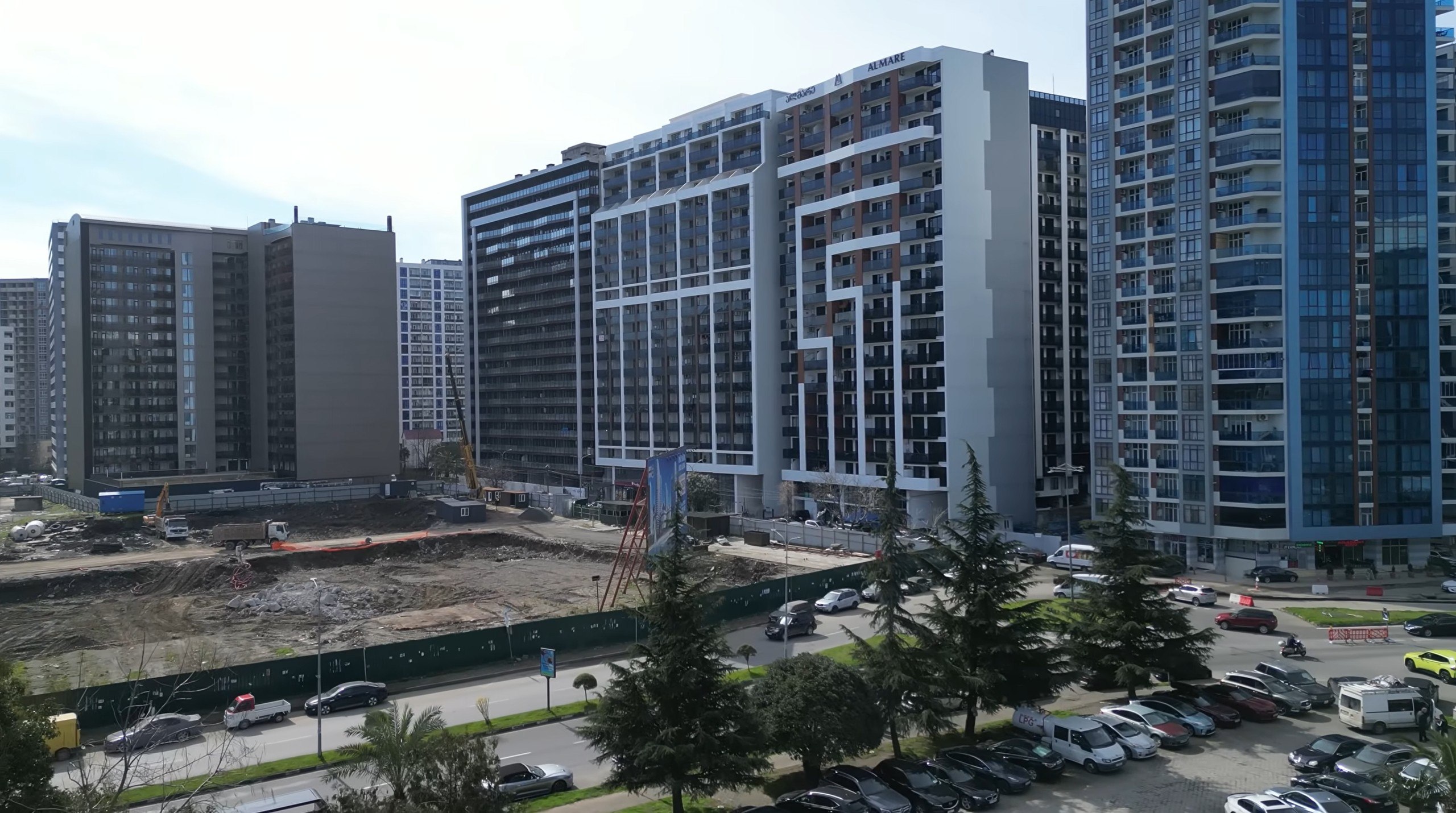
Buying off-plan in Georgia gives you the lowest entry price on the market and, at the same time, the format that most rewards sober due diligence. The off-plan risks in Georgia are real, and we will name them plainly, but almost all of them are mitigated by a clear set of actions: registering the preliminary contract, paying in stages tied to construction, and vetting the developer before you commit. This is how to enter early without being left alone with the risk.
Let us state the conclusion up front: off-plan risk is manageable. Not absent, but manageable. We will take each risk in turn and show what closes it and what the Colchis team handles in the process.
Why off-plan is attractive and why it carries risk
Buying early has two strong advantages. The first is the entry price: at launch, the price per square meter is well below that of a finished building, and by handover, the unit has usually appreciated alongside its completion. As a gauge, the average new-build turnkey price in Batumi reached about US$1,865 per square meter at the end of 2025, up 9.4% year on year (Galt and Taggart, 2025 review). The second is the developer's interest-free payment plan, typically a 20-30% down payment, with the balance spread interest-free over the build period, with no bank and no credit check (developer market practice; varies by project).
Both advantages flow from one fact: you are paying in advance for something that does not yet exist. That is where the risk lives. Several years pass between signing and keys, and during that time, it matters that the build is completed, that the delivered area matches what was promised, and that your right to the apartment is protected against competing claims. The good news is that every one of these points can be checked in advance.
The real off-plan risks, named plainly
Here are the risks without softening; staying silent on them would do you a disservice. Each is closed later in the article.
Stalled construction and developer default. The hardest scenario: the developer fails to mobilize funding, and construction stops indefinitely (legal.ge, off-plan guidance, 2025-2026). This is the central early-stage risk, and checking the developer's finances is what guards against it.
Area discrepancy. The measured area on completion can differ from the plan. Closed by a price-recalculation formula in the contract.
Double sale. An unscrupulous company sells the same apartment to two buyers. This is possible exactly when the preliminary contract is not registered in the Public Registry (legal.ge, 2025-2026).
Mortgaged land. The plot under the project may be pledged to a bank. This is not always a deal-breaker, but the mortgage status is always verified before payment is made.
Supply overhang and delays. Batumi has a lot of supply: unsold stock rose about 14% year on year, to roughly 12,400 apartments by the end of 2025, while the 2025-2029 pipeline holds around 58,000 units, about 80% aimed at short-term rental (Galt and Taggart, 2025 review). A heavy pipeline raises competition and can stretch timelines at weaker projects.
Now, in order: what to do about each.
Escrow in Georgia: an honest word about protecting your money
This is where it matters most and where we part ways with anyone promising "full safety by default." Georgia has no mandatory escrow and no dedicated shared-construction law (legal.ge, 2025-2026). That means your money is not protected automatically by the mere fact of the transaction.
Escrow accounts and bank guarantees exist in Georgia, but they are optional: the law does not impose them; they must be included in the contract and agreed with the developer (legal.ge, 2025-2026). So "escrow protects your money" is true in only one case: when your specific contract provides for escrow or a bank completion guarantee, and you have verified it. By default, protection is built not by a bank but by a well-drafted contract and a staged payment structure.
This is not a reason to walk away. It is a reason to buy through a contract that protects you specifically and through someone who can read that contract.
The main protection is registering the preliminary contract at the Public Registry
If you remember one action from this article, let it be this. The preliminary contract with the developer should be registered at the Public Registry. That registration gives you a priority right to the unit and closes the double-sale risk: your right to the unit becomes publicly visible and senior, and the developer can no longer sell the same apartment in good faith to another buyer. An important caveat: if the land under the project is pledged to a bank (one of the risks above), the priority of claims is governed by the terms of that pledge, so the land status is verified separately and before payment (legal.ge, 2025-2026).
Under Georgian law, off-plan purchases are governed by the Civil Code and the Law on the Public Registry, and a written preliminary contract followed by registration is the lawful mechanism that protects the buyer (legal.ge, 2025-2026). An unregistered contract leaves you exposed; a registered one makes your rights visible and senior. That difference is the difference between manageable and unmanageable risk.
The second supporting mechanism is paying in stages tied to construction rather than the full sum up front. Payment linked to completion milestones means you do not hand over everything before the developer has built anything, and you keep leverage at each step.
A developer due-diligence checklist
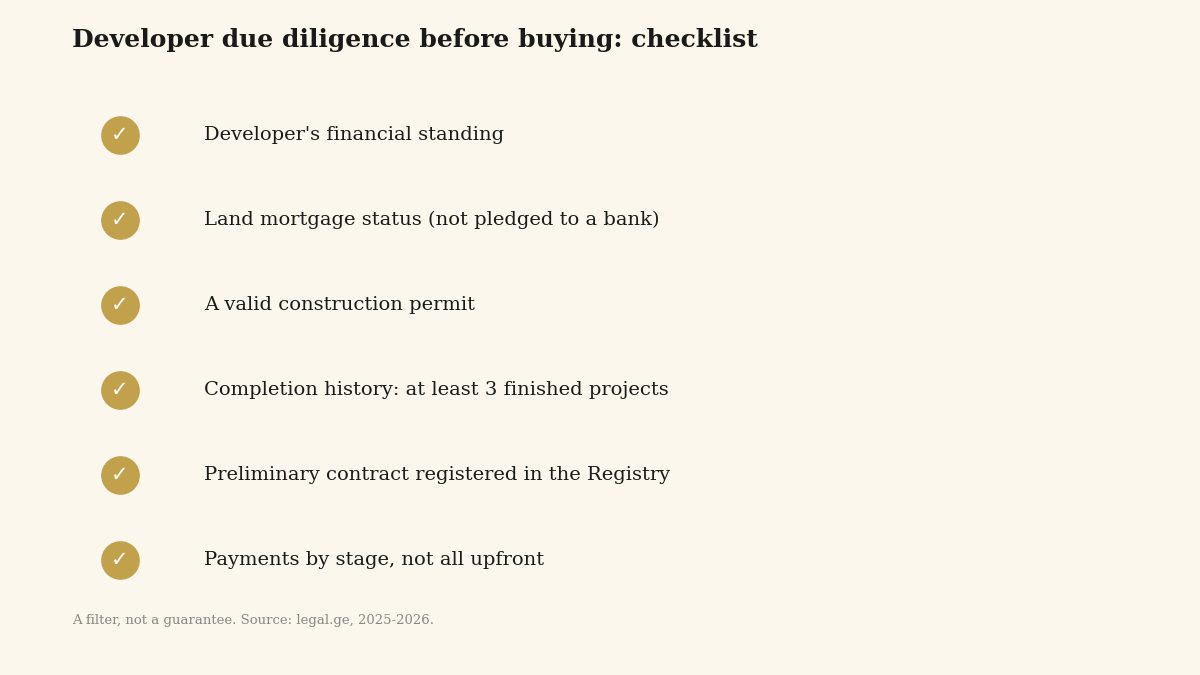
A sound deal starts not with the contract but with who sits on the other side of it. Before any money moves, the developer is checked against clear points (legal.ge, 2025-2026).
Financial standing. Whether the company can carry the build to completion on its own balance sheet, rather than depending on the next round of sales. Stalled builds most often trace back to a funding shortfall.
Land mortgage status. Whether the plot is pledged to a bank, and if so, on what terms and what that means for buyers.
A valid building permit. Whether there is a current permit and whether the project's parameters match the permitted density and coefficients.
Track record. The leading benchmark is no fewer than three completed projects; years in the market alone prove little without a confirmed record of completions. This is not a guarantee but a filter that screens out companies without a demonstrated record of finishing what they start.
A separate point about honesty. A title such as "more than ten years in the market" proves nothing on its own until a verifiable record of completions sits behind it. We propose measuring competence not by how loudly a developer states it, but by whether it passes this checklist on the facts. We ask you to judge us the same way: not by claims, but by the method of verification you see here.
Red flags in the contract
The contract is where a sound developer and a problematic one most visibly diverge. Three clauses should put you on guard.
Vague finishing standard. Georgia uses grades of completion: black frame (bare walls), white frame (plaster and screed, utilities run in), green frame (partial finishing), and turnkey (move-in ready). If the contract does not state precisely the condition in which you receive the apartment, you risk paying extra for what you assumed was included, so it must be fixed unambiguously (legal.ge, 2025-2026).
No penalty for late delivery. If the contract sets no liability for missing the handover date, the developer has no financial incentive to avoid delay. A late-delivery penalty is your leverage.
Payment of 100% up front. A demand to pay the whole sum before or at the very start of construction strips away your main instrument of control. The healthy model is a down payment plus payments tied to completion.
Add a recalculation formula for any area discrepancy and a clause providing for registration of the preliminary contract. A contract that contains all of this turns an abstract risk into a set of concrete, manageable terms.
How we vet the property and the developer
Our role here is substantive. Colchis is an introducer and marketing partner of vetted Georgian developers, not a seller of "any build by the sea." The developer pays our fee; there is no separate commission from you, and because we are not tied to one developer, we can decline a weak project and offer one that passes the checks.
In practice, we run the same checklist on the property you are considering: the developer's financial position and completion history, the land status and a valid permit, the preliminary contract for its finishing standard, late-delivery penalty and payment structure, and registration at the Public Registry with a priority right in your name. We close the supply-overhang risk not by selection alone but with verifiable signals of liquidity: we look at rental demand in the district itself, the share of unsold stock within the specific project and its pace of sales, and we favor locations where demand is borne out by the numbers rather than the view alone. If you want the full path of the deal, from reservation to title, we set it out in our guide to buying a new-build and in our article on buying property in Georgia online for the remote scenario.
The takeaway is sober and reassuring at once. Off-plan in Georgia carries real risks, but they are manageable: register the preliminary contract, pay in stages, and vet the developer on the facts. Do those three things, and an early entry becomes what it should be, the best-value way into a growing market. Our job is to make sure you have passed those checks before the first payment.
Ready to check a specific property? Get the "Georgia Investor Guide 2026" on WhatsApp or book a consultation, and we will vet the developer and the contract against this checklist together before the first payment.
This material is for information only and is not investment, legal, or tax advice. Figures are given as of the publication date with their source and may change. Verify thresholds, taxes, rules, and contract terms at the time of the transaction, and consult a licensed lawyer in Georgia.
Ready to move from the overview to specifics?
Related reading
Frequently asked questions
Is it safe to buy off-plan in Batumi?
The risk is real but manageable. The key protections are registering the preliminary contract at the Public Registry (priority right and protection against double sale), paying in stages, and vetting the developer on finances, land status and permit (legal.ge, 2025-2026). On those terms, an early entry delivers a better price at controlled risk.
Does escrow protect my money in Georgia?
Not by default. Georgia has no mandatory escrow and no shared-construction law; escrow and bank guarantees exist but are optional and must be included in your contract (legal.ge, 2025-2026). Without such a clause, protection comes not from a bank but from the contract itself and the payment structure.
How do I vet a developer in Georgia?
On four points: financial standing, land mortgage status, a valid building permit, and a track record of completions (a benchmark of no fewer than three completed projects; years in the market alone prove little). It filters out companies without a demonstrated record of finishing what they start (legal.ge, 2025-2026).
What happens if the developer does not complete the building?
This is the hardest off-plan risk, and it arises mainly from a funding shortfall at the developer (legal.ge, 2025-2026). That is why checking finances and completion history, paying in stages, and holding a registered contract matter before any money moves: they lower the probability and protect your rights.
What is registering the preliminary contract, and why does it matter?
It is the entry of your contract with the developer into the Public Registry. It grants a priority right to the unit and eliminates the risk of double sale, making your right publicly visible so the developer can no longer sell the same apartment in good faith to another buyer (legal.ge, 2025-2026). An important caveat: if the land under the project is pledged to a bank, the priority of claims is governed by the terms of that pledge, so the land status is verified separately and before payment. Without registration, the contract leaves you exposed.
Is Batumi's supply overhang a problem for buyers?
Batumi has a large supply, and a heavy pipeline increases competition for tenants and buyers (Galt and Taggart, 2025 review). For a buyer, this is not a prohibition but a reason to choose a strong project in a liquid location where demand is borne out by the numbers. We set out the detailed effect of the overhang on yield in our article on rental income in Batumi (/en/batumi-rental-yield).
What should I check first in the contract?
A precisely stated finishing standard, a late-delivery penalty, payment in stages (not 100% up front), and a clause for registering the preliminary contract. A vague finishing standard, no penalties, and a full prepayment demand are red flags.