Investing in Batumi Property: Can You Really Earn on Rent?
Gross vs net, short-term vs long-term, seasonality, and costs. What you can realistically earn renting out a Batumi apartment, with sources.
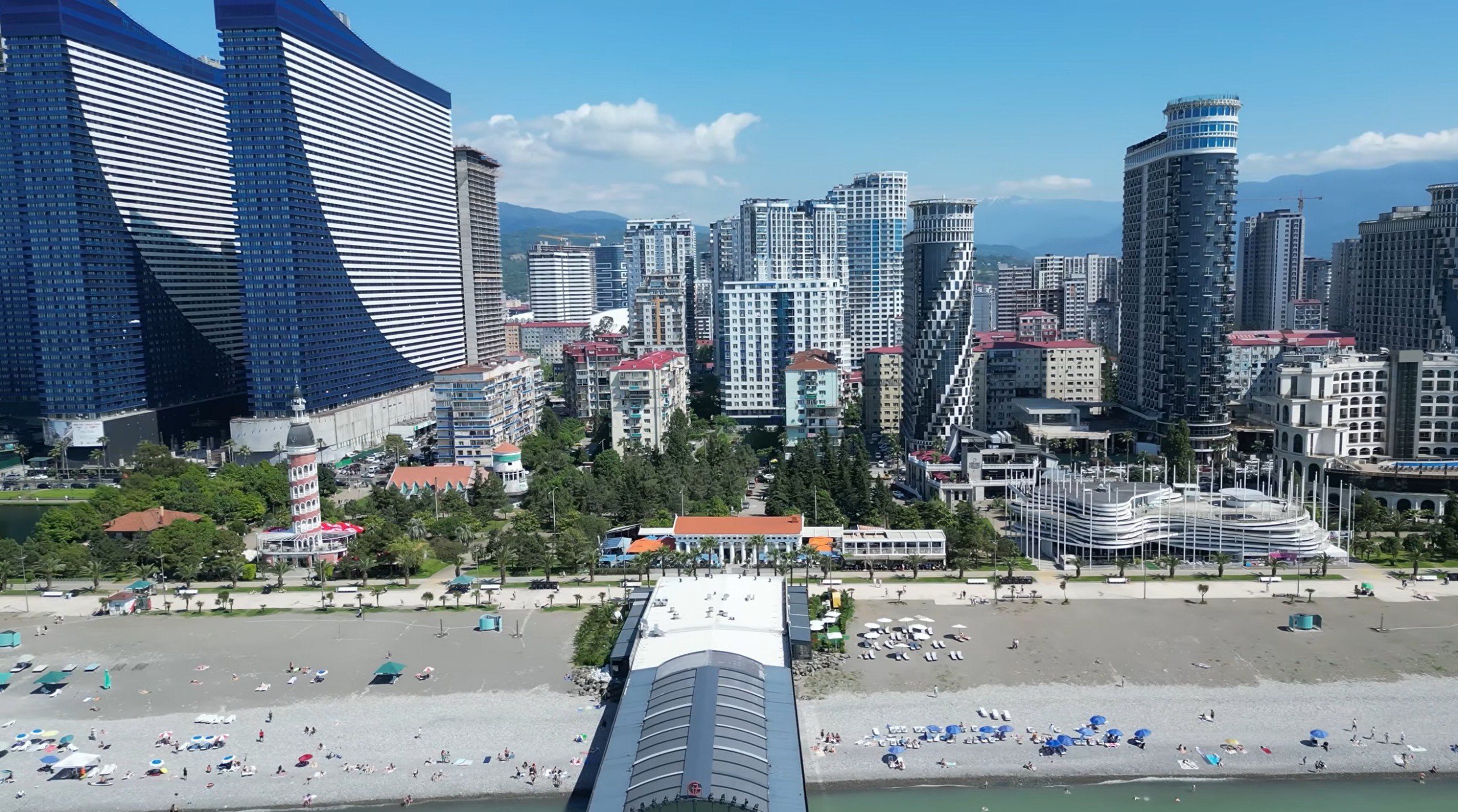
The short answer is yes, you can earn on rent in Batumi, but not the 12 to 18 percent that advertising banners promise. The real picture is more modest and more honest, and it is the one to work from if you take yield seriously rather than buying on emotion. Below, we break down Batumi rental yield by the facts: gross versus net, short-term versus long-term, seasonality, costs, and a real worked example on a studio. Each figure is accompanied by its source and period, so you can check them yourself.
Where an honest calculation starts: gross
Gross yield is annual rent divided by the property's purchase price, before costs and taxes. In the first quarter of 2026, it stood at around 7.42 percent across Georgia, around 7.53 percent in Tbilisi, and around 7.31 percent in Batumi (Global Property Guide, February 2026). Studios run higher, around 8.03 percent in Batumi, because a smaller unit at a similar rent reads as more efficient (Global Property Guide, February 2026). Larger apartments, by contrast, sit lower.
This is the honest ceiling to count from. A little over seven percent gross is a sound, healthy figure for a coastal market, but it is not yet what reaches your pocket.
The key split: gross is not net
Net yield, meaning income after tax, vacancy, maintenance, and management, is usually 1.5 to 2 percentage points below gross (Global Property Guide, February 2026). So from a gross of about 7.3 percent in Batumi, a realistic net falls toward 5 to 6 percent on a well-run long-term let, and lower again on an average self-managed short let. The gap between the promised number and the real one almost always hides here, in the word "net" that advertising leaves out.
Short-term versus long-term: where the money is, and where the season is
You have two letting scenarios, and they are counted differently.
Long-term letting. A stable tenant on an annual contract, a predictable flow, and minimal management. Lower income but steady, without seasonal troughs.
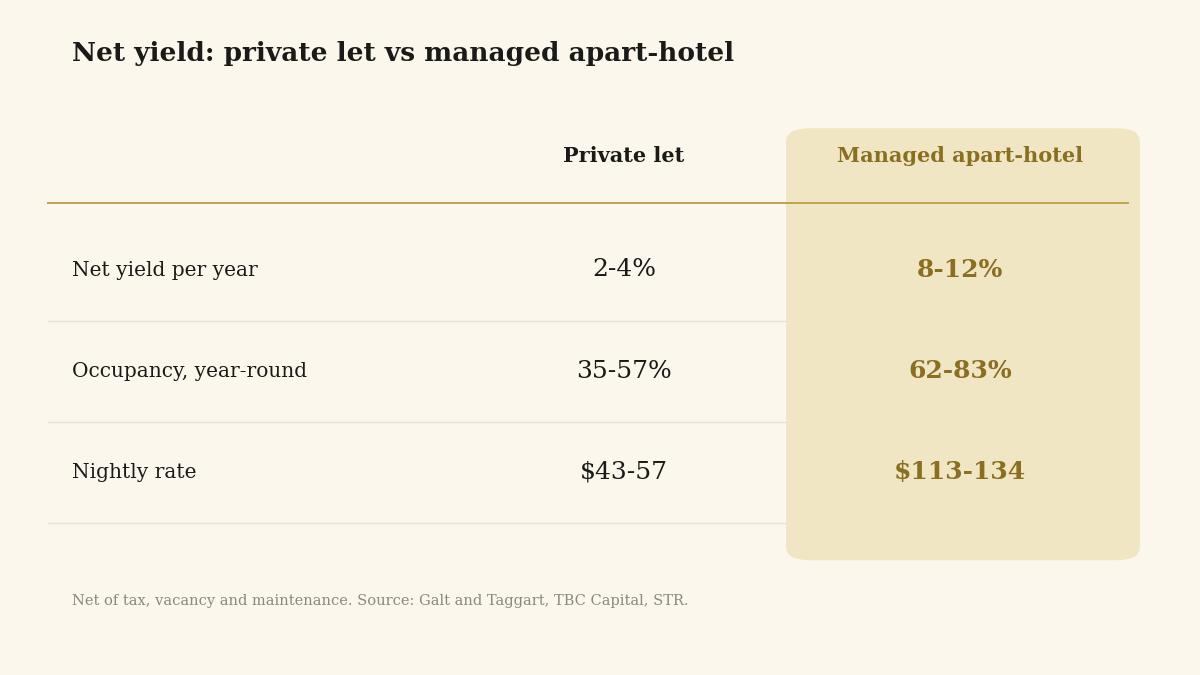
Short-term letting, nightly. Higher gross nightly rate, but higher costs and stronger seasonality. The average nightly rate in Batumi was around USD 35.6 for the full year 2025, broadly flat year on year (Galt and Taggart, 2025). Occupancy is sharply seasonal, peaking in July and August, with demand falling from November to April. Independent aggregators disagree on occupancy and rate by methodology: from around 35 percent occupancy at roughly USD 57 a night (AirROI, April 2026) to around 57 percent occupancy at about USD 43 a night (Airbtics, October 2025); treat all of these as approximate figures. The official average nightly rate (around USD 35.6, Galt and Taggart) sits below the aggregator figures because it is an average across the entire stock and the whole year, whereas the aggregators count active listings in the high season. Managing a nightly let absorbs about 25 percent of revenue, on top of furnishing, consumables, and the gaps between guests (Galt and Taggart, 2025).
Taxation in either scenario is among the lowest in the region: individual income from residential rent can be taxed at a flat 5 percent of the gross amount (PwC, 21 January 2026). This is a separately chosen regime and should not be confused with the 1 percent small-business regime, which in fact excludes rental income; we cover property taxation in full in a separate piece on taxes in Georgia. Note that the special fixed regime for short-term accommodation (code 55.2) lapsed on 1 January 2026, so the current short-let treatment should be confirmed on rs.ge or with a tax adviser.
A worked example of a real studio
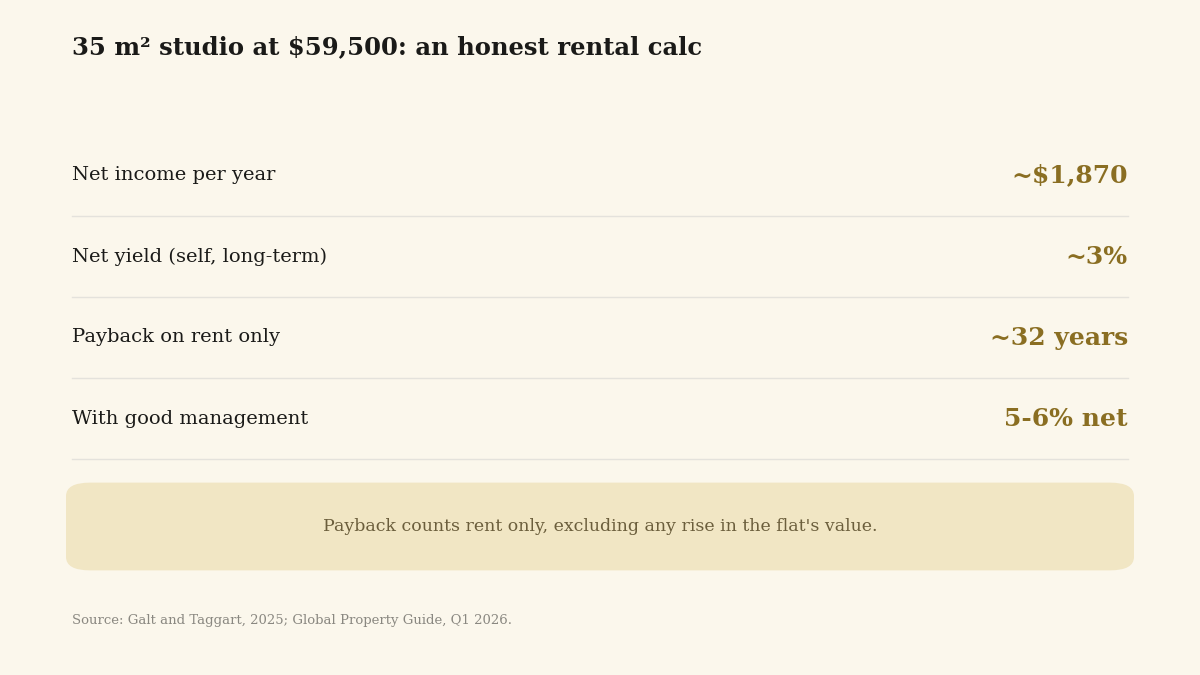
Take numbers, not slogans. A 35-square-meter studio at USD 59,500 on a long-term lease returns about USD 1,870 net per year, roughly 3 percent net, with a payback of about 32 years (Galt and Taggart, 2025). A caveat: this figure is counted on the rental flow alone and does not account for any appreciation in the value of the apartment itself, which, for a coastal new-build, has historically delivered a notable share of total return (see the Batumi price analysis). The same unit on a nightly let at around 43 percent occupancy (Galt and Taggart full-year estimate) yields about 2.8 percent net (Galt and Taggart, 2025). And the key honest caveat from the same source: without professional management, short-let yield can fall to zero or go negative.
These are two distinct cases. Around 3 percent net is the average for a single studio with no optimization of the letting; 5 to 6 percent net is the ceiling for a well-run long-term let, where size, location, and management work together. Not one figure, but two different scenarios.
Why is the result modest? Because this is an average single studio that the owner lets alone, without year-round occupancy and without a pool. That is not a verdict on the market; it is a verdict on the strategy of "buy any studio by the sea and wait for 12 percent."
Where the "up to 12 percent" figure comes from
It exists, but in two specific contexts, and it matters not to pass them off as a general benchmark.
First, a historic peak. In August 2022, gross yield in Batumi reached 12.31 percent, and in Tbilisi, 10.18 percent (Global Property Guide). By August 2025, Batumi had cooled to around 8.11 percent (Global Property Guide). It cooled not because the market broke, but because prices rose faster than rents: regional rental rates softened while the price per square meter kept climbing. When the denominator grows faster than the numerator, the yield falls. That is arithmetic, not crisis.
Second, a branded apartment hotel under professional management. These formats hold occupancy year-round through a room pool, a hotel operator and amenities (restaurants, pool, spa), and operators cite yields of around 8 to 12 percent a year. Income is shared across owners by pool, so a vacancy in your specific unit is smoothed out. Entry to this format starts at roughly USD 65,000 to 70,000, because the asset is managed and comes with infrastructure.
What an honest breakdown will not show you is a 12 to 18 percent general market benchmark. That is marketing, not data.
The risk sellers stay quiet about: the supply overhang
Construction along the coast is intense, and the figures show it. By the end of 2025, the volume of unsold housing in Batumi had increased by about 14 percent over the year, reaching roughly 12,400 apartments, while the declared pipeline for 2025 to 2029 totals around 58,000 units, of which about 80 percent are tailored for nightly letting (Galt and Taggart). For yield, this means rising competition for the same guest: the more uniform studios reach the short-term market, the harder it becomes to hold both rate and occupancy.
We name this plainly, because a silenced risk costs more than a stated one. But the conclusion runs against panic. The overhang hits commodity stock, identical studios with no differentiation, and no management. It barely touches a well-chosen asset: a strong location, a sought-after unit type, a professionally managed format. A large pipeline of buildings is not a reason not to buy; it is a reason to buy deliberately with someone who screens out weak stock.
How to actually raise yield
Yield in Batumi is not a lottery; it is the sum of decisions. Four levers work in your favor.
Location. Price and demand depend heavily on the district: the periphery starts at around USD 1,487 per square meter, while Gonio and Kvariati, where Eagle Hills is building a marina, are around USD 2,048 per square meter (Galt and Taggart, Q4 2025). Proximity to growth nodes and to the sea directly converts into occupancy. We give a full district breakdown in a separate piece on Batumi districts for investment.
Unit type. Studios deliver a higher gross percentage (around 8 percent against 7.3 on average) but depend more on the season; a managed format smooths seasonality better than a private apartment.
Management. This is the decisive lever. The difference between "toward zero" on a self-managed let and year-round occupancy in a managed format is precisely professional management and the pool.
Payment plan as a lever. A developer's interest-free installment plan, usually with a 20 to 30 percent deposit and the balance interest-free over the build period of about 2 to 4 (up to 5) years, lets you enter with less capital and start counting yield from a smaller committed sum (developer market practice, varies by developer).
The honest verdict
Earning from rent in Batumi is real. But the honest figure is around 5 to 6 percent net on a well-run long-term let, around 3 percent on an average self-managed short let, and 8 to 12 percent in a branded managed format with year-round occupancy. The result depends most on management and on the choice of asset, not on the market in general. If you are weighing Batumi in the context of diversification and market choice, we compare it with Dubai, Cyprus, and Turkey in a separate piece.
Our job is to get you into the right asset for your goal and to keep you from mistaking an operator's gross promise for net income. We check the operator's calculation: whether it is figured on gross or net revenue, whether VAT, the management fee, and operating costs are included, and whether the operator gives priority to its own remaining inventory. Before an off-plan deal, it is worth running a separate check on the developer and the project.
Ready to run the numbers on a specific asset? Take the "Georgia Investor Guide 2026" on WhatsApp with the full calculation, or message us, and we will find an income property for your strategy and verify the operator's figures.
This material is for information only and is not investment, legal, or tax advice. Yield is not guaranteed and depends on the asset, the management, and the market. Figures are stated as of the publication date with their source and may change. Confirm taxes, regimes, and rules at the time of the transaction, and consult a licensed lawyer and tax adviser in Georgia.
Ready to move from the overview to specifics?
Related reading
Frequently asked questions
What yield can you realistically expect from a Batumi apartment?
On self-managed letting, realistically around 3 percent net on an average short let and around 5 to 6 percent on a well-run long-term let. A branded apartment hotel under management delivers around 8 to 12 percent through year-round occupancy and a pool (Global Property Guide and Galt and Taggart, 2025 to 2026).
Is short-term or long-term more profitable?
Short-term has a higher gross nightly rate but higher costs too (management around 25 percent, vacancy, season). Long-term is steadier and more predictable. Without professional management, short-term can go negative (Galt and Taggart, 2025).
Can you really earn 12 percent or more?
Twelve percent is the historical peak in August 2022 (Batumi: 12.31 percent, Global Property Guide) and the upper band for managed aparthotels. As a general market benchmark, 12 to 18 percent is advertising, not data.
What is the tax on rental income?
Individual income from residential rent can be taxed at a flat 5 percent of the gross amount (PwC, 21 January 2026). It is a separate regime, not to be confused with the 1 percent small-business one. The short-term accommodation regime (code 55.2) lapsed on 1 January 2026, so confirm the current treatment on rs.ge.
Will the large building pipeline crush yields?
The supply overhang is real: around 58,000 units across 2025 to 2029 projects, roughly 80 percent of which are for short-term rental (Galt and Taggart). It presses on commodity stock, so the outcome is decided by location, format, and management, not by buying "any studio."
How long until a studio pays back?
An average 35-square-meter studio at USD 59,500 on a long-term lease pays back in about 32 years at around 3 percent net (Galt and Taggart, 2025). The right format and management improve that picture.