Property Taxes in Georgia for Foreign Owners (2026)
Rental income tax, property tax, purchase costs and capital gains in Georgia, explained accurately for foreign owners with sources.

Property taxes in Georgia for a foreign owner are arguably the most pleasant part of the whole transaction, and also the part most shrouded in confusion. Georgia remains one of the lowest-tax jurisdictions in the region for a private residential owner: no stamp duty, no purchase tax, flat-rate rental income, and capital gains that drop to zero after two years of ownership. The trouble starts with specific rates, because the single most common error in marketing copy is confusing the 5 percent rental tax with the 1 percent small-business regime. They are not the same thing.
Below, we set out an owner's and a landlord's taxes by the facts, every figure with a source and a period, so you can feed each into your own yield calculation. The honest frame: Georgia's tax environment is light, but not a flat zero, and several regimes changed in 2026, so confirm the final rates at the time of your deal with a licensed tax adviser in Georgia.
Briefly: why Georgia counts as a low-tax state
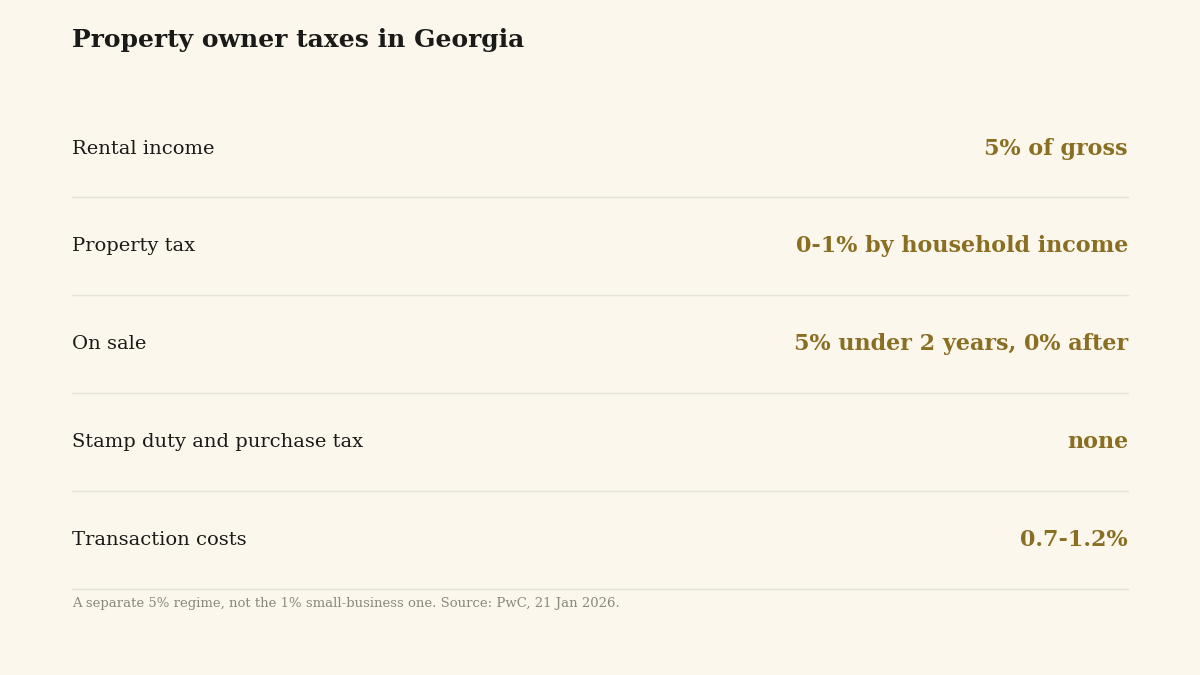
For a private residential buyer, the picture is simple. At entry, there is neither stamp duty nor a purchase tax, and ancillary costs typically range from 0.7 to 1.2 percent of the property price (PwC, 21 January 2026). Rental income can be taxed at a flat 5 percent; property tax for most owners is zero or a fraction of a percent; capital gains tax on a sale is zero after two years; and there is no inheritance tax at all (PwC, 21 January 2026). That is the low-tax base the market honestly rests on, without overstatement about an "offshore" or "zero tax" haven.
Rental income tax: 5 percent, not 1 percent
This is the central point, and where buyers are most often misled. An individual's income from renting out residential space can be taxed at a flat 5 percent on the gross amount, with no deduction of expenses, provided you choose this regime (PwC, 21 January 2026). The word "gross" is key: the 5 percent is calculated on the entire rent received, not on profit after costs.
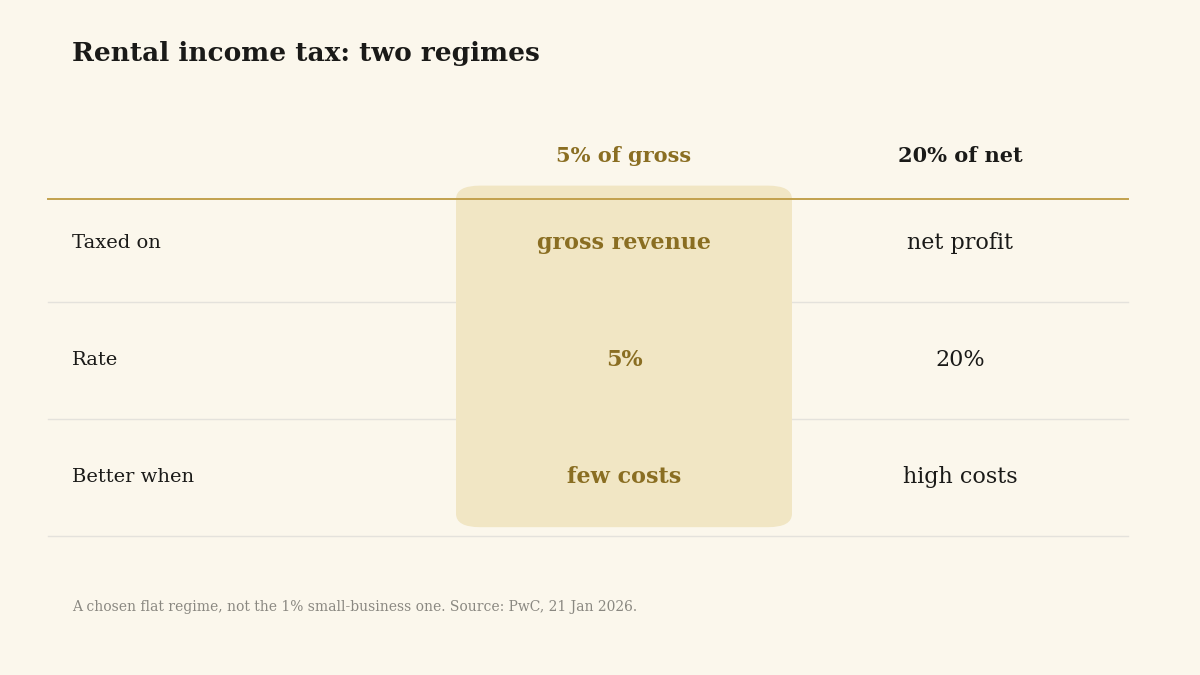
Now the myth. Georgia has a popular small-business regime at 1 percent on turnover, and it is constantly attributed to rent. That is wrong: the small-business (individual entrepreneur) status at 1 percent specifically EXCLUDES income from residential rental (PwC, 21 January 2026). You cannot pay 1 percent on rent as a private individual. A landlord's real choice is different: either a flat 5 percent on gross rent, or 20 percent on net income, after deducting documented expenses (PwC, 21 January 2026).
In practice, the 5 percent gross regime is attractive when running costs are low: you pay little on all revenue, and skip the paperwork. The 20 percent net regime makes sense where costs are genuinely high (management, repairs, furniture depreciation) and the taxable base shrinks sharply. For a typical private apartment rental in Batumi or Tbilisi, the 5 percent flat rate is almost always simpler and cheaper, and among the lowest rates for rental income in the region.
The 2026 nuance: the special short-term rental regime has expired
Here, precision matters because many guides still repeat an outdated rule. From 1 January 2023, Georgia operated a separate fixed regime for short-term, hotel-style accommodation: activity under EU statistical code 55.2 (Holiday and other short-stay accommodation, that is, holiday-style daily letting) was taxed at a special fixed rate, subject to income below GEL 100,000. That regime ran for a limited period, from 1 January 2023 to 1 January 2026, and has now expired (PwC, 21 January 2026).
The takeaway is simple. The baseline flat 5 percent on residential rental income remains in force as of early 2026 (PwC, 21 January 2026), but the special fixed regime for short-term, hotel-style accommodation under code 55.2 has ended and should no longer be presented as current. If your strategy is holiday-style daily letting, confirm the current procedure and rate on the Revenue Service site rs.ge or with a tax adviser: this is exactly the kind of rule that changed within the year.
Property tax: 0 to 1 percent, by family income
The annual property tax for an individual is tied not to the property in isolation, but to the household's annual income. Only families whose combined annual income exceeds GEL 40,000 in a calendar year are liable for property tax (PwC, 21 January 2026). Below that threshold, no property tax is charged on the home, so for many owners, it is simply zero.
If income is above the threshold, the rate is a fraction of a percent of the property's value on a scale: roughly 0.05 to 0.2 percent for household income up to about GEL 100,000, and 0.8 to 1.0 percent above that (project fact base drawing on PwC and Global Property Guide, 2026). The exact rate within these bands is set by the municipality on market value, so confirm the precise sum with a tax adviser. The order of magnitude is clear: for a private owner, this is either zero or a fraction of a percent per year, not a meaningful cost line item.
Costs and taxes at purchase: no stamp duty
One of the most welcome points for a foreigner: at purchase, there are essentially no special acquisition taxes. Georgia has no stamp duty and no purchase tax on real estate as such, and a buyer's ancillary costs (notary, title registration, minor fees) usually fall within roughly 0.7 to 1.2 percent of the property price (PwC, 21 January 2026). Against markets where a transfer tax alone takes several percent, that is a noticeable saving at the start.
On registration: foreigners own apartments on the same basis as citizens, with the only restriction being agricultural land, and the National Agency of Public Registry records title through the House of Justice, usually within 1 to 4 business days (registration and ownership sources, 2026). We cover the step-by-step mechanics of the deal, from reservation to title, in our guide to buying a new-build in Georgia.
Tax on sale: 5 percent for the first two years, then zero
Capital gains tax on the sale of a home is structured in the long-term owner's favor. Profit from selling an apartment (or a house with the attached land plot) is taxed at 5 percent if you sell within the first two years of ownership, and drops to zero after two years (project fact base drawing on PwC and Global Property Guide, 2026; the 5 percent rate on the sale of residential property is confirmed by PwC, 21 January 2026). Georgia has no inheritance tax (PwC, 21 January 2026).
For strategy: if you plan to resell quickly within two years, build 5 percent of the gain into your model. If your horizon is longer, typical for a rental investment and a residency-driven purchase, the exit tax is zero. The two-year threshold, like any tax rule, is worth confirming at the time of the deal.
VAT at 18 percent: the developer's matter, not yours
Another frequent confusion. Georgia's standard VAT rate is 18 percent and applies to economic activity, that is, to business (PwC, 21 January 2026). On a new-build, this is a tax in the developer's orbit as a seller carrying on business, not a separate tax a private buyer pays on top of the price. For you, VAT is part of the developer's pricing, not an extra line in your tax burden.
Relocation context: entrepreneur status and rent
If you are relocating, another layer appears. Many people who move to Georgia register as individual entrepreneurs under the small-business regime at 1 percent on turnover, a convenient tool for freelance and remote income. But the limit noted above matters: the 1 percent regime excludes residential rental income (PwC, 21 January 2026). Your entrepreneurial income may sit at 1 percent, while rent from a flat is counted separately (a flat 5 percent on gross or 20 percent on net). The two income buckets simply should not be mixed. We cover residency through purchase in our article on the Georgia residence permit through property.
How taxes affect your net yield
Tax is the bridge from a handsome gross figure to the real income in your pocket. The gross rental yield in Batumi in the first quarter of 2026 was about 7.31 percent (Global Property Guide, February 2026), before costs and tax; net yield, after tax, vacancy and maintenance, is usually 1.5 to 2 percentage points below gross (Global Property Guide, February 2026). The good news is that tax itself contributes modestly to that gap. At a flat 5 percent, rental tax takes a small slice of revenue; most of the drop from gross to net comes from vacancy, management, and seasonality, not tax. Georgia's low taxes work in your favor, but do not remove the need to count occupancy and costs honestly. We set out a full net-yield calculation on a specific studio, with all deductions, in our article on Batumi rental yields.
What this means for you
Georgia's tax environment really is in your favor, provided you count it precisely rather than from marketing slogans. Remember three things: rent is taxed at 5 percent on gross as a separate regime, not the 1 percent small-business rate, which excludes rent; there is no stamp duty or purchase tax at entry, and capital gains on exit are zero after two years; and several regimes changed in 2026, so confirm current rates on rs.ge and with a tax adviser. Our job is to correctly incorporate taxes into the net-yield calculation for a specific property.
Ready to calculate your real net yield with taxes included? Get the "Georgia Investor Guide 2026" on WhatsApp with a full breakdown, or book a free consultation, and we will build taxes into the calculation for a specific property matched to your goal.
This material is for general information only and is not investment, legal or tax advice. Figures are given as of the date of publication with a source and may change. Georgia's tax regimes changed during 2026, so always confirm thresholds, taxes and rules at the time of your deal on rs.ge and with a licensed tax adviser in Georgia.
Ready to move from the overview to specifics?
Related reading
Frequently asked questions
What is the rental income tax in Georgia?
An individual's residential rental income can be taxed at a flat 5 percent on the gross amount, with no deduction of expenses (PwC, 21 January 2026). The alternative is 20 percent on net income. It is among the lowest rental rates in the region.
Is it true that rent is taxed at 1 percent?
No, a common error. The small-business regime at 1 percent on turnover excludes residential rental income (PwC, 21 January 2026). Rent is taxed either at a flat 5 percent of gross or at 20 percent of net.
Is there a purchase tax on property in Georgia?
No. Georgia has no stamp duty and no purchase tax; a buyer's ancillary costs are roughly from 0.7 to 1.2 percent of the price (PwC, 21 January 2026).
What is the tax when selling an apartment in Georgia?
Profit is taxed at 5 percent if sold within the first two years of ownership, and zero after two years (project fact base drawing on PwC and Global Property Guide, 2026). There is no inheritance tax.
How much is the property tax?
Only families with an annual income above GEL 40,000 pay it; below that, it is not charged (PwC, 21 January 2026). Above it, the rate is a fraction of the value on a scale, roughly 0.05 to 1.0 percent by family income.
Does the buyer pay 18 percent VAT?
No, not as a separate tax on top of the price. The 18 percent VAT applies to the developer's economic activity as a seller (PwC, 21 January 2026); for a private buyer, it is included in the price.
Is the special short-term rental regime still in effect?
The fixed regime for short-term, hotel-style accommodation under code 55.2 ran from 1 January 2023 until 1 January 2026 and has now expired (PwC, 21 January 2026). Confirm the current procedure on rs.ge or with a tax adviser.