Georgia Residence Permit Through Property: The 2026 Rules
The US$150,000 threshold from March 2026, valuation, family, timelines and the off-plan catch. How residency by property works.

A Georgia residence permit through real estate is one of the clearest, most predictable ways to establish yourself in the country: you buy a property for your own purpose, and residency for you and your family becomes part of the same transaction. There is no lottery, no minimum-stay requirement, and no language exam. But in 2026, this route saw a few important changes that affected the calculation, and one of them is critical for anyone buying off-plan. Below, we lay it all out, with sources.
What the permit gives you and your family
A Georgian residence permit granted based on property gives you the legal right to live in the country for the term of the permit, to come and go without a visa-free limit, and to open accounts as a resident. Importantly, it covers not only the buyer but also your spouse and minor children, so the whole family gains resident status on the basis of a single asset (legal.ge, 30 December 2025; IMI Daily, 2 February 2026). For a family considering Georgia as a safe harbor, that is often the decisive argument, more than yield itself; the practical side of relocating is covered in our guide to moving to Georgia with your family.
That is the core logic for our reader. You are not choosing between investing money and obtaining a document; one property solves both. The apartment remains your freehold property, can generate rental income, and serves as your residence. One distinction matters from the outset: a residence permit is neither a citizenship nor a passport. It is a right of residence that you renew and that, over time, opens a path to permanent status.
The US$150,000 threshold from 1 March 2026, and the grandfather clause
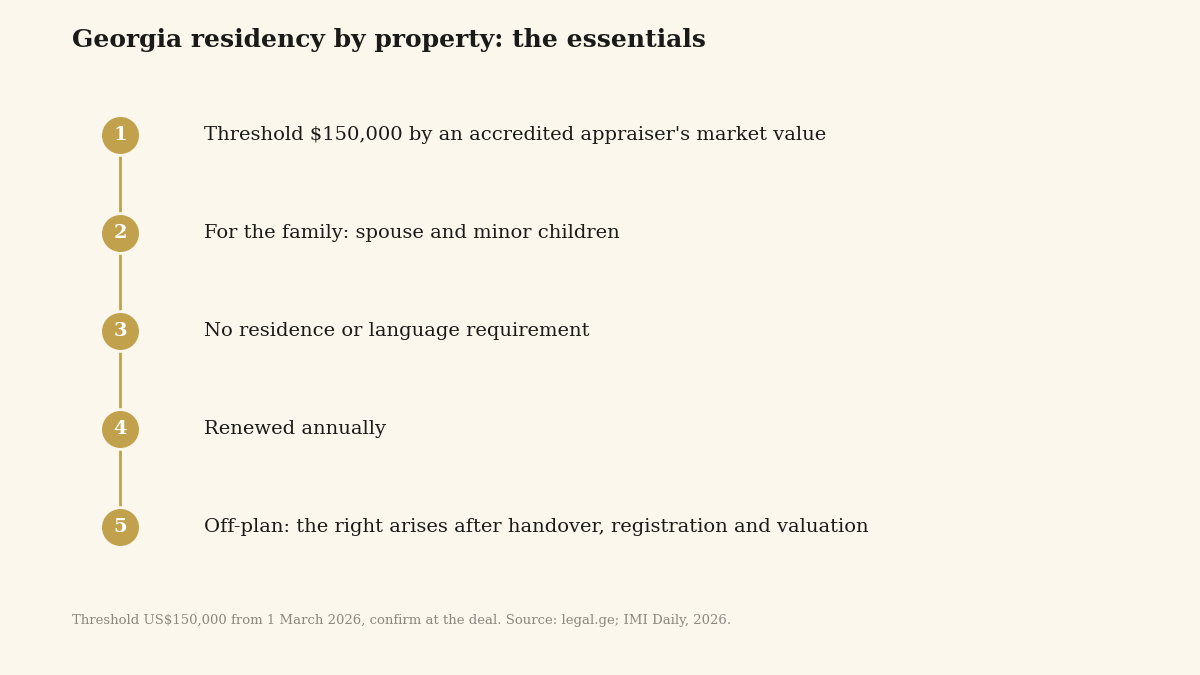
The key change for 2026: from 1 March 2026, the minimum property value for the short-term residence permit is US$150,000. The previous threshold was US$100,000, a 50% increase (legal.ge, 30 December 2025; IMI Daily, 2 February 2026). This is the most common outdated error online: several pages still show US$100,000 because they have not been updated for the reform. The current reference is US$150,000, and it should be confirmed at the time of the deal, as thresholds change.
The reform comes with a grandfather clause, and it matters. If your title was registered, that is, the property fully paid and formalized in your name, before 1 March 2026, the previous US$100,000 threshold applies, and holders of permits obtained at that level keep the old terms on renewal (legal.ge, 30 December 2025; IMI Daily, 2 February 2026). But if the title is registered on or after 1 March 2026, the new US$150,000 threshold applies. For an off-plan buyer, this means one simple thing: plan around US$150,000, because a completed unit will almost certainly be registered after that date.
Valued at market value, not at the purchase price
The threshold is measured neither against the contract figure nor against the cadastral value, but against the property's market value, set by an accredited appraiser, a body accredited by Georgia's National Accreditation Body. Market valuation rather than purchase price was introduced specifically to prevent inflated values (legal.ge, 30 December 2025; IMI Daily, 2 February 2026).
Two practical consequences follow. The price you paid and the appraised value may differ, and the latter counts. And in welcome flexibility for many buyers, the threshold applies to total holdings, not to a single property, so several registered and valued properties can be combined (IMI Daily, 2 February 2026): a residency-plus-income goal can be met with two managed units rather than one expensive apartment.
Term, renewal, and no stay or language requirement
The short-term residence permit through property is issued for one year and is renewable. It lacks two barriers that deter applicants elsewhere: there is no minimum physical-stay requirement and no language test (legal.ge, 30 December 2025; IMI Daily, 2 February 2026). You need not spend a set number of days in Georgia to maintain the status, and you do not need to take a Georgian exam.
One candid point: the condition for renewal is that the basis still holds, namely, ownership of the property. This is a status you maintain, not a stamp valid for years, which is why it makes sense to choose a liquid property from a proven developer from the outset: it serves as both a basis for the permit and an asset you can sell or rent if needed.
The off-plan catch: the right to residency arises only after completion
This is the most important point in the article for off-plan buyers, and the one most often left unsaid. The right to a residence permit through property arises not when the contract is signed and not at the first payment, but only after the property is completed, title to the finished unit is registered in your name, and it has been valued (legal.ge, 30 December 2025; IMI Daily, 2 February 2026). While you are paying for construction and hold only a contractual claim under the preliminary agreement, the basis for residency does not yet exist.
Let us name the risk plainly: a promise of "residency immediately on buying off-plan" is a simplification that later turns into disappointment. But this is no reason to avoid the construction stage, where the best prices and interest-free installments are available. It is a reason to plan the timing deliberately: you arrange residency after delivery, and by then the threshold will almost certainly be US$150,000 rather than US$100,000, so budget from US$150,000 based on valuation. Our work here is to select a property with a realistic delivery date from a developer with a track record of completed projects, and to support the registration of title, after which the permit will be filed. How the transaction itself works is set out in our guide to buying a new-build.
Procedure, timelines, and PSDA fees
The application is filed through the Public Service Development Agency (PSDA), and the procedure is transparent: the faster you need a result, the higher the fee. PSDA state fees for 2026 are (legal.ge, 30 December 2025; PSDA, sda.gov.ge):
- review within 30 calendar days: GEL 300;
- review within 20 calendar days: GEL 450;
- review within 10 calendar days: GEL 600.
This is the fee for the review period itself, separate from the property valuation and legal services. Timelines and rates should also be confirmed at the time of filing, as they are revised from time to time. You can file without being permanently in the country: remote support for the transaction and parts of the procedure in Georgia is lawful and common, covered in our guide to buying property in Georgia remotely.
The faster route, and the path to permanent residence
If the goal is a more durable status from the start, there is a separate route. The investor visa, for an investment of US$300,000, grants an immediate five-year residence permit, including spouse and minor children, provided the investment is maintained; in year five, it may convert to a permit for indefinite stay (IMI Daily; immigrantinvest.com, 2026). The short-term permit at US$150,000 remains the rational entry point for most buyers and pairs well with an income-producing property; the US$300,000 route suits those who value a five-year planning horizon and a shorter path to permanent status.
Do not confuse residency with citizenship, and do not confuse the two timelines to permanent status. On the ordinary permit, the path to permanent residence is six years of residence. The investor route is shorter: the five-year permit, at US$300,000 as noted above, converts to an indefinite stay in year five. In other words, six years on the ordinary permit versus five on the investor route. Citizenship is a separate, longer matter: generally about ten years, plus an exam in the Georgian language and history, and Georgia generally does not allow dual citizenship, with exceptions only by special presidential decision (IMI Daily, 2026). So if you already hold a citizenship, you will not give it up. The realistic goal here is residency and, in time, permanent residence, not a second passport: a lawful, renewable right to live in the country for the whole family, tied to an asset you own.
A 2026 nuance: residency and the right to work are now separate
From 1 March 2026, an important rule changed, worth knowing in advance. A short-term (temporary) residence permit by itself no longer grants an automatic right to work or run a business: a separate work permit is required, where previously temporary residency implied that right (legal.ge, 2026).
But for our reader, there is good news. Holders of an investment residence permit and of a permanent residence permit are exempt (legal.ge, 2026). So on the US$300,000 route, or once you obtain permanent residence, you need no separate work permit. And for a short-term permit priced at US$150,000, aimed at residency and rental income rather than employment, the rule creates no real inconvenience: renting out your own property is not an activity that requires a work permit. The fine points of your status should be checked with a licensed lawyer. The taxes an owner and landlord pay are covered separately in our guide to property taxes in Georgia.
What this means for you
A Georgia residence permit through property in 2026 is a lawful, predictable route for the whole family, with no stay requirement and no language test. The threshold today is US$150,000, based on the market valuation of an accredited appraiser, confirmed at the time of the deal: a completed property confers residency upon title registration, while an off-plan confers it upon completion and valuation. Our role is not legal advice but selection and support: to choose a property that meets the threshold while remaining liquid and producing income, to vet the developer and the delivery schedule, and to carry the transaction through to the registration of title, where the residency process begins. The legal part is handled by a licensed lawyer in Georgia, with whom we align at every step.
Ready to run your own residency scenario? Message us on WhatsApp, and we will select properties that meet the threshold and also provide income, or take the short quiz with the goal "Residency" for concrete options for your family and budget.
This material is for general information only and is not investment, legal, or tax advice. Figures are given as of the date of publication with a source reference and may change. The residency threshold, state fees, timelines, and rules are confirmed at the time of the deal: verify them with a licensed lawyer and tax adviser in Georgia before making a decision.
Ready to move from the overview to specifics?
Related reading
Frequently asked questions
How much must I invest to get a Georgia residence permit through property?
From 1 March 2026, the minimum market value is US$150,000 (previously US$100,000), set by an accredited appraiser at market value, not at the purchase price. Confirm the threshold at the time of the deal (legal.ge, 30 December 2025; IMI Daily, 2 February 2026).
Can I get residency by buying off-plan?
The right to residency arises only after the property is completed, the title is registered, and it has been valued. At the construction stage, the basis does not yet exist, so timing must be planned in advance (legal.ge, 30 December 2025).
Do I have to live in Georgia and pass a language exam?
No. The short-term permit through property has no minimum-stay requirement and no language test. It is issued for one year and renews while ownership is maintained, and it covers the buyer, spouse, and minor children (legal.ge, 30 December 2025).
Can I combine several properties to reach the amount?
Yes. The threshold applies to total holdings: several registered and valued properties can be combined (IMI Daily, 2 February 2026).
What does it cost and how fast is it processed?
PSDA state fees: GEL 300 for review within 30 days, GEL 450 within 20 days, GEL 600 within 10 days. Valuation and legal services are paid separately. Confirm rates at filing (legal.ge, 30 December 2025; PSDA).
Does the permit give the right to work in Georgia?
From 1 March 2026, a short-term permit alone does not authorize employment; a separate work permit is required. Holders of an investment permit and of permanent residence are exempt, and income from renting your own property needs no work permit (legal.ge, 2026).