Moving to Georgia with Your Family: The 2026 Guide
Residency, schools, healthcare, budget, banking, and climate: what a family needs to know before relocating to Georgia in 2026, with sources.
Moving to Georgia with your family in 2026 is an appealing prospect: a warm coastline, one of the most foreigner-friendly tax systems in the region, and residency you can secure alongside a property purchase. Behind that picture sit concrete rules, and several of them changed this year. This guide walks you through the practical layers of the move: visas and the legal grounds to stay, schools, healthcare, budget, banking, climate, and safety. No varnish, and with sources, so you plan on facts rather than promises.
Where the move begins: visa-free entry and insurance
Citizens of many countries enter Georgia visa-free and may stay for up to 365 consecutive days. That is convenient for a first, exploratory period: you can arrive with the whole family, settle in, and choose a city and a school without arranging status in advance. Note the limit: visa-free entry up to 365 days is a visitor status, not residency, and not a right to work (legal.ge, 2026). In the long term, you need a separate legal foundation, which is covered below.
The 2026 rule you cannot skip. From 1 January 2026, everyone entering Georgia needs valid health insurance for the entire stay (US Embassy in Georgia; Georgia Today, 2026). Minimum cover is around GEL 30,000, including roughly GEL 5,000 for outpatient care and GEL 30,000 for hospitalization; the policy must be in Georgian or English, on paper or electronic, and is checked at the border (Andersen Georgia, 2026). It may be issued by a Georgian or a foreign insurer. For a family, this means one simple action: arrange insurance for each member before you fly.
The legal grounds to stay
Visa-free entry buys time, not status. To stay in the long term, a family has several options.
Residency through property. The clearest path for a buyer is a residence permit upon the purchase of a home. From 1 March 2026, the threshold is US$150,000, measured by the market value assessed by an accredited appraiser, not the cadastre or the purchase price (legal.ge, 30 December 2025; IMI Daily, 2 February 2026). You may combine several properties. The permit is issued for a year and is renewable, with no minimum stay requirement and no language test, and it extends to a spouse and minor children. The threshold should be confirmed at the time of the deal. We cover the procedure, the grandfathering clause, and the off-plan catch in our article on residency through property.
Sole proprietor status at 1%. For a family whose income comes from remote work or services, the small business sole proprietor regime at 1% of turnover is popular (PwC, 21 January 2026). One caveat matters: this regime excludes residential rental income, which is taxed separately at 5% of gross. In other words, the 1% applies to your professional activity, not to letting out a flat you have bought.
Other routes. There is an investor visa from US$300,000 that grants five-year residency for the whole family at once, plus work-based and other grounds (IMI Daily, 2026). Which path is optimal depends on your situation, and it is worth discussing with a lawyer before the move.
The 2026 catch that changes the plan: work and residency are now separate
Honesty matters most here because the internet is full of outdated advice along the lines of "move and work freely." From 1 March 2026, a temporary residence permit no longer automatically confers the right to work in Georgia; employment requires a separate work permit (legal.ge, 2026).
That sounds like a drawback, but look at the full picture. Holders of an investment residence permit and permanent residence are exempt from the work permit requirement. In other words, for a qualified buyer entering through property at the investment level, this barrier falls away. And for a family with remote income from abroad, the work permit question often does not arise at all: you are not being hired by a Georgian employer. The practical takeaway: do not build your plan on the idea that "residency means I can work anywhere." First, define your income source, then choose the legal ground to match it. Our job is to match the property and the purchase format to your family's real goal, not the other way round.

Schools: where education is stronger
This is one of the deciding factors for a family, and there is no room to embellish.
Tbilisi is markedly stronger for international education. The capital hosts international schools with English and international programs: among them, the British International School of Tbilisi (BIST), New School, the first in Georgia to offer all three International Baccalaureate programs, the European School with IB, and German and Finnish schools (international-schools-database.com, 2026; ExpatHub, April 2026). As a cost reference, QSI International School of Tbilisi lists around US$6,200 a year for full-day preschool for 2025/2026 (US Department of State fact sheet, 2025). Most schools do not officially publish fees by grade, so exact figures must be confirmed with admissions.
Batumi is weaker for international education. The city has no full international school, only English-oriented and bilingual formats (ExpatHub, April 2026). So families for whom a full English or international program is essential are usually better served by Tbilisi. That is not a verdict on Batumi as a place to live by the sea, but the schooling question honestly tilts the balance toward the capital. If your choice of city hinges on the children, work through the trade-off in our Batumi vs Tbilisi guide.
Healthcare
Private healthcare in Georgia is generally adequate for a foreign family, and it is more developed in Tbilisi. The capital has large private clinics, among them American Hospital, Evex, and MediClub (ExpatHub, April 2026). Private health insurance for a family costs roughly US$50-100 per person per month, depending on age and coverage (ExpatHub, April 2026). This is a separate matter from the visitor entry policy: an annual family health plan is for settled daily life, not just for crossing the border.
A family budget: Tbilisi and Batumi
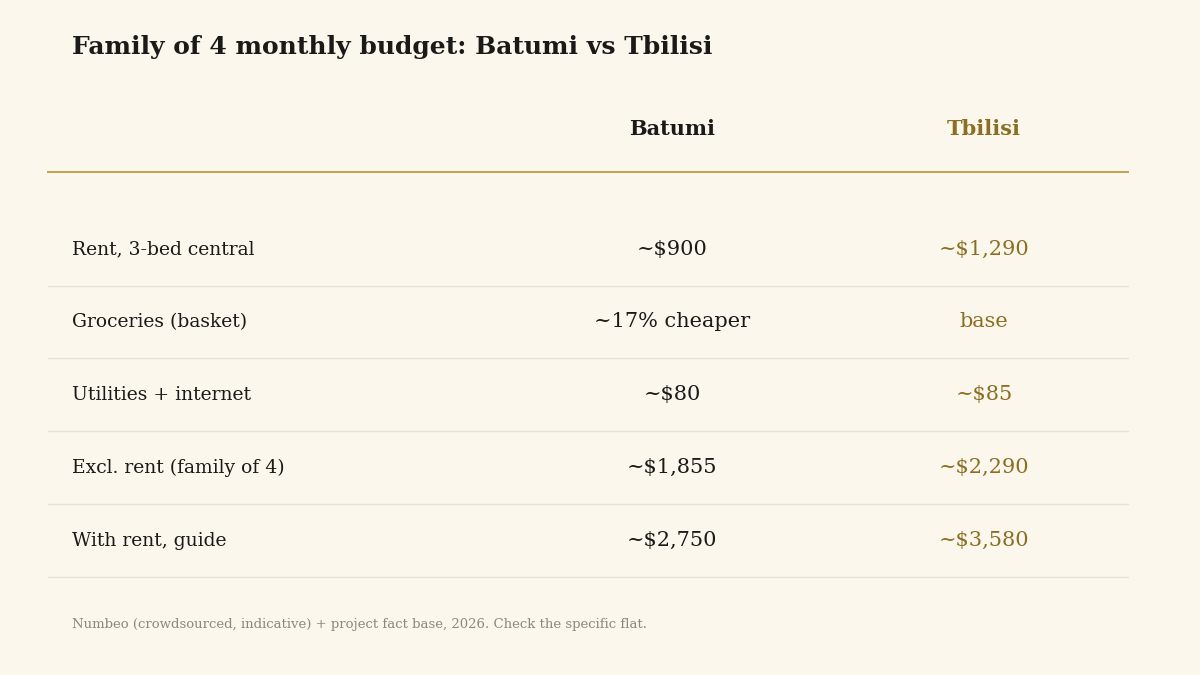
Georgia remains affordable, and Batumi is noticeably cheaper than the capital. By a crowdsourced estimate (indicative, not official statistics), a family of four in Tbilisi spends around US$2,290 a month without rent; a one-bedroom in the center is around US$680, and a three-bedroom around US$1,290 (Numbeo, March-April 2026). Batumi is roughly 19% cheaper, including rent: a one-bedroom in the center around US$460 and a three-bedroom around US$900; groceries are about 17% cheaper (Numbeo, March-April 2026). Internet runs around US$20 a month, and mobile service is fast and inexpensive. We include the full family budget in our cost-of-living guide for Georgia.
Housing: rent versus buy
The logical sequence for a family is to rent first, then buy. Renting for the first year gives you time to learn the city, the district, and the school without commitment, especially while you live with visa-free entry. Buying solves two things at once: you secure a home of your own and, at US$150,000 or more by valuation, you gain the basis for residency for the whole family (legal.ge, 2025 to 2026). Foreigners own apartments on the same ownership basis as Georgian citizens; only agricultural land is off-limits to foreign individuals, which matters for houses on a plot but not for flats (ExpatHub, April 2026). The title is registered by the National Agency of Public Registry through the House of Justice, usually within a few working days. The purchase can also be completed remotely, by notarised power of attorney, covered in our article on the remote deal.
Banking for a foreigner: stricter in 2026
A family can still open a Georgian bank account, but expect a more thorough check than a few years ago. In 2026, both Bank of Georgia and TBC will have tightened KYC: the bank asks you to prove the source of funds, the purpose of the account, and sometimes a connection to Georgia (Consensus Legal, 2026; easyglobalbanking.com, 2026). In practice, arriving with a passport alone is a reliable path to rejection: carry home bank statements for the past 6 to 12 months in English or another major language. Accounts are usually opened in person at a branch, though a notarised and apostilled power of attorney also works (Consensus Legal, 2026). The good news: buying property and arranging residency strengthen your application, since the bank sees a clear economic purpose for your presence (ExpatHub, April 2026).
Climate, safety, language, community
Climate. This is another honest split between the cities. Batumi is humid subtropical, with heavy rainfall of around 2,400 mm a year, roughly five times that of Tbilisi, which sees about 500 mm (ExpatHub, April 2026). Tbilisi is drier and more continental, though the capital has higher urban pollution. Sea versus a dry climate is a lifestyle question worth weighing honestly in advance.
Safety. Georgia feels like a safe country. On Numbeo's crowdsourced safety index, Tbilisi scores around 74 and Batumi around 77 (Numbeo, 2026; indicative). For a family with children, that is one of the visible pluses of daily life.
Language and community. The state language is Georgian. Russian is widely understood, which removes the everyday language barrier for a Russian-speaking family, and English is common among younger people, in IT and in top clinics (ExpatHub, April 2026). Established relocation and diaspora communities exist in both cities, and in the early period, they help with the practical side: schools, doctors, and daily logistics.
Checklist and an approximate timeline
An indicative sequence for a family:
One to two months before the move: arrange visitor health insurance for each family member (mandatory from 2026); define your income source and provisionally choose the legal ground to match it; gather 6 to 12 months of bank statements for the future account; shortlist schools in your chosen city and contact admissions.
First month on the ground: enter visa-free; rent for the first period; submit the children's school applications; begin the bank account process.
Months 2 to 6: settle on a city and district; if you decide to stay long term, move from renting to buying; start the residency through the property process (off-plan residency rights arise only after handover, registration, and valuation of the completed property); arrange an annual private health plan for daily life.
Beyond that: renew residency annually; if you need to work for a Georgian employer, obtain a work permit separately (not required if you hold an investment residence permit or permanent residence).
Moving to Georgia with your family is a solvable task if you plan on facts: insurance from 2026, the separation of work and residency, the Tbilisi versus Batumi schooling split, and realistic banking. Our job is to match the home and the purchase format to your family's real goal and to guide the deal step by step.
Ready for specifics? Get the "Georgia Investor Guide 2026" on WhatsApp with figures, thresholds, and properties, or take the short quiz with the goal "Residency," and we will shortlist options for your family.
This material is for reference only and is not investment, legal, or tax advice. Figures are given as of the publication date with a source and may change. Confirm thresholds, taxes, and visa and migration rules at the time of the deal, and check with a licensed lawyer and tax adviser in Georgia. Note separately: from 1 March 2026, a temporary residence permit does not grant a right to work without a separate work permit (holders of an investment residence permit and permanent residence are exempt); confirm status and the right to work against the current text of the law.
Ready to move from the overview to specifics?
Related reading
Frequently asked questions
How long can you stay in Georgia without a visa?
Citizens of many countries may stay visa-free for up to 365 consecutive days. It is a visitor status: it grants neither residency nor the right to work (legal.ge, 2026).
Do you need insurance to enter Georgia in 2026?
Yes. From 1 January 2026, everyone entering Georgia needs valid health insurance for the entire stay: cover of around GEL 30,000, and the policy is checked at the border (Andersen Georgia, 2026).
Does a Georgian residence permit grant the right to work?
From 1 March 2026, a temporary residence permit by itself does not grant the right to work: employment with a Georgian employer requires a separate permit. Holders of an investment residence permit and permanent residence are exempt (legal.ge, 2026).
Where are the schools stronger, Tbilisi or Batumi?
International education is markedly stronger in Tbilisi: BIST, New School, and the European School with IB. Batumi has no full international school, only English-oriented and bilingual formats (ExpatHub, April 2026).
How much does family life in Georgia cost?
By Numbeo's crowdsourced estimate, a family of four in Tbilisi spends around US$2,290 a month excluding rent; Batumi is roughly 19% cheaper including rent (Numbeo, March-April 2026).
Is it hard for a foreigner to open a Georgian bank account?
Harder than it used to be: banks have tightened KYC and ask you to prove the source of funds. Home bank statements for the past 6-12 months help, and buying property and arranging residency strengthen the application (Consensus Legal, 2026).