Batumi vs Tbilisi: Where to Live and Buy in Georgia
Jobs, schools, healthcare, climate, cost of living and prices. An honest Batumi vs Tbilisi comparison for movers and buyers.
Batumi or Tbilisi is the first fork in the road for almost anyone planning a move to Georgia or a purchase here. The honest answer is that there is no universal winner, only your scenario. The city you want to live in and the city you want to invest in are not always the same address, and the most expensive mistake is choosing with the heart what should have been chosen based on the numbers. Below, we separate those two questions and compare both cities on what drives quality of life and quality of asset: jobs, schools, healthcare, climate, cost of living, prices, and yield, with sources.
The short verdict for three personas
If you don't have time for the full breakdown, here is a compressed answer for three common cases.
A family with school-age children
Tbilisi, most likely. The decision is driven not by property but by schools and healthcare, both of which are concentrated in the capital. Batumi is lovely for a summer rhythm, but the choice of a full English-language school there is limited.
An investor seeking income
Batumi, most likely. Resort demand, the foreign buyer base, and the branded aparthotel format make the coast more income-oriented in character, at a comparable gross rate. But it is a seasonal market that needs management, whereas Tbilisi is steadier.
A remote worker
It depends on your priority. Tbilisi offers a capital's infrastructure, community, flights and a dry climate most of the year. Batumi offers the sea outside your window and a lower budget, but humid subtropics and a narrow off-season. Many end up living across both.
We unpack each conclusion with facts below.
Economy and work
Tbilisi is the capital and the country's business center: head offices, IT companies, the financial sector, academia and the main labor market are located here. If your income is even partly tied to local employment or on-the-ground clients, the depth of the capital market is far greater. Batumi is, above all, a narrower, more seasonal economy of tourism, hospitality, port logistics, and seasonal services.
One 2026 nuance matters for anyone moving to "live and work": since 1 March 2026, a temporary residence permit alone no longer automatically grants the right to work; employment requires a separate work permit. Holders of an investment residence permit and of permanent residence are exempt (legal.ge, 2026). For a remote worker for a foreign employer, this is usually neutral, but if you count on local employment, plan that step in advance. We cover the family fork in our guide to moving to Georgia with family.
Schools: Tbilisi is clearly stronger
This is the topic where honesty matters more than a compliment to the city. If there are children in the family and you need a full English-language or international curriculum, Tbilisi wins by a wide margin. The capital hosts several international schools: QSI (around US$6,200 per year for a full-day preschool), BIST, the European School with an IB program, and German and Finnish schools (ExpatHub, 2026). That is a genuine choice of educational tracks, including the International Baccalaureate.
Batumi has no such choice. The city has, in effect, no full international school, only English-oriented and bilingual options that lack the same depth (ExpatHub, 2026). There is no point glossing over it: for a family that needs a British or IB program, this is often the deciding argument for the capital.
What to do if your heart wants the sea. Weigh your children's ages against the horizon: for preschool and primary years, the gap feels smaller than for a teenager close to graduation. And consider a "base in Tbilisi for the school year, Batumi for summer and investment" format. This is exactly why we separate "where to live" from "what to buy" from the outset: they can have different answers, and that is fine.
Healthcare
The logic mirrors schools: the depth of private medicine is greater in the capital. Tbilisi is home to the larger private clinics, including American Hospital, the Evex network, and MediClub; private insurance runs roughly US$50 to US$100 per person per month (ExpatHub, 2026). For a family, for older residents, and for anyone who values access to a wide range of specialists, that is a meaningful plus for Tbilisi.
Batumi covers basic and emergency needs, but the capital offers a wider range of specialist care. That is no reason to cross the coast off, only to assess your family's medical profile soberly. On safety, the cities are comparable and both high: by the crowdsourced Numbeo index Tbilisi sits around 74 and Batumi around 77 (Numbeo, 2026, crowdsourced, indicative), so safety can be treated as roughly equal.
Climate: the one honest divide
If there is a factor on which the two cities diverge sharply, it is the weather. Batumi is humid subtropical on the Black Sea coast: around 2,400 mm of rainfall a year, roughly five times Tbilisi's roughly 500 mm (ExpatHub, 2026; figures consistent with climate records for Batumi at about 2,400 mm). Summers are warm and very humid, with humidity holding around 70 to 80%, with a rainy shoulder season. Tbilisi is drier and more continental: hot, dry summers, a colder winter, but noticeably higher urban air pollution in the dense core.
Let us not soften it: Batumi really is rainy, and anyone who has seen it only in August easily underrates November. But rain is no verdict on an asset and no reason to give up the sea. It is precisely the subtropical climate and greenery that make the coast valuable and sustain demand for resorts. And for a rental investment, the weather works differently than for living: your guest arrives in season, and a resort property's yield depends far less on whether February suits you personally. So climate is a strong argument in "where to live" and a much weaker one in "what to buy for income".
Cost of living: Batumi is cheaper
Here the coast has a clear edge. According to the crowdsourced Numbeo estimate (March to April 2026, indicative), a family of four in Tbilisi spends around US$2,290 per month, excluding rent. Batumi is roughly 19% cheaper once rent is included; rent itself is about 29% cheaper, and groceries about 17% cheaper. In absolute terms, a one-bedroom in the center is around US$680 in Tbilisi, compared with about US$460 in Batumi, and a three-bedroom is around US$1,290 in Tbilisi, compared with about US$900 in Batumi (Numbeo, 2026, crowdsourced, indicative).
The caveat matters: Numbeo is crowdsourced, a guide rather than official statistics, and real figures depend on district and lifestyle. But the direction is consistent: all else equal, everyday life in Batumi costs less than in the capital. We set out model budgets for both cities in our piece on the cost of living in Georgia.
Property prices and yield: where intuition lives and where the facts are
Here is the most common misconception, worth dispelling directly: because life in Batumi is cheaper, apartments there must be cheaper too. For new-builds, that is not the case. The figures to use are Galt and Taggart's new-build data, not crowdsourced indices.
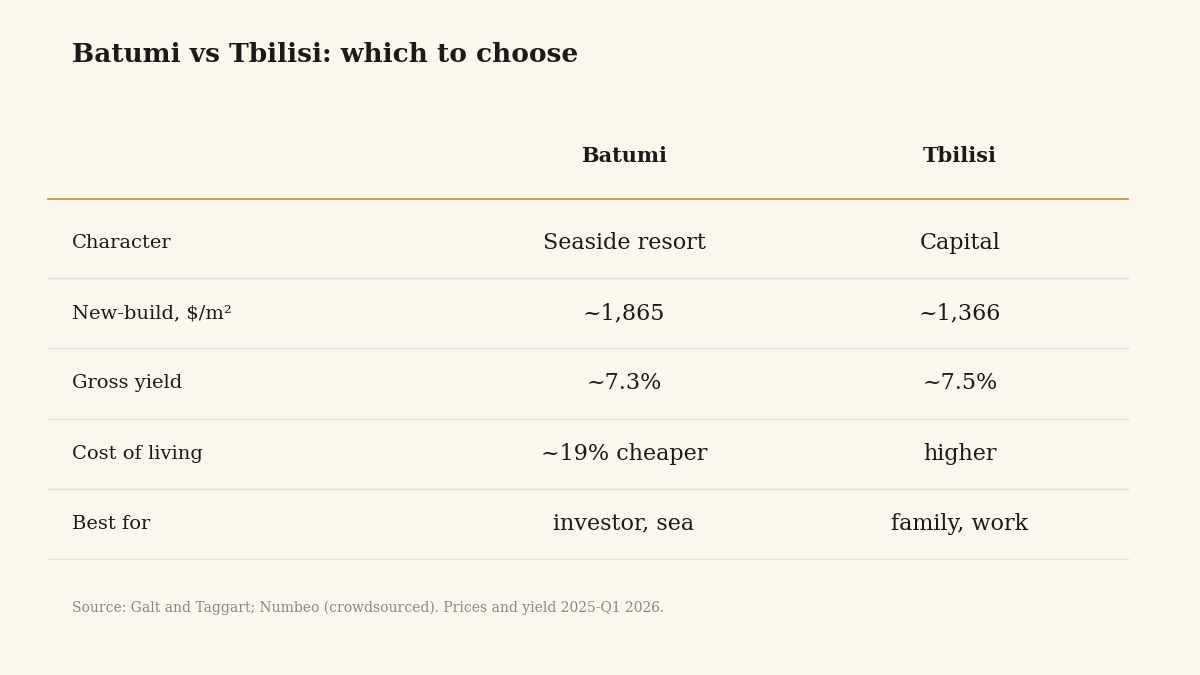
The average new-build (turnkey) price in Batumi for 2025 was around US$1,865 per square meter, up roughly 9.4% on the year; the series runs around US$1,569 in 2023, US$1,699 in 2024 and US$1,865 in 2025 (Galt and Taggart, via Investor.ge, April 2026). The average new-build price in Tbilisi sits around US$1,366 per square meter (Galt and Taggart, November 2025). On a comparable basis, then, Batumi is on average dearer than Tbilisi, not cheaper.
The nuance is in the samples. Batumi is a resort with a large share of view and seafront lots and strong foreign demand, which pulls the average up; Tbilisi is a broad domestic market with many budget districts, which pulls it down. Comparing average against average is misleading: a cheap inner Tbilisi district and the Batumi periphery can sit close, while a Batumi seafront line is several times dearer. The real entry price is determined by the specific district and lot type, not the city average. We map Batumi prices by district in our Batumi districts guide.
Now yield, where intuition also misleads. On the gross rental rate, the cities are almost level: in the first quarter of 2026, Georgia as a whole sat around 7.42%, Tbilisi around 7.53%, and Batumi around 7.31% (Global Property Guide, February 2026). Gross is even marginally higher in the capital. The difference is not the headline percentage but the nature of the income: Tbilisi has steadier year-round end-user demand, and Batumi is a seasonal resort income peaking in July and August, which depends heavily on management and format. These are gross figures; net runs 1.5 to 2 percentage points lower after tax, voids, and maintenance. So "Batumi yields more" is not about a higher percentage but about more resort upside under a well-managed format, and we take on the job of checking an operator's numbers.
Lifestyle: a seaside resort against a capital
In the end, it is a choice between two environments. Batumi has the sea within walking distance, subtropical greenery, a lower budget, and a pronounced summer rhythm. Tbilisi is a capital-city density: culture, a business environment, international schools and clinics, year-round life, and a dry climate, at the cost of a sea horizon and a higher budget. Neither is "better" in a vacuum; they answer different questions.
Comparison matrix
| Criterion | Batumi | Tbilisi |
|---|---|---|
| Character | Seaside resort, seasonal | Capital, year-round |
| Labor market | Narrow, tourism and services | Deep: offices, IT, finance |
| International schools | Limited choice | Strong choice (QSI, BIST, IB) |
| Private healthcare | Basic and emergency care | Deeper (American Hospital, Evex, MediClub) |
| Climate | Subtropical, around 2,400 mm of rainfall, humid | Drier, around 500 mm, continental |
| Cost of living | Cheaper (roughly 19% with rent) | Higher (base ~US$2,290 for a family, excluding rent) |
| New-build, average | About US$1,865 per sqm (turnkey, 2025) | About US$1,366 per sqm (2025) |
| Gross yield | About 7.31% (Q1 2026) | About 7.53% (Q1 2026) |
| Income profile | Seasonal resort income, needs management | Steady, end-user tenants |
| Best fit | Income investor, sea lover | Family, remote worker, end user |
Figure sources: Galt and Taggart (new-build prices, 2025); Global Property Guide (yield, Q1 2026); Numbeo (cost of living, 2026, crowdsourced); ExpatHub (schools, healthcare, climate, 2026).
The honest takeaway: separate "live" from "invest"
The most useful conclusion is that the question is not "Batumi or Tbilisi" but "what exactly are you deciding?". For a family with school-age children, the capital is the more logical place to live: schools, healthcare, a dry climate, a deep labor market. For income and a seaside lifestyle, the coast: resort demand, the foreign buyer, managed formats, and a lower everyday budget. The remote worker prioritizes between sea and infrastructure and often combines the two.
Your property need not mirror where you live. You can live in Tbilisi for school and hold an income property in Batumi, or vice versa. Our job is not to talk you into one city but to match your goal (income, residency, a home for yourself) to a specific city, district, and property format, and to verify the numbers before the deal.
Ready to match a city to your goal? Take the short quiz or book a consultation, and we will match the city, district, and property to your task: income, residency, or a home for yourself. Full figures for both markets are in the "Georgia Investor Guide 2026", available on WhatsApp.
This material is for reference only and is not investment, legal, or tax advice. Figures are given as of the date of publication with a source and may change. Confirm thresholds, taxes, and rules at the time of the transaction and consult a licensed lawyer and tax adviser in Georgia.
Ready to move from the overview to specifics?
Related reading
Frequently asked questions
Where is the best place for a family with children to live in Georgia?
Usually Tbilisi. Schools and healthcare decide it: international schools (QSI, BIST, the European School with IB) and the larger private clinics sit in the capital, while Batumi's choice of full English-language programs is limited (ExpatHub, 2026).
Where is it cheaper to live, Batumi or Tbilisi?
Batumi. By the crowdsourced Numbeo estimate (2026), everyday life there is roughly 19% cheaper once rent is included, with rent about 29% cheaper. This is a guide, not official statistics.
Where are apartments cheaper?
For new-builds, Batumi is, on average, dearer: around US$1,865 per square meter compared with about US$1,366 in Tbilisi (Galt and Taggart, 2025). These are averages across different samples; the real entry price depends on district and lot type.
Where is the rental yield higher?
On the gross rate, the cities are close: Tbilisi at around 7.53% and Batumi at around 7.31% in the first quarter of 2026 (Global Property Guide). The profile differs: Batumi has a seasonal resort income, and Tbilisi has a steadier year-round. Net runs 1.5 to 2 points below gross.
How rainy is Batumi?
Noticeably: around 2,400 mm a year against roughly 500 mm in Tbilisi, with summer humidity of 70 to 80% (ExpatHub, 2026). It is an important factor for living, but less critical for resort rental.
Can you obtain residency by buying in either city?
Yes. The residence permit is tied to the property's value (at least US$150,000 by market valuation, as of 1 March 2026), not to the city. Confirm the threshold at the time of the deal.