The Tbilisi New-Build Market: Outlook for 2026 and Beyond
Prices, districts, demand and the 2026 outlook for new-builds in Tbilisi, a capital, end-user market distinct from Batumi, with sources.
When people think about buying property in Georgia, Batumi usually comes to mind first: the sea, branded aparthotels, and short-let income. But the Tbilisi property market works on a different logic, and for a sizeable group of buyers, the capital is the more accurate choice. This is a living city, where people buy homes to live in, and where demand comes from permanent residents rather than tourists who arrive for three summer months. If you are weighing relocation, a steadier asset, or a base for a family, the outlook for the Tbilisi new-build market in 2026 deserves to be examined on its own terms, with figures and sources, not by analogy with the coast.
Below we set out the capital's market honestly: how it differs from Batumi, what a square meter costs and where, who buys here, what yield to expect, and what the 2026 outlook actually says. Where a number is inconvenient, we will not hide it; we will explain what lies behind it.
How Tbilisi differs from Batumi
This is the first thing to grasp, and almost everything else follows from it. Batumi and Tbilisi are two markets of different natures, and drawing conclusions from one to the other is a mistake.
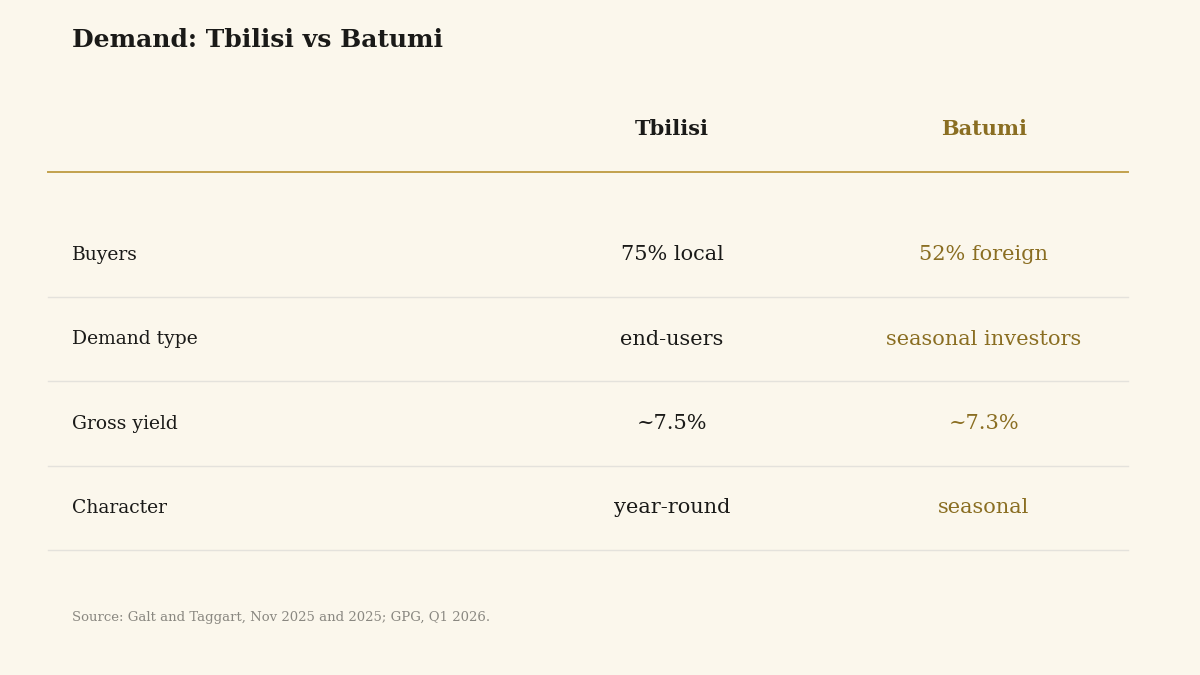
Tbilisi is the capital and a predominantly domestic market. According to a Galt and Taggart developer survey (November 2025), around 75% of buyers here are Georgian citizens, while foreigners make up roughly 25%, with Israel the most visible single group (around 11%). The foreign share is rising: it stood at about 15% back in 2023. Batumi is the mirror image: there, foreigners account for around 52% of transactions (Galt and Taggart, full-year 2025), and the market is investment-led and export-facing by nature.
Three practical differences follow. First, Tbilisi is dominated by the end-user, not the short-let investor. Second, there is less seasonality: Batumi yields ride the summer peak of July and August and sag in winter, whereas demand in the capital is steadier across the year because it comes from a permanent population. Third, the capital's price dynamics are calmer, without the sharp swings typical of a resort riding a construction boom.
In short, Batumi is about seaside income and its seasonal peaks, while Tbilisi is about durable demand, daily life, and a more predictable asset. We give a full city-by-city comparison for movers in our separate piece on choosing between Batumi and Tbilisi.
Market size: the scale of the capital
By size, Tbilisi is clearly larger than the coast. In 2025, the capital recorded around 42,388 apartment transactions, up about 4.3% from 2024, with a market volume of roughly 3.57 billion USD (Galt and Taggart, full-year 2025). For reference, Batumi recorded around 17,478 transactions and a market volume of around 1.3 billion USD in the same year. So the capital is several times larger, both in the number of deals and in the amount of money.
It is not only the size that matters, but the character of that volume. Recent data show demand in the capital is alive. According to TBC Capital, in the first two months of 2026, the Tbilisi residential market reached about USD 589 million, up around 19% year on year. In its January 2026 review, Galt and Taggart note that the year opened with strong primary-market demand: new-build sales rose, while secondary-market activity was weaker. That is an argument for the primary market, but it needs a sober note on supply, which we return to below.
Prices and a slowing climb: a sign of maturity, not weakness
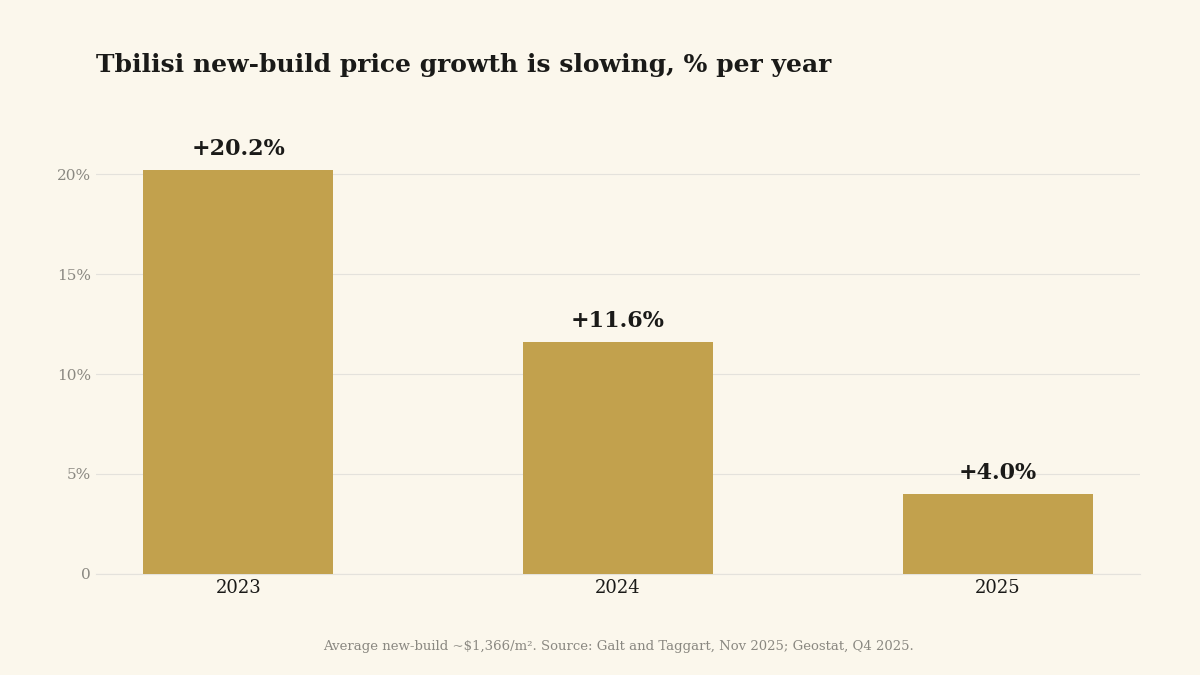
Now to the numbers most readers come for. The average primary-market price in Tbilisi is around 1,366 USD per sqm (Galt and Taggart, November 2025; about 1,373 USD in December 2025). That is appreciably below the Batumi primary average, which reached around 1,865 USD per sqm by the end of 2025 (Galt and Taggart). Contrary to the common impression, capital-city housing is, on average, more affordable than property by the sea.
What is more telling than the level is the trajectory. Primary price growth in Tbilisi has been slowing for several years running: 2023 delivered plus 20.2%, 2024 plus 11.6%, and 2025 only plus 4.0% (Galt and Taggart). Independent data confirm the direction: by the Geostat index, Tbilisi apartments rose around 3.5% nominally in the fourth quarter of 2025 (Geostat, published 23 January 2026).
It is important not to misread this. A slowdown from double digits to about 4% is easy to read as a warning sign, but it is a normal mark of a maturing market. Rapid 20% annual growth is the behavior of a young, overheated market, and it cannot last forever. The move to calm single-digit growth means the market is stabilizing, not falling: prices are still rising, simply at a moderate pace. For a buyer seeking a durable asset rather than a speculative jump, that is a positive. We set the wider Georgian context for both cities in our pillar article on the Georgia property market in 2026.
Tbilisi prices by district
An average figure hides a wide spread, so the district view matters. Below are primary-market reference points per sqm (Galt and Taggart, November 2025):
- Mtatsminda, around 3,325 USD: the historic center, the most expensive segment.
- Vake around 2,655 USD: the most expensive residential district, prestigious and green, the traditional choice of affluent residents.
- Saburtalo, around 1,603 USD: a large, modern business district.
- Krtsanisi around 1,550 USD.
- Isani is around 1,327 USD.
- Didi Dighomi, around 1,086 USD: a district of active new construction.
- Gldani around 1,044 USD: one of the most affordable.
It helps to separate where it is expensive from where the deals happen. Premium Vake and Mtatsminda set the price ceiling, but the bulk of transactions concentrate elsewhere: Didi Dighomi, Samgori, Saburtalo, and Isani (Galt and Taggart). Mass demand flows into the mid and affordable tiers, where new housing is built for permanent residents. For a buyer, this is a clear fork: prestige and capital preservation point to Vake, while a more affordable entry and active new supply point to Didi Dighomi and Saburtalo.
Who buys in Tbilisi
We have already identified the key fact: the capital's market is domestic, with around 75% of buyers Georgian citizens and around 25% foreigners (Galt and Taggart, November 2025). Within the foreign segment, Israel is the most visible (around 11%), and interest from outside is gradually rising. Foreign buyers tend toward new builds and clear, liquid districts.
What this means for you as a buyer. Domestic demand is the foundation of stability: a market that rests on its own residents is less exposed to external shocks, the swings of tourism, and the seasons. But an honest caveat follows: if your sole goal is maximum income from short-term letting to tourists, Tbilisi will not replicate the economics of a seaside apartment hotel. The capital is first about living, the end user, and steady rather than peak income.
Tbilisi yields without illusions
This is where honesty matters most, because yield is easy to overstate. The gross rental yield in Tbilisi is around 7.53% (Global Property Guide, first quarter 2026), slightly above Batumi (around 7.31%) on the same date. By type, smaller units yield more: Tbilisi studios run around 8.46% gross.
The caveats begin there, and they cannot be skipped. First, this is gross, before costs. Net yield is usually 1.5 to 2 percentage points below the gross figure (Global Property Guide) because taxes, vacancies, maintenance, and management must be deducted from it. Second, asking rents in the capital have been correcting downward for several years: per TBC Capital, Tbilisi rents fell by around 8% in 2024 and 11% in 2025, and in early 2026, the average rent per sqm was about 10.0 USD, down around 6% year on year. Yield held at an acceptable level largely because prices rose faster than rents fell.
The conclusion is sober but not alarming. Tbilisi is a market of steady, moderate income for the end-user and long-term letting, not a venue for chasing double-digit returns. Figures in the 7-8% gross range are a realistic market reference, not a promise, and you should always count net after costs. Those who specifically need high rental income, we honestly point to our piece on income in Batumi, where we cover the operator-managed branded format. Carrying those figures across to Tbilisi would be incorrect.
The 2026 outlook: single-digit growth and a supply overhang
Where is the capital's market heading? On the 2023 to 2025 trend and fresh early-2026 data, primary price growth in Tbilisi is most likely to continue at moderate, single-digit rates, in line with the observed slowdown (Galt and Taggart). That is the base, calm scenario: neither a jump nor a fall.
But there is a factor we must name plainly: supply. The capital's primary market has a lot of new construction, and a large share of sales for completed projects is financed through developers' interest-free installments. Per market monitoring, in projects completing in 2025, around 78% of apartments had already been sold, mostly via developer in-house installment schemes. This tells us that much of the further price path will depend on the supply side: how many new projects come to market, at what pace, and at what prices. A new supply overhang restrains any sharp price rise and keeps the scenario moderate.
How to work with this deliberately. A large volume of construction is not a reason not to buy; it is a reason to choose carefully. What wins is a combination of three things: a liquid district with durable end-user demand, a proven developer with a real delivery record, and a sober calculation that does not lean on speculative growth. Selecting that developer and that liquid unit in a well-supplied market is precisely what we take on: we check the developer's finances, land status, valid permit, and delivery history, so that you do not end up in a project that stalls or sells its remainder slowly.
Who Tbilisi suits
It comes down to a simple choice. Tbilisi is your city if you are planning to relocate to or live in Georgia, buy for your family and yourself, value a mature urban environment with schools, healthcare, and services, and want a steadier, less seasonal asset with moderate income from long-term letting. For a relocating family, it is often the more logical choice over the coast.
Batumi, by contrast, suits those whose main goal is seaside yield, who are ready to work with seasonality and a branded managed format for higher potential return. This is not a question of which city is better in the abstract, but of which fits your specific objective. We cover everyday budgets for both cities in our piece on the cost of living in Georgia, and the relocation fork in our Batumi versus Tbilisi comparison.
Ready to look at specifics in the capital. Take the "Georgia Investor Guide 2026" on WhatsApp for a full breakdown of the figures, or write to us and we will put together Tbilisi options matched to your goal: living, residency, or steady income.
This material is for general information only and is not investment, legal, or tax advice. Figures are given as of the publication date with a source and may change. Yield is not guaranteed. Verify prices, thresholds, taxes, and rules at the time of the deal, and consult a licensed lawyer and tax adviser in Georgia.
Ready to move from the overview to specifics?
Related reading
Frequently asked questions
Is it worth buying an apartment in Tbilisi in 2026?
It depends on the goal. For living, relocation, and a durable long-term asset, the capital makes sense: the market is large, domestic, and stable, with prices rising moderately. For maximum income from tourist letting, Tbilisi trails seaside Batumi. Always count net and against your own strategy.
How much does a square meter cost in a Tbilisi new-build?
The average primary price is around 1,366 USD per sqm (Galt and Taggart, November 2025). The spread by district is wide: from around 1,044 USD in Gldani to around 3,325 USD in Mtatsminda. That is below the Batumi primary average (around 1,865 USD per sqm for full-year 2025).
Why has price growth in Tbilisi slowed?
Growth fell from plus 20.2% in 2023 to plus 4.0% in 2025 (Galt and Taggart). This is a sign of a maturing market, not a fall: prices keep rising, but moderately, which is normal for a market that has moved from a boom phase into stabilization.
What is the rental yield in Tbilisi?
The gross yield is around 7.53% (Global Property Guide, first quarter 2026), higher for studios at around 8.46%. Net yield is usually 1.5 to 2 percentage points lower due to tax, vacancy, and costs. Asking rents in the capital have been falling in recent years, so count conservatively.
Tbilisi or Batumi, which to choose?
For living, family, and stability, the choice is more often Tbilisi. For seaside income and seasonal letting, it is more often Batumi. Your goal decides, not a general ranking. We give a full comparison of jobs, schools, healthcare, and prices in a separate article.
Can foreigners buy apartments in Tbilisi?
Yes, foreigners own apartments on the same freehold basis as citizens. The restriction applies only to agricultural land, not to city apartments. The purchase can be completed remotely.