Georgia's Property Market in 2026: What the Income and Growth Are Built On
What drives income in Georgia in 2026: major capital, tourism, branded apart-hotel yields up to 12%, and an honest look at Batumi and Tbilisi, with sources.
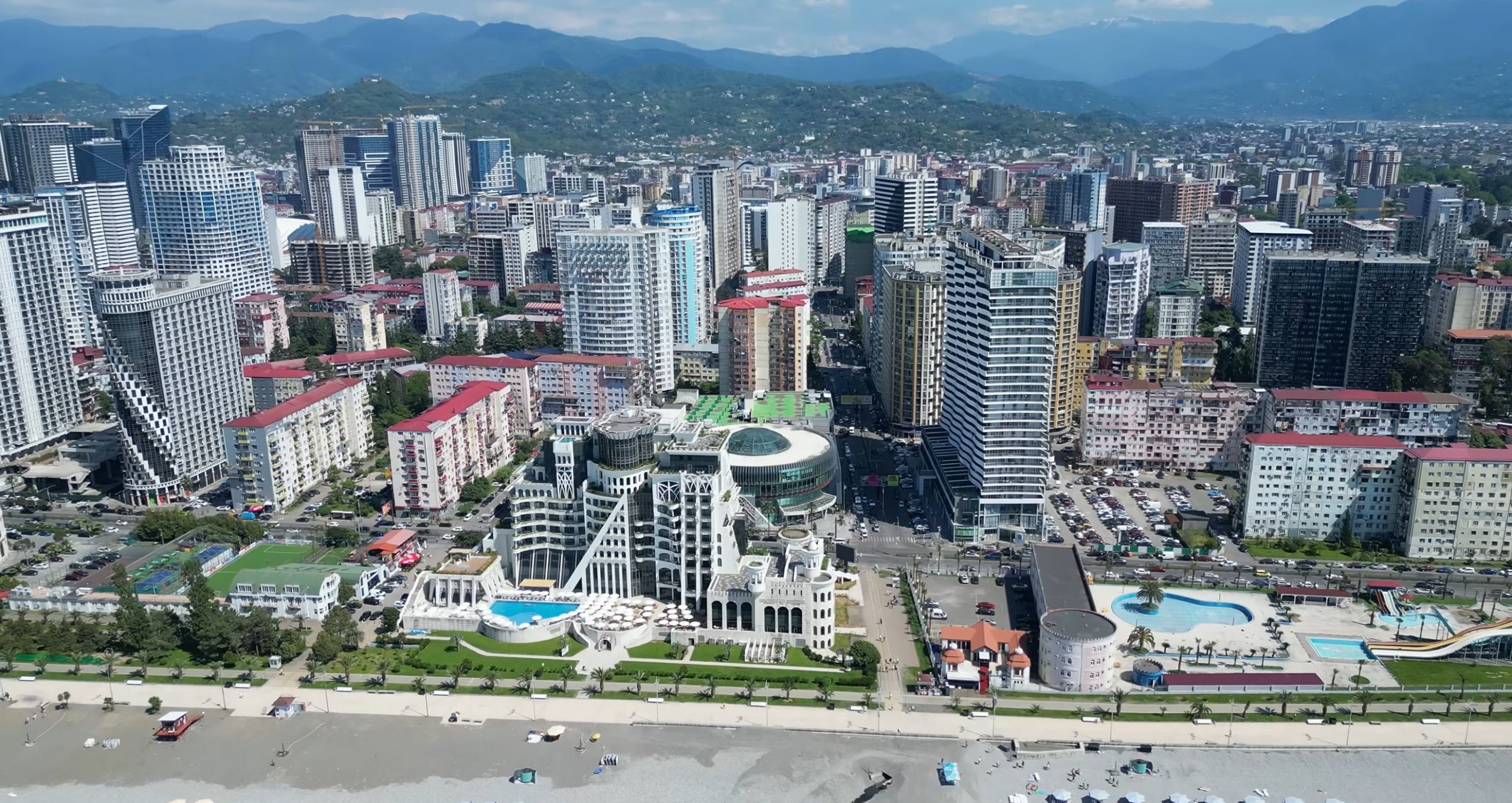
Georgia's property market in 2026 is one of the most dynamic seaside markets for an international buyer, and it is now entering a new phase. Over the past two years, developer capital on the scale of Dubai has arrived, projects worth billions of dollars are under construction on the Batumi coast, and tourist flow keeps setting records. For a buyer, the key point is this: the rental demand that feeds yield rests not on expectations but on concrete construction and figures.
Buyers come to Georgia with one of three goals, and we keep all three in mind: income (rental yield and capital growth), residency (for you and your family alongside the asset), and a seaside home of your own. Below, we break down what each one rests on, with sources, so you can check the numbers yourself.
Why Batumi is growing: major capital has arrived
The best argument for a market is the money professionals put into it, and in Georgia, that money is plain to see.
Eagle Hills, the company of Emaar founder Mohamed Alabbar (the developer behind Burj Khalifa), signed an investment of about US$6.5 billion in Georgia: the Tbilisi Waterfront project in the capital and Gonio Yachts and Marina near Batumi, with the state holding a 33% stake (agreements of October 2025). In parallel, Ambassadori Group is building Ambassadori Island, the first artificial island in the Black Sea: a US$3 billion project with its own marina, five-star hotels and a casino, with main-phase delivery around 2029. International hotel operators are entering the market, among them Wyndham Grand and Radisson in the Gonio area. Casinos run year-round and hold winter tourist flow, and the number of visits to Georgia in 2025 was about 7.8 million, up roughly 6% for the year.
The chain is simple and verifiable: more tourists mean higher occupancy, higher occupancy means higher rents, and higher rents mean higher yield on your unit. Those who enter now are buying before these projects are completed and reprice their districts, first of all, Gonio, where the Eagle Hills marina is being built.
The market in numbers
Batumi recorded 17,478 apartment transactions in 2025, up 15% year on year, with a market volume of about US$1.3 billion, up roughly 24% (Galt and Taggart). The market is genuinely international: about 52% of deals went to foreigners, and the fastest-growing segment is Israel, about 13% of all deals.
New-build prices are rising. The average turnkey new-build price reached about US$1,865 per sqm at the end of 2025, up 9.4% for the year (Galt and Taggart). The spread by district is wide: the sales leader New Boulevard at about US$1,761 per sqm, Heroes Alley at about 2,095, premium Old Batumi at about 3,028, and the periphery from about 1,487. Over three years, from 2022 to 2025, Batumi prices increased by around 40%, as shown in the growth history on the site. In 2026, per the Galt and Taggart forecast, new-build growth continues at a more moderate pace of about 4-6%, with the next impulse coming from the large projects noted above.
Tbilisi is a second market, distinct in character: a capital with predominantly domestic demand, about 42,388 deals in 2025, an average new-build of about US$1,366 per sqm, with growth of around 4% (Galt and Taggart). It is steadier and calmer than Batumi, and for relocating, it is often the more logical choice. We cover the capital in detail in the piece on the Tbilisi property market.
Yields: where the percentages come from
Here it pays to be precise, because yield depends heavily on HOW you let the unit. There are two scenarios, and their numbers differ.
A private apartment you let yourself
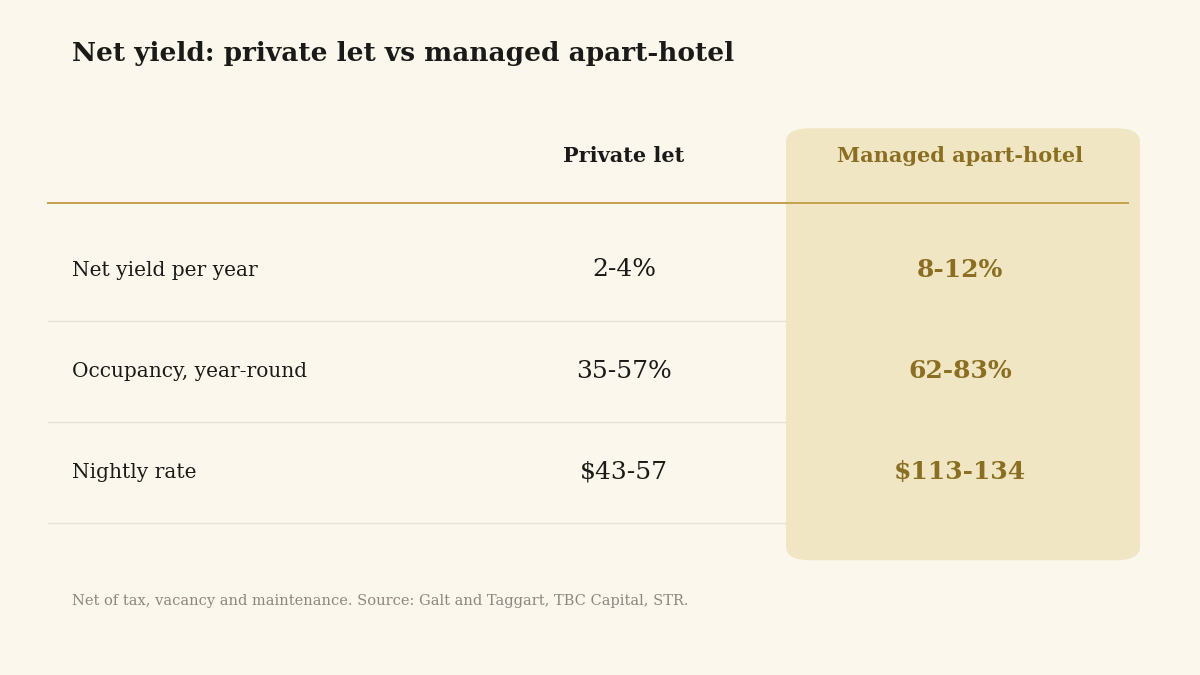
Gross yield in Batumi at the end of 2025 is about 7.4% (Galt and Taggart), but that is before costs. After tax, vacancy and maintenance, the net on a self-managed short let realistically comes to about 2-4%, and the market here is highly seasonal: peak occupancy falls in July and August, while the low season from November to April has to be weathered. An average private Batumi apartment on Airbnb holds occupancy of about 35-57% at a nightly rate of around US$43-57.
A branded, managed aparthotel
This is where site-level yield appears. Managed hotel residences, for example, Wyndham Grand Batumi Gonio, Archi Ramada by Wyndham, and Ramada Residences, hold occupancy of about 62-83% year-round against 35-57% for a private apartment, at a nightly rate of around US$113-134 against 43-57 (TBC Capital and STR data on branded hotels against Airbnb analytics). Income is pooled across all owners, so even a vacancy in your specific unit is smoothed out. Operators state yields of about 8-12% per year, which is how the "up to 12%" figure is reached. Entry into this format starts at about US$65,000-70,000 because the unit is managed and comes with infrastructure: restaurants, pools, a spa, and a casino, which keep occupancy up during the off-season.
Our principled stance, and at the same time your protection: for any offer with "guaranteed" percentages, you need to check whether the yield is counted off gross or net revenue, whether VAT, the operator's fee, and operating costs are included, and whether the management company gives priority to its own room inventory. This is exactly the check we take on. We give a fully worked example for a specific unit in the piece on Batumi rental yields.
Why so much is being built, and what it means for you
This is the honest answer to a question any buyer should ask. There genuinely is a lot of supply by the sea: projects for 2025-2029 hold around 58,000 units, and the short-term rental stock, by the Galt and Taggart estimate, will double by 2029. In 2025, the secondary market overtook the primary market by number of deals for the first time.
But it matters to understand what stands behind this, because the conclusions here run counter to the alarm. The secondary overtook the primary not because of fire sales at a loss, but because built housing has simply accumulated, and secondary prices are still rising too, about plus 6.9% in 2025, just more slowly than primary (Galt and Taggart). People are not exiting at a loss; the market is maturing.
What this means for you personally: the market rewards not "any studio by the sea", where the net sags to 2-4% with vacancy risk, but the right choice. The winning combination is three things: a location near growth points, a managed or branded letting format, and a unit from a vetted developer. A large volume of construction is not a reason not to buy; it is a reason to buy deliberately and with a curator who screens out the illiquid. Before an off-plan deal, it is worth running developer and project due diligence.
The legal and tax framework for a foreigner
Georgia is one of the friendliest jurisdictions for a foreign buyer, which removes most fears. Foreigners own apartments in full ownership on a par with citizens; only agricultural land is restricted. The title is registered by the NAPR through the House of Justice, usually within 1-4 business days. Rental income can be taxed at a flat 5% of revenue; there is no stamp duty or purchase tax, and on sale after two years of ownership, capital gains tax is zero. Developers offer interest-free 0% installments for the construction period, with a first payment of about 20% as a rule. And on a purchase of US$150,000 by market valuation, you and your family obtain residency, with no residence or language requirement (the threshold applies from 1 March 2026; confirm at the time of the deal). We cover the procedure in detail in the article on residency by property.
Entry to the market remains accessible: small new studios start at US$40,000, managed aparthotels from US$65,000, and flagship projects, such as the island, from US$110,000 and up.
What this means for you: three goals
Income
If the goal is maximum yield, your format is a managed, branded aparthotel with 8-12% and year-round occupancy. If entry price and growth potential matter more, it makes sense to look at growing districts such as Gonio before the large projects are delivered. In both cases, you should count net, not gross, and choose the unit to fit the strategy.
Residency
Residency for you and your family is achievable with a purchase of US$150,000 at market valuation. Note the off-plan nuance: the right to residency arises after the completed unit is delivered, registered and valued.
For yourself
An accessible entry, simple ownership, and a choice between seaside Batumi and capital Tbilisi to fit your lifestyle.
One conclusion: Batumi in 2026 is a market whose growth is backed by real capital and real tourist flow, not by expectations. Yield at the "up to 12%" level does exist, but in a specific format and with a sound choice. Our job is to make sure you enter the right unit.
Ready to move from the overview to specifics for your goal? Get the "Georgia Investor Guide 2026" on WhatsApp with a full breakdown of figures and projects, or take a short quiz, and we will select units to fit your goal: income, residency, or a home of your own.
This material is for reference and is not investment, legal, or tax advice. Figures are given as of the date of publication with a source and may change. Thresholds, taxes, yield, and rules should be confirmed at the time of the deal and verified with a licensed lawyer and tax adviser in Georgia.
Ready to move from the overview to specifics?
Related reading
Frequently asked questions
What does your service cost?
For you, it is free. You buy at the developer's price, and our fee is paid by the developer; there is no separate commission from the buyer.
Can I buy remotely?
Yes, the deal can be done entirely online, from selection to title registration, including by power of attorney.
Can a foreigner buy property in Georgia?
Yes, foreigners own apartments on the same terms as citizens. The restriction applies only to agricultural land, not to apartments.
How safe is buying off-plan?
The key protections are registering the preliminary contract in the Public Registry and paying in construction stages, plus developer due diligence: finances, land status, a valid permit, and completion history. There is no mandatory escrow in Georgia, so choosing a reliable developer is especially important.
What is the minimum to start?
Small studios start at US$40,000; managed aparthotels start at 65-70 thousand. The residency threshold is separate, at US$150,000.
What yield can I expect?
For a self-managed apartment, realistically about 2-4% net; for a branded, managed apart-hotel, about 8-12%. Always verify the figure: gross or net, and whether VAT, the operator's fee, and costs are included.
How do the installments work?
Developers offer interest-free 0% installments for the construction period, usually with a first payment of about 20%, the rest on the construction schedule. Terms and delivery dates should be checked before signing.
Does buying give residency?
Yes, on a purchase of US$150,000 by market valuation, for you and your family, with no residence or language requirement. Off-plan, the right arises after the unit is delivered and valued.
What taxes apply?
Rent is taxed at 5% of revenue, property tax from 0 to 1% based on household income, and on sale, 5% in the first two years and 0% after. There is no stamp duty or purchase tax.