Cost of Living in Georgia: A Family Budget for Batumi and Tbilisi
Rent, groceries, schools and healthcare: a realistic family budget for Batumi and Tbilisi in 2026, with worked examples and sources.
For almost anyone weighing a move, the first question is plain: what is the cost of living in Georgia, and what family budget do you really need to live comfortably? The answer turns on the city, your habits, and one decision that reshapes the whole calculation: whether you rent or buy. What follows is a calm, concrete breakdown of expenses for a family of four in Batumi and Tbilisi in 2026, with sources and an honest note on how far these figures can be trusted.
Let us set the frame first. The most detailed open data on living costs comes from Numbeo, but it is crowdsourced: the figures are submitted by users, so they are a guide rather than official statistics. We use them as an order of magnitude, not a precise budget, and where costs are highly individual, such as schools and healthcare, we say so plainly.
What a family budget is made of
A family's spending splits into a few large categories, and the proportions in Georgia are fairly predictable. Housing is the biggest expense, especially if you rent. Next come groceries, utilities and connectivity, then children's education and healthcare, and finally transport, which is comparatively cheap here.
The main fork runs between Batumi and Tbilisi. Tbilisi is the capital, with a deeper market for jobs, schools, and clinics, and life there is, on average, more expensive. Batumi is a seaside city, noticeably cheaper for rent and groceries, but with a narrower choice, for example, in international schooling. Per Numbeo (crowdsourced, approximate, March-April 2026), Batumi is around 19% cheaper than Tbilisi once rent is included.
Rent: Batumi versus Tbilisi
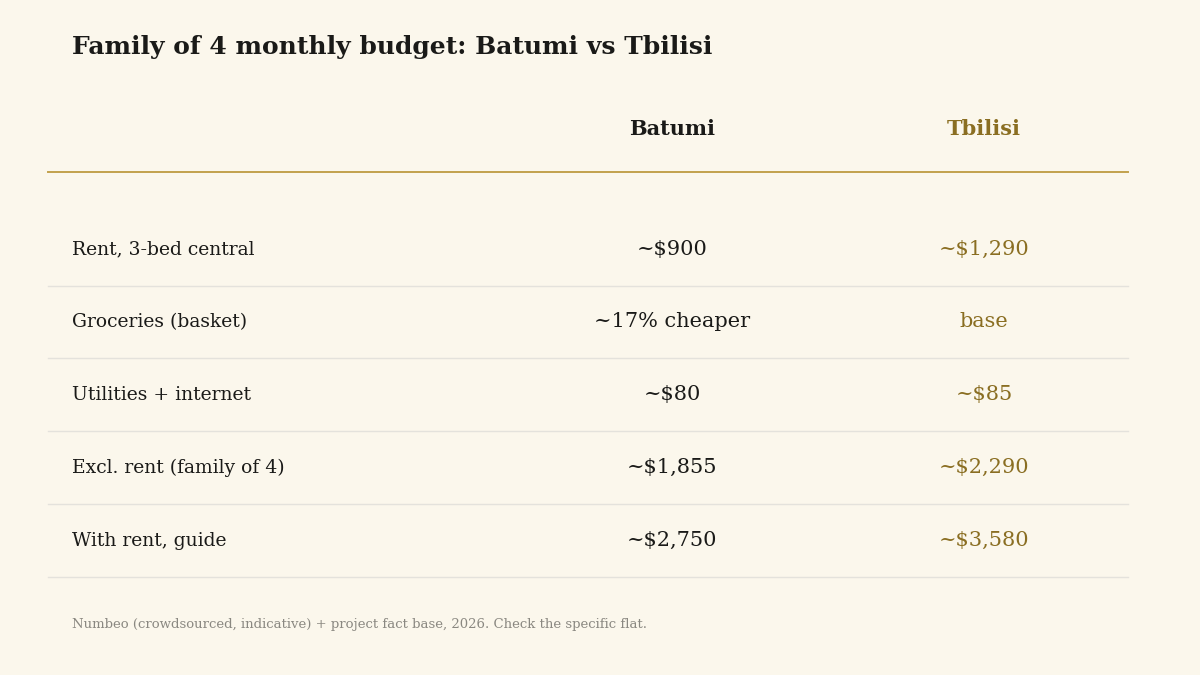
Rent sets the tone for the whole budget, and the gap between the cities is at its clearest here. Per Numbeo (crowdsourced, approximate, March-April 2026), a one-bedroom apartment in central Tbilisi costs around US$680 a month, and a three-bedroom in the center around US$1,290. In Batumi, the same formats cost less: a one-bedroom in the center around US$460, a three-bedroom around US$900. Overall, rent in Batumi is roughly 29% cheaper (Numbeo, March-April 2026).
Treat these as a range, not a fixed quote. Crowdsourced readings drift, and Numbeo's more recent June 2026 figures sit higher on some lines: a central one-bedroom in Batumi, for instance, reads closer to US$530 in the June sample. That movement is the nature of such data, and exactly why we suggest checking a specific apartment in person rather than by index.
A family of four usually needs a two- or three-bedroom apartment, so those lines matter most for planning. And this is where buying your own home changes the maths most, which we return to at the end.
Groceries, utilities, internet
Groceries are markedly cheaper than in Western and Central Europe, especially seasonal fruit and vegetables, a real advantage of life here. Per Numbeo (crowdsourced, approximate, March-April 2026), the grocery basket in Batumi is around 17% cheaper than in Tbilisi, so the seaside city wins here too.
Utilities are moderate. Per Numbeo (crowdsourced, approximate, June 2026), a basic utilities package for an apartment of around 85 m2 (electricity, heating, water, refuse) in Tbilisi comes to roughly US$60 to 65 a month, with clear seasonality: heating raises the bill in winter, and it falls in summer. Climate shapes this line too: Batumi is humid subtropical; Tbilisi is drier and colder in winter, so the heating and cooling profiles of the two cities differ.
Internet and mobile are a pleasant line item. Home internet runs at around US$20 a month, and mobile service in Georgia is fast and inexpensive (project fact base, June 2026; Numbeo, March-April 2026). For a family working remotely, that is a tangible gain in quality of life at a low price.
Schools: a wide range of prices
Education is the line where averages mean almost nothing: everything depends on whether you need an international curriculum or whether a local or bilingual school will do. Honesty matters here more than a tidy average.
If your child needs a full international curriculum, the choice is concentrated in Tbilisi. The capital hosts international schools including QSI, the British BIST, a German and a Finnish school, and costs vary substantially by school and grade. As a guide: at QSI International School of Tbilisi, preschool runs at around US$4,200 a year for half-day and around US$6,200 a year for full-day, plus a one-time registration fee of about US$300 (QSI Tbilisi, 2025-2026; confirmed by a US State Department fact sheet, 2025). Senior grades and International Baccalaureate programs at international schools are usually more, and the final figure should always be confirmed with the specific school for the current year.
Batumi has essentially no full international schools, only English-oriented and bilingual formats. So a family that specifically wants an English or international diploma track will find Tbilisi the more logical choice. State and local private schooling in both cities costs a fraction of the international tier, and many families combine a local school with tutoring and clubs. We cover the Batumi-versus-Tbilisi fork for families in a separate piece on choosing a city.
Healthcare and insurance
Healthcare in Georgia is a mix of a public system and a well-developed private sector, and here, Tbilisi is again deeper: the capital has more large private clinics. Many families take out private health insurance so they can use private clinics without high one-off costs.
As a cost guide: local private insurance runs at roughly US$50 to 100 per person per month for cover at Georgian private clinics; international plans with worldwide cover and evacuation cost more (project fact base, June 2026; market guide, June 2026). Treat that as a guide only: the final price depends on age, health and the chosen clinic, so insurance is priced per policy, not by an average. Safety, meanwhile, is high: Numbeo safety indices for Tbilisi and Batumi sit around 74 to 77 (crowdsourced, approximate, June 2026), an important part of the picture for a family with children.
Transport
Transport is the easiest line for any budget. Public transport is cheap: a single ride costs very little, and a monthly pass in Tbilisi costs around US$10 to 12 (Numbeo, crowdsourced, approximate, June 2026). The cities are compact, ride-hailing apps are reasonably priced, and many families manage without a car. If you do need one, the main expenses are fuel and insurance, not ownership itself.
Worked budgets and the cost of living in Georgia: modest and comfortable
Let us assemble two indicative monthly budgets for a family of four in each city. These are planning models, not a guarantee: real totals depend on district, school, healthcare and lifestyle.
The starting point, per Numbeo (crowdsourced, approximate, March-April 2026): in Tbilisi, a family of four needs around US$2,290 a month to live, excluding rent. That covers the basics (groceries, utilities, connectivity, transport, daily life) before housing and before schools. Batumi is around 19% cheaper, including rent, so it is reasonable to keep its rent-free base roughly 12 to 15% below the Tbilisi figure.
Tbilisi, modest scenario. A rent-free base of around US$2,290 plus a three-bedroom apartment outside the center (roughly US$900 to 1,000) gives around US$3,200 to 3,300 a month without an international school. With a local school and without expensive private care, that is a workable, comfortable minimum for a family.
Tbilisi, comfortable scenario. The same base plus a central three-bedroom at around US$1,290, family private insurance, and a budget for an international school for one child changes the picture sharply: full-day international schooling alone adds around US$500 to 700 a month spread over the year, and the total easily moves past US$5,000 to 6,000 a month. The school, not the rent, is the main multiplier here.
Batumi, modest scenario. A rent-free base roughly 12 to 15% below Tbilisi, plus a three-bedroom apartment at around US$900, gives roughly US$2,700 to 2,900 a month. For a family with no need for an international school, Batumi is meaningfully more affordable.
Batumi, comfortable scenario. Even with a more spacious rental, private insurance, and a good standard of daily life, Batumi stays cheaper than Tbilisi on rent and groceries. The same caveat holds: if you need an international school, Batumi essentially does not have one, and that single requirement tilts the choice toward the capital.
Spending versus income: how buying changes the maths
Every figure above rests on a single large variable: rent. Remove it, and a family's budget shifts radically: in Tbilisi, roughly US$900 to 1,290 a month is gone; in Batumi, US$900 or less. That is why the rent-or-buy question is not only about an asset but about a family's monthly cash flow.
Buying your own home closes the largest line item in the budget for good and makes the rest predictable. It also has a second side for anyone planning to stay: on a purchase of US$150,000 by market valuation, you and your family qualify for a Georgian residence permit, with no minimum stay requirement and no language test (the threshold applies from 1 March 2026, to be confirmed at the time of the transaction). The same money that would otherwise drain into rent for years can work as your home, an asset, and a basis for residency at once. How that works step by step, and the nuances of buying off-plan, we cover in our pieces on relocating with a family and on the Tbilisi market.
That is the honest takeaway: family life in Georgia is affordable by European standards, especially in Batumi, but "cheap" does not mean "without planning". Schooling and healthcare can double a modest budget, so run the numbers for your own family rather than off an index, and weigh buying not only as an investment but also as a way to remove the budget's largest line item.
Ready to size up a budget for your own situation and see where renting wins and where buying does? Get the Georgia relocation guide on WhatsApp or book a consultation, and we will help break down the costs and match a home to your goal: relocation, income or residency.
This material is for reference only and is not investment, legal, or tax advice. Figures are stated as of the publication date with a source and may change. Living-cost data is drawn from crowdsourced sources and is indicative. Confirm thresholds, taxes, school and healthcare prices, and rules at the time of the transaction, and consult a licensed lawyer and tax adviser in Georgia.
Ready to move from the overview to specifics?
Related reading
Frequently asked questions
How much does a family of four need to live in Georgia?
Per Numbeo (crowdsourced, approximate, March-April 2026), in Tbilisi, basic costs excluding rent are around US$2,290 a month. With a three-bedroom rental, a realistic modest budget is around US$3,200 to 3,300, and Batumi is roughly 19% lower. An international school and private healthcare can significantly increase the total.
Where is it cheaper to live, Batumi or Tbilisi?
Batumi is more affordable on average: per Numbeo (crowdsourced, approximate, March-April 2026), it is around 19% cheaper, including rent; rent is about 29% cheaper and groceries about 17% cheaper. But Tbilisi has a deeper market of international schools and private clinics, which matters for families with children.
How much does it cost to rent an apartment in Georgia?
Per Numbeo (crowdsourced, approximate, March-April 2026), in Tbilisi, a one-bedroom in the center is around US$680 and a three-bedroom around US$1,290; in Batumi, around US$460 and US$900, respectively. Recent crowdsourced readings drift, so check a specific apartment in person.
How much does an international school cost in Georgia?
Prices vary a lot by school and grade. As a guide, at QSI International School of Tbilisi, preschool is around US$4,200 a year for half-day and around US$6,200 for full-day, plus a registration fee of about US$300 (QSI Tbilisi, 2025-2026). Senior grades cost more; confirm the exact figure with the school.
How much is health insurance?
Local private insurance costs roughly US$50 to 100 per person per month for coverage at Georgian private clinics; international plans cost more (project fact base, June 2026). This is a guide: the total depends on age, health, and the chosen clinic, so it is priced per policy.
How far can these figures be trusted?
We take detailed living-cost data from Numbeo, but it is crowdsourced, so it is a guide rather than official statistics. Schools and healthcare vary widely. Treat the figures as an order of magnitude and check them against your own family and specific offers.