Batumi vs Dubai, Cyprus, and Turkey: Where to Invest by the Sea
Entry price, yields, taxes and residency compared across Georgia, Dubai, Cyprus and Turkey. Where Batumi wins and where it does not.
When you decide where to invest in property by the sea, you almost always weigh several markets at once: Georgia and Batumi, Dubai, Cyprus, and Turkey. That is the right instinct, and this article runs the comparison honestly, along the axes that shape your return rather than the loudest marketing. The conclusion up front: there is no single best market; the best one depends on your goal. Below, we show where Batumi wins, where it falls short, and which market suits it.
All Georgia figures carry a source and a period. Figures for Dubai, Cyprus, and Turkey are 2026 reference points to verify against current data before you decide, as foreign program thresholds, taxes, and yields are subject to change.
How to compare seaside markets honestly
Comparing countries on a single yield number is meaningless: behind that number sit very different entry costs, taxes, and risk. So we use six axes, and only the combination gives an honest picture.
Entry is the sum you can start with, plus the norm for buying off-plan. Yield is rental income relative to price, split into gross (before costs) and net (after taxes, vacancy, and management). Tax is the load on rental income, the gain on sale, and the transaction itself. Residency is the status that the purchase grants, to whom, and from what threshold. Liquidity is market depth and how fast you can exit without losing value. Country risk is the stability of the currency, economy, and legal environment.
A market strong on one axis is often weak on another. Dubai offers zero tax but a high entry. Turkey offers a large, affordable market, but currency turbulence. Cyprus offers an EU-grade environment but high transaction costs. Georgia offers a low entry and low taxes, but on a smaller scale. Now, each market in turn, briefly and to the point.
The Georgia and Batumi profile
Georgia is a low-entry, low-tax market with a legal framework that is easy for a foreigner to read. The average new-build price in Batumi in turnkey condition reached about USD 1,865 per square meter at the end of 2025, up 9.4% year on year (Galt and Taggart, via Investor.ge, April 2026). Small studios start at USD 40,000, managed aparthotels from 65 to 70 thousand, and flagship projects from 110 thousand and up. Always check the exact entry price against current inventory.
Gross rental yield in Batumi is about 7.31% (Q1 2026, Global Property Guide), around 7.42% for Georgia as a whole. Net is usually 1.5 to 2 percentage points lower; a self-managed short let nets realistically around 3% after costs, while yields of 8 to 12% are achievable in a branded, managed aparthotel through year-round occupancy. We give the full calculation in our piece on Batumi rental yields.
Rental income for an individual can be taxed at a flat 5% of gross receipts, under a separately elected regime, among the lowest rates in the region (PwC, January 2026). There is no stamp duty and no purchase tax; capital gains tax is zero after two years of ownership, and buyer costs range from 0.7 to 1.2%. Developers offer 0% interest-free installments over the build period, typically with a 20 to 30% down payment and the balance without a bank or credit check (developer market practice). Buy from USD 150,000 by market valuation, and you and your family qualify for residency, with no stay or language requirement (the threshold applies from 1 March 2026 and is confirmed at the time of the deal). We cover the procedure in our article on residency through property.
Dubai: zero tax at a high entry
Dubai is a premium market with zero personal tax and strong liquidity, but entry costs more. For an individual, there is zero income tax, zero capital gains tax, and untaxed rental income, along with a one-time Dubai Land Department fee of about 4% of the sale price (official UAE data, 2026; verify against current data).
Buying off-plan is common and treated as the norm. Entry into a budget-area studio ranges from USD 95,000 to 300,000, with the average new-build price per square meter well above Georgia's (2026 market data, reference only; verify against current date). Gross yields on Dubai apartments run to roughly 7% in select segments, with the UAE average around 5% (Global Property Guide, 2026, reference). When comparing yields across markets, note that slices differ: a best segment against a country average is not like-for-like; an average against an average is fairer. Residency: the 10-year golden visa is granted for property holdings of AED 2 million (about USD 545,000), with the option to include family (official UAE program, 2026; verify against current date). In other words, the residency entry threshold in Dubai is several times higher than Georgia's.
Cyprus: an EU environment at a high transaction cost
Cyprus is a European Union market, and that is its core value for anyone who wants an EU jurisdiction. Permanent residency by investment is granted for an investment of EUR 300,000 in a new property (plus VAT), with confirmed foreign income of EUR 50,000 per year (official Cyprus program, 2026; verify against current date).
The defining feature of Cyprus is its transaction cost. New-build carries 19% VAT (a reduced 5% rate is possible for a primary residence under certain conditions), and total buyer costs are materially higher than Georgia's (2026 market data, reference only; verify against current date). Gross yield for Cyprus overall is roughly 5%, higher for apartments in Limassol at about 5.5 to 6% (Global Property Guide, 2026, reference). Residency here is pricier and tied to an income requirement, and the deal itself costs more on the way in, which matters in the math.
Turkey: a large market and currency risk
Turkey is a large, price-accessible market that grants citizenship rather than residency, at the price of currency instability. Citizenship by investment is granted on a property purchase from USD 400,000 with a three-year hold, no stay or language requirement, the option to include family, and the right to keep a second citizenship (official Turkey program, 2026, verify against current date).
Gross yield for Turkey is roughly 7.3%, higher for Istanbul at about 8% in select districts (Global Property Guide, 2026, reference). But the decisive factor is currency. The Turkish lira weakened by roughly 15% against the dollar in the year to May 2026, with inflation around 33% in 2025 (2026 market data, reference only, verify against current date). Because of this, many developers already price in dollars or euros, and an investor should count returns in hard currency, not in lira.
The comparison table
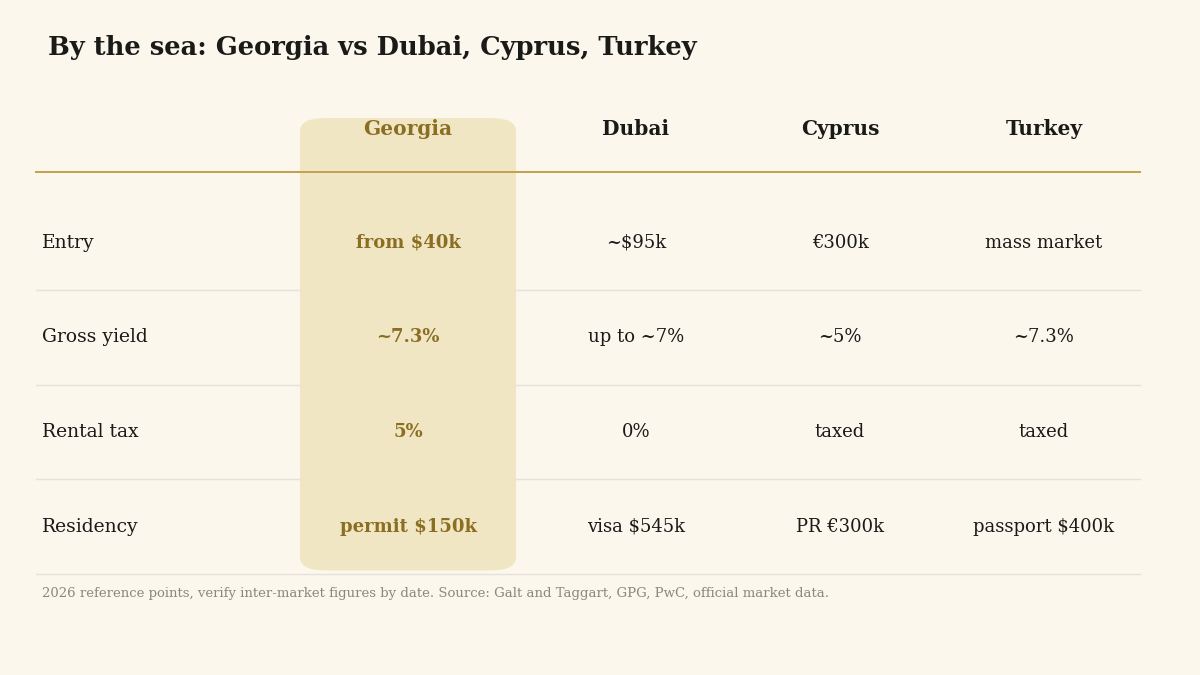
A summary across the six axes. Georgia figures carry a source and period; inter-market figures are 2026 reference points; verify against the current date.
| Axis | Georgia (Batumi) | Dubai | Cyprus | Turkey |
|---|---|---|---|---|
| Entry | from USD 40k; managed units from 65k | from ~USD 95k for a studio (reference) | from EUR 300k for residency | affordable mass market |
| Installments | 0% from the developer, usually 20-30% down | common off-plan | via the developer, less common | via the developer |
| Gross yield | ~7.3% (Batumi, Q1 2026, GPG) | up to ~7% for apartments (reference) | ~5% (reference), Limassol higher | ~7.3% (reference), Istanbul ~8% |
| Rental tax | 5% of receipts (elected regime, PwC) | 0% for individuals | taxed, plus VAT on new-builds | taxed, count in hard currency |
| Residency | permit from USD 150k by valuation | golden visa from ~USD 545k | PR from EUR 300k + income | citizenship from USD 400k |
| Country risk | smaller market scale | high entry, premium market | high transaction costs | currency volatility |
Where Georgia wins, and where it does not
Let us state both sides plainly, because honesty is the argument.
Georgia wins on entry price: you can start with sums that barely open the door elsewhere. It wins on installments: an interest-free developer schedule with no bank involvement is rare; Dubai and Turkey also offer installments, but the terms and checks differ. On rental tax, Georgia (5%) is lighter than Cyprus and Turkey, but not Dubai, where rent is untaxed. And the 5% is charged on gross receipts, with no deduction for costs, which is worth building into the math. Zero on the gain after two years remains one of the region's lightest loads (PwC, January 2026). And it wins on the cost of residency: a permit from USD 150,000 is cheaper than Dubai's golden visa (~USD 545k), Cyprus residency (from EUR 300k) or Turkish citizenship (from USD 400k). An important caveat: USD 150,000 in Georgia buys an annual, renewable residence permit, whereas EUR 300,000 in Cyprus grants permanent residency outright and USD 400,000 in Turkey grants citizenship. These are statuses of different depths, so comparing them on the entry sum alone is misleading. The comparable Georgian product in terms of durability is the investor route from USD 300,000 with a five-year residency: cheaper to enter, but with a status of different strength.
Now the honest part: where Georgia falls short, and what to do about it. First, scale and liquidity: the Batumi market is smaller than those of Dubai, Istanbul, or a mature Cyprus market, and exiting an illiquid unit is harder here. That is not a reason to avoid the market; it is a reason to buy a liquid format: a first-line and growth district, a vetted developer, a managed or branded unit that is easier to let and resell. That selection is exactly what Colchis takes on. Second, country risk: Georgia is a smaller, younger economy than the UAE or the EU. The mitigant is that the currency of the deal and of seaside rent is typically the dollar, the tax framework for a foreigner is simple and stable, and a foreigner's title is protected on the same footing as a citizen's. We do not claim the risk is absent; we show how to reduce it through the choice of unit and the developer check.
Calling Georgia "always the best" would be dishonest. If your priority is an EU-grade environment, Cyprus is the more honest answer. If it is zero tax and maximum liquidity, then Dubai is more logical, given the budget for a high-ticket. If you specifically need a second passport and are ready to manage currency risk, then Turkey is for you. But if you want a low entry point, 0% installments, low taxes, and affordable residency by the sea, Georgia is often the most rational way in.
Which market suits whom
Affordable entry and seaside income point to Georgia and Batumi: low threshold, 0% installments, 5% tax, and a transparent deal. Zero personal tax and deep liquidity, with the budget for a high ticket, point to Dubai. An EU environment and EU permanent residency point to Cyprus, allowing for high transaction costs. A second passport within a reasonable timeframe, counted in hard currency, points to Turkey. Many investors diversify rather than pick one, and Georgia is a convenient, affordable entry alongside costlier assets.
Ready to compare the markets for your goal? Take the "Georgia Investor Guide 2026" on WhatsApp with the full numbers, or book a free consultation, and we will line Georgia up against your alternative: income, residency or a home by the sea.
This material is for reference only and is not investment, legal, or tax advice. Georgia figures are stated as of the publication date with a source and may change. Inter-market data for Dubai, Cyprus, and Turkey is given as a reference and must be verified against the current date. Confirm program thresholds, taxes, and rules at the time of the deal and check with a licensed lawyer and tax adviser in the relevant jurisdiction.
Ready to move from the overview to specifics?
Related reading
Frequently asked questions
Which of these four is the cheapest to enter by the sea?
On entry price, Georgia is usually the most accessible: small Batumi studios start at USD 40,000, while managed aparthotels start at 65 to 70 thousand. A Dubai studio entry is roughly from USD 95,000, and the Cyprus residency threshold starts at EUR 300,000. Verify the inter-market figures against the current date.
Which market has the lightest tax on rent?
In Dubai, an individual's rental income is not taxed (official UAE data, 2026). In Georgia, a flat 5% regime on receipts applies, one of the lowest rates in the region (PwC, January 2026). Cyprus and Turkey tax rental income, and Cyprus adds VAT on new builds.
Which market gives the cheapest residency?
Of these four, Georgia: a residence permit on a purchase from USD 150,000 by market valuation, for you and your family, with no stay or language requirement (threshold from 1 March 2026, confirmed at the time of the deal). Dubai's golden visa, Cyprus PR and Turkish citizenship all require substantially larger sums. But these are statuses of different depth: the Georgian threshold opens an annual, renewable permit, while Cyprus grants permanent residency and Turkey grants citizenship, so compare on status strength, not just the sum.
What is the main risk in Turkey for an investor?
Currency. The lira weakened by roughly 15% against the dollar in the year to May 2026, with high inflation (reference, verify against the date). So income and value in a Turkish unit are counted in dollars or euros, and many developers there already price in hard currency.
Is Georgia definitely better than the rest?
No, and we will not claim it. The best market depends on your goal: an EU environment leans towards Cyprus, zero tax and liquidity to Dubai, a second passport to Turkey. Georgia most often wins where low entry, 0% installment plans, light taxes, and affordable seaside residency matter most.
Can I buy in Georgia remotely, like in these countries?
Yes, a Georgian deal can run entirely online, from selection to title registration, including by power of attorney. The developer pays our fee, with no separate commission from the buyer.