0% Developer Payment Plans in Georgia: How They Work
How interest-free developer payment plans work in Georgia: deposit, term, completion risk and what to check before you sign. With sources.
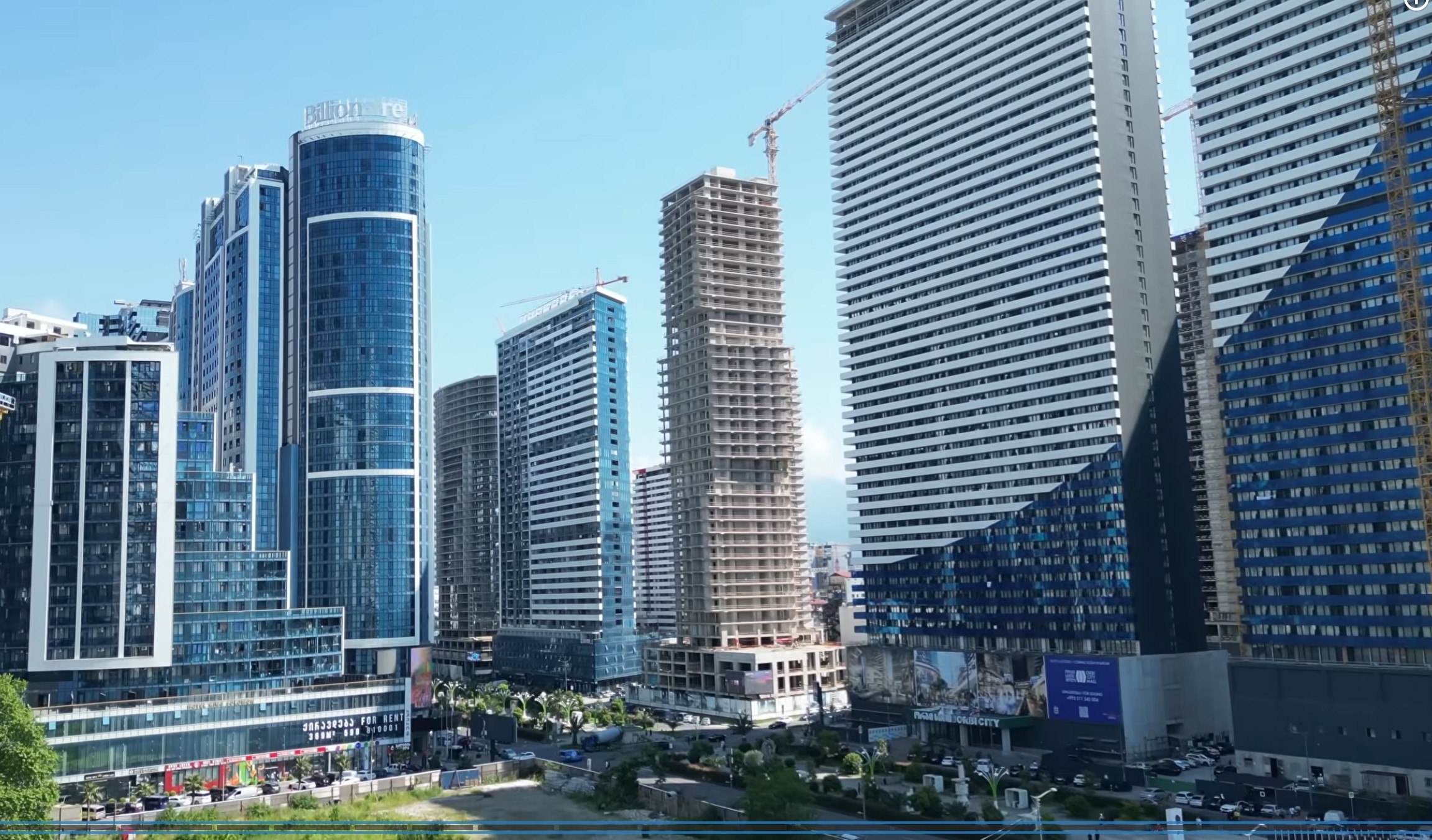
An interest-free developer payment plan is one of the main reasons buyers consider Georgia an entry point into property at all. The appeal is obvious: you step into a unit with a deposit of around a quarter of the price, then pay the balance in stages through to completion, with no interest on top. It sounds like free money. In practice, it is a real, legitimate tool, but it is not charity: it has a price, hidden somewhere other than the interest rate, and risks that the marketing page leaves out. Below, we explain how a 0% developer payment plan in Georgia actually works, why developers offer it, what to check before you sign, and how it lines up with your residency timeline.
How a 0% plan is usually structured
One caveat first: there is no single standard here. Georgia has no law dictating the terms of a payment plan, so everything is set by the individual developer and the specific contract. What follows is typical market practice, not a rule, and the numbers will differ from project to project.
The usual shape looks like this (terms vary by developer):
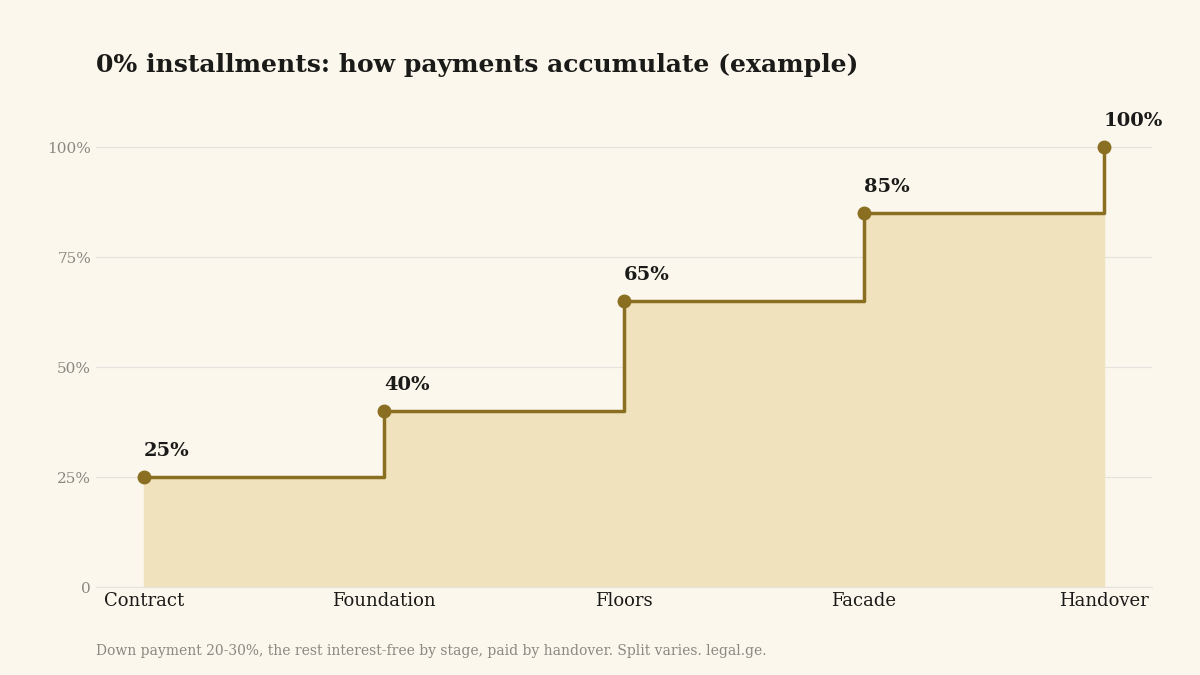
- A deposit, typically 20 to 30 percent of the price. The closer the building is to completion, the larger the upfront share tends to be.
- The balance is interest-free, split into payments on a construction schedule tied to milestones (foundation, floors, facade, finishing).
- A term that matches the build, usually around 2 to 4 years, sometimes up to 5, with full payment almost always expected at or near handover.
- No bank, no credit check, no income statements: this is a contract directly with the developer, not a loan.
This benchmark comes from developer-side market practice, not an official norm, so always confirm the exact percentages and terms in the contract. The finishing condition at handover, from bare shell to turnkey, is fixed separately in the schedule and affects the final figure.
Why developers offer interest-free terms
An interest-free plan is not a gift but a sales and construction-financing tool, and understanding the motive helps you judge the terms soberly.
First, buyers' money is the cheapest capital a developer can get. Buyer payments fund the construction itself, which is cheaper for the developer than taking bank project finance at interest. In effect, you finance the build, and your "interest" for doing so is already priced into the unit.
Second, a plan sharply widens the pool of buyers. A unit at 70,000 or 100,000 dollars that few would buy in one payment becomes reachable for someone who has a fifth or a quarter now and the rest on schedule. More demand means faster sales.
Third, in a rising market, a developer would rather sell off-plan earlier and at a cheaper price, securing a stream of payments, than sit on finished stock. Which brings us to the key trade-off for you.
What to check before you sign
This is the honest part. A 0% plan looks free, but it has at least four places where the real cost and the real risk hide.
Installment price versus the price of a finished unit
This is the crux. A 0% rate almost always means you pay the developer's full, and often higher, launch price. The comparison to make is not "with or without interest" but between two totals: what you will pay over the whole plan, and what a comparable finished or near-finished unit costs today. Sometimes the discount for a single full payment is so large that it is effectively the interest rate, just with the sign reversed. Interest-free is not the same as cheap: value is measured by the numbers, not by the words "0%".
Completion risk
This is the main risk, and there is no skirting it. A payment plan, by definition, means buying during construction, so you take on off-plan risk: a stalled build or developer default, slipping deadlines, an area discrepancy, in the worst case, a double sale or land mortgaged to a bank under the project. A key fact about Georgia: there is no mandatory escrow and no dedicated shared-construction law. Escrow and bank guarantees exist, but they are optional and apply only if explicitly written into your contract (legal.ge, off-plan page, 2025-2026). So "a plan from a reliable developer" and "a plan from any developer" are two very different products in terms of risk.
This is not a reason to avoid off-plan; it is a reason to enter through due diligence. The buyer's baseline protection in Georgia is registering the preliminary contract in the Public Registry, which gives a priority right and prevents a double sale, together with tying payments to construction stages rather than paying everything upfront (legal.ge, 2025-2026). Before the deal, it is worth running a developer check: financials, the land's mortgage status, a valid permit, a delivery history. How we do this and which contract red flags we look for are set out in our piece on off-plan risks and vetting a developer.
What happens if you stop paying? Read this scenario in the contract before signing, not after. Consequences for missed payments vary by developer, from penalties and interest charges to termination with part of what you paid withheld. Answer three questions in advance: how much delay is allowed without penalty, on what terms the contract is terminated, and what share of your money is returned. An interest-free plan does nothing to protect you from your own cash-flow gap, and the finish is expected at handover, not stretched out over years as a mortgage would be.
Reselling before completion
Many buy off-plan intending to resell at a higher price before they get the keys. Sometimes that works, but it is a separate contract term to check in advance: does the developer allow assignment of the contract before handover, on what terms, and at what fee? If assignment is barred or tightly limited, your "quick exit" may be closed, and given the supply overhang in Batumi, where unsold stock rose about 14 percent over the year to around 12,400 units by the end of 2025 (Galt and Taggart), competition for a resale buyer is real.
Payment plan versus mortgage
For a foreign buyer, this is often not even a choice: a mortgage against a Georgian property is hard and expensive for a non-resident to obtain, while a payment plan is available with no bank and no credit history. Still, the logic is worth comparing.
A payment plan: no interest, no bank, no credit check, but a short term (through to handover), a large deposit, and full payment within 2 to 4 years. It is a tool for the build period, not a long-term loan.
A mortgage: a long-term (years after handover), a smaller monthly load, but interest, bank underwriting, insurance, and, for a non-resident, limited availability. In effect, a payment plan moves the "cost of money" into the unit's price, while a mortgage makes it explicit as a rate. For most of our buyers, the working combination is a plan over the build plus a pre-planned source for the final payment at handover.
How a payment plan lines up with the residency timeline
This is where the costliest misunderstanding usually arises, so we will be blunt. Buying off-plan on a payment plan does not, by itself, grant you residency at the moment you sign.
The right to residency through property in Georgia arises only after the unit is completed, the title is registered, and the value is confirmed by an accredited valuer (legal.ge, 30 December 2025; IMI Daily, 2 February 2026). The threshold is 150,000 dollars by market valuation and applies from 1 March 2026 (to be confirmed at the time of the deal). While you are paying for the plan and the unit is unfinished, the basis for residency on that unit does not yet exist.
The practical takeaway: if your goal is residency by a specific date, plan around not just the payment schedule but the completion date plus the time for registration and valuation. A plan spreads the payments; it does not bring forward the moment you can apply. We cover the full procedure, thresholds, and the off-plan catch in our article on residency through property.
Questions for the developer before signing
A short list worth asking before you pay the deposit:
- What is the price for a single full payment versus the plan: what is the real difference in money?
- What is the deposit and the exact payment schedule by construction stage?
- What completion date is fixed in the contract, and are there penalties on the developer for delay?
- Is the preliminary contract registered in the Public Registry?
- What happens if I miss a payment: penalties, termination, what share is returned?
- Is assignment of the contract allowed before completion, and on what terms?
- In what finishing condition (shell or turnkey) is the unit handed over, and is that fixed in the contract?
- Is there escrow or a bank guarantee, and is it written into the contract?
Ready to look at specific properties with a payment plan for your goal and budget? Message us on WhatsApp, and we will shortlist options with a transparent schedule and a vetted developer, or book a free consultation. The full numbers and methodology are in the "Georgia Investor Guide 2026", also available on WhatsApp.
This material is for reference only and is not investment, legal, or tax advice. Figures and plan terms are given as typical market practice as of the publication date, with sources, and may change. Confirm thresholds, taxes, contract terms, and rules at the time of the deal, and check with a licensed lawyer and tax adviser in Georgia.
Ready to move from the overview to specifics?
Related reading
Frequently asked questions
Is a 0% plan really free of any markup?
Free of interest as such, yes. But "no interest" doesn't mean "no markup": the cost of money is usually already built into the installment price. Compare the plan total with a comparable finished unit and with the discount for full payment.
What is the usual deposit?
Typically 20 to 30 percent, depending on the developer and how complete the building is. This is market practice, not a fixed rule, so check the exact figure in the contract.
How long is the plan?
Usually for the build period, around 2 to 4 years, sometimes up to 5, with full payment by handover. It is a contract with the developer, not a bank loan, so the project sets the terms.
Can I get residency while paying for the plan?
No. The right to residency arises only after completion, title registration and a market valuation, at a threshold of 150,000 dollars from 1 March 2026 (to be confirmed at the time of the deal). Before completion, there is no basis for that unit yet.
What if I cannot keep paying?
It depends on the contract: penalties, interest charges, or termination with a partial refund are all possible. Read these terms before signing, not after.
Does the plan protect my money if the build stalls?
Not by itself. Georgia has no mandatory escrow. Protection comes from registering the preliminary contract in the Public Registry, paying in stages, and vetting the developer before the deal.