A Branded Apart-Hotel in Batumi: How the Economics of a Managed Unit Work
Occupancy, revenue share with the operator, costs, taxes and "guaranteed" income: what stands behind "up to 12%" in Batumi's branded apart-hotels.
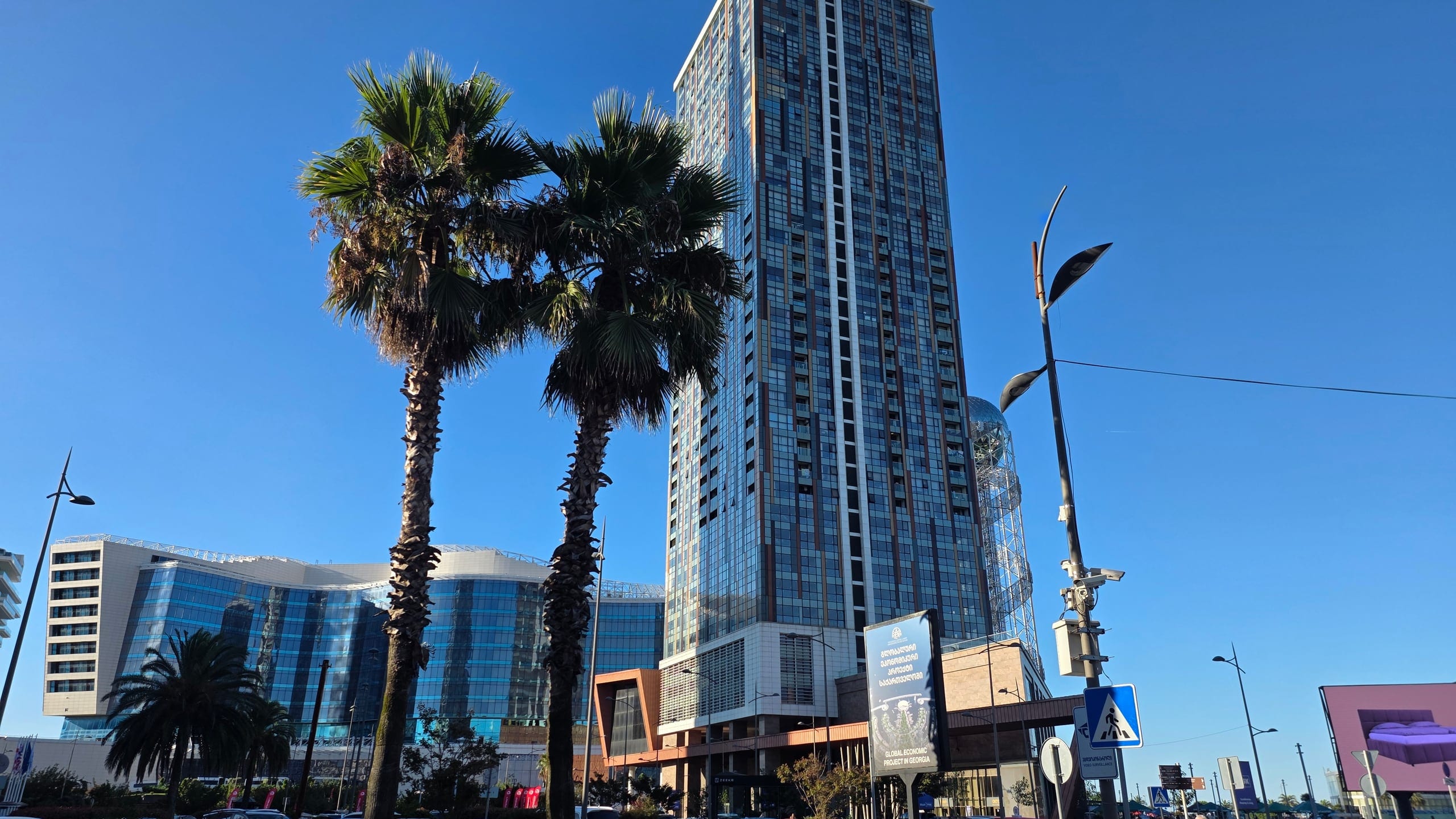
An apart-hotel in Batumi is the format that the "up to 12%" yield rests on, and a format where the terms of the contract matter more than the sign on the facade. You buy a unit in a building operating under a hotel brand, the operator lets it nightly together with the other units, and you receive a share of the income. The difference between a good contract and a bad one is measured in percentage points per year.
Below are the mechanics, in order: how a unit differs from an apartment, occupancy and rate, the revenue share, "guaranteed" income, taxes, and the checks to run before signing. Figures are given with their source and period, and the worked example is built on stated assumptions.
How an apart-hotel unit differs from an apartment
The unit is registered to you in the Public Registry as real estate; its status, residential or non-residential, is worth checking in the registry extract, since the tax treatment depends on it. The difference from an apartment lies in how the unit lives: it is part of a single hotel stock managed by the operator, with a common finishing standard, a front desk, bookings through the brand's channels, and infrastructure that keeps guests coming outside the beach season: restaurants, a pool, a spa, and often conference rooms or a casino.
For the owner, this means three things. You do not let the unit yourself, and usually you cannot let it without going through the operator. Income is most often distributed through a pool: the revenue of all units in one category is divided among the owners proportionally, so downtime in your particular unit is smoothed out. And you have a limited right of use: a set number of days per year under the operator's rules, sometimes outside the high season, so for a "home by the sea" goal this is a different format.
Demand for the format is explained by the structure of the market: of the 58,000 apartments in Batumi's 2025-2029 construction pipeline, 46,300 are investment units, and more than half of those are identical studios (Galt and Taggart, Batumi trends review, October 2025). In competition like this, what stands out wins: the brand, the management, the infrastructure.
Occupancy and rate: where the difference in income comes from
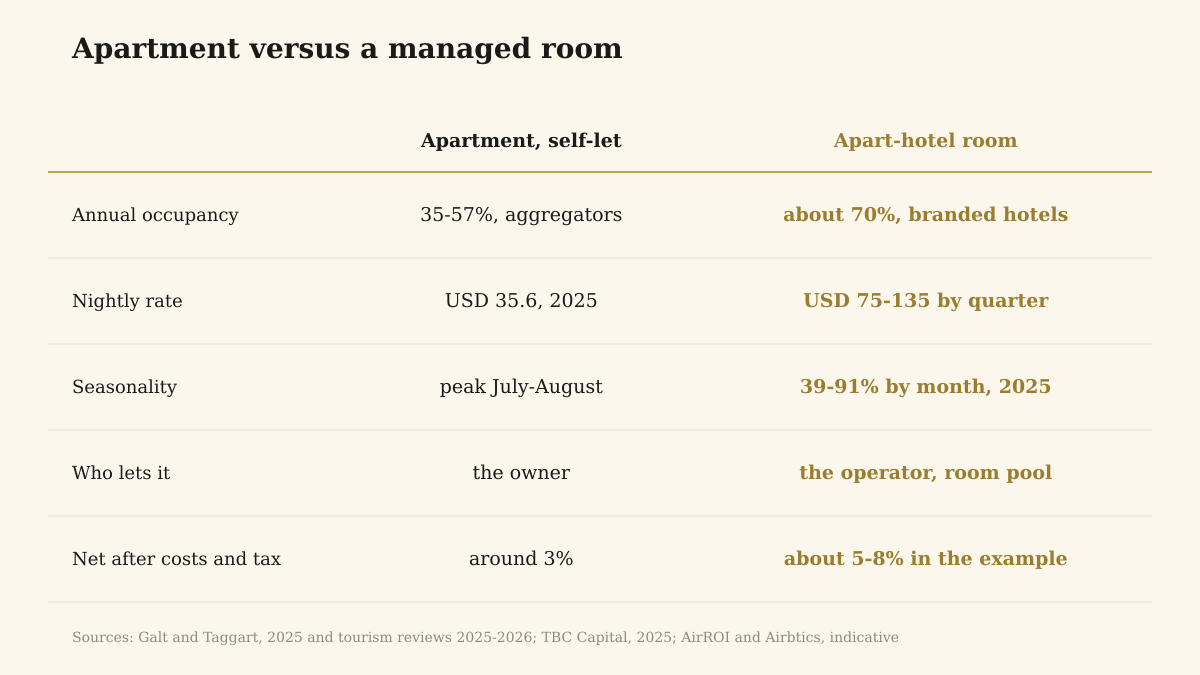
A regular seaside apartment lives by the season. The average nightly rate for small apartments in Batumi in 2025 was USD 35.6, occupancy peaks in July and August, and self-managed short-term letting at typical occupancy yields around 3% net after costs (Galt and Taggart, 2025). The gross yield of a regular apartment fell from 8.8% in 2024 to 7.4% in 2025 and about 7.1% in the first half of 2026, because prices rose faster than rents (Galt and Taggart, 2025 and Q2 2026 reviews).
The hotel segment works differently. In the Galt and Taggart hotel sample, occupancy in Batumi in 2025 ranged from 39% in February to 91% in August: 82% in the third quarter at an average rate of USD 119 a night excluding VAT, and 50% in the fourth at USD 75 (Galt and Taggart, tourism reviews for Q4 2025 and Q3 2026, updated sample). Branded hotels, according to TBC Capital, held occupancy of about 70% for the year in 2022-2024 (TBC Capital, 2025). A private apartment on Airbnb in Batumi, by contrast, cost USD 57 a night in the third quarter of 2025 and USD 35 in the second quarter of 2026 (Galt and Taggart, tourism reviews for Q3 2025 and Q2 2026). The gap in revenue per unit is several-fold, and it is what allows operators to state yields of 8-12%.
The flip side: hotel demand in Batumi is seasonal and depends on guests from the Middle East. In the first quarter of 2026, against the backdrop of regional escalation, occupancy fell to 31% versus 47% a year earlier, at a rate of USD 81; in the second quarter it returned to 60%, and in the third it rose to 84% at a rate of USD 135, when visits from Israel turned upward again, up 19.1% (Galt and Taggart, tourism reviews for Q1, Q2 and Q3 2026). For a unit owner, this means the annual figure is made up of a strong summer and a weak winter, and the stability of income depends on how the operator diversifies its guests: conferences, sports training camps, the casino, European markets.
How revenue is shared: contract models
Management program terms come down to two basic models, to which a pool may be added.
Fixed lease
The operator leases your unit at a fixed annual rate, most often set as a percentage of the purchase price, for example 8-10% for the first years. This is the "guaranteed" income in most offers: it is not the market that pays but a specific company, and your yield equals that company's ability to pay.
Income split
The most common model: income is split 60/40 or 70/30 in the owner's favor. The key question, which changes the result twofold, is the base the share is calculated from. If it is revenue, the operator covers operating costs out of its part. If it is operating profit, staff, cleaning, utilities, platform commissions and marketing are first deducted from revenue, and the remainder is split. Both schemes are legal, but "70% to the owner" means different money in each.
Pool
A pool is a way of distributing income within an income split: income is calculated across all units of one category and divided in proportion to floor area or the number of units. This protects against bad luck with the floor or the view, but it requires transparent reporting: you should see the occupancy and rate of the whole pool, not just your own payout.
In all models, the owner usually still bears property tax, a contribution to the furniture renewal fund and, under some contracts, insurance and utility bills during downtime. These lines are worth putting into the calculation separately; otherwise the stated yield will turn out higher than the actual one.
Worked example: a unit at USD 80,000
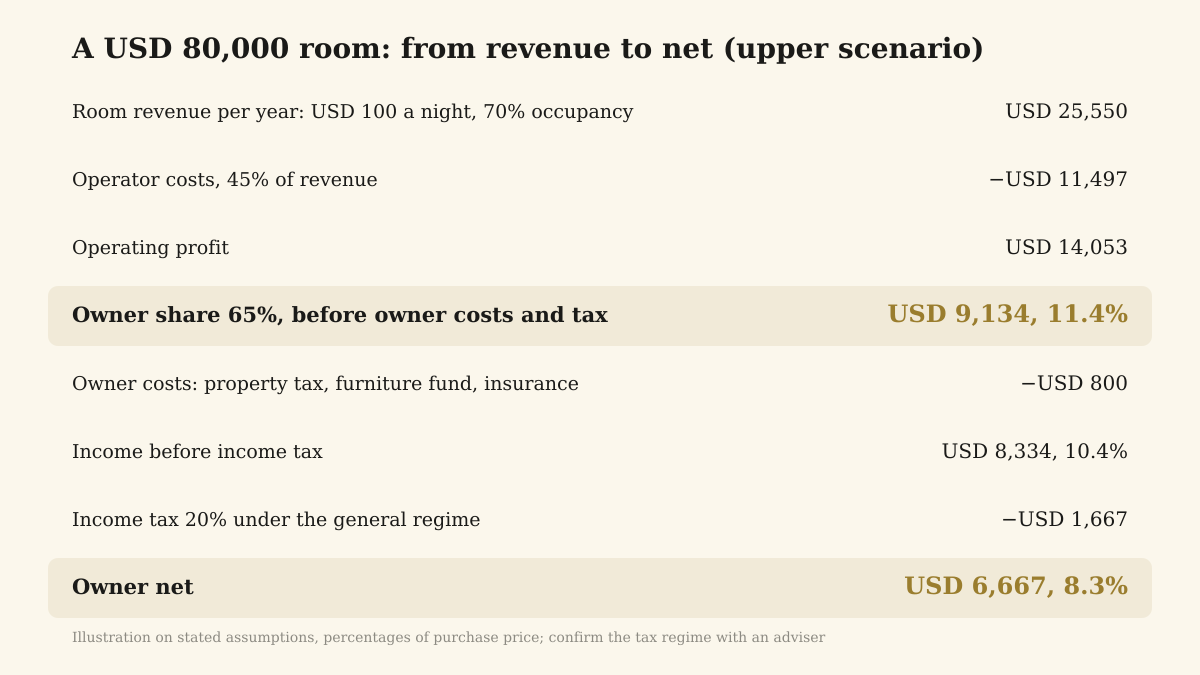
Take a 35 sqm unit at USD 80,000: entry into Batumi's branded projects starts at roughly USD 65-70 thousand (benchmark based on Batumi operators' offers, 2026); this is an illustration, not the price list of a specific project:
| Item | Base scenario | Upper scenario |
|---|---|---|
| Average nightly rate | USD 80 | USD 100 |
| Annual occupancy | 60% | 70% |
| Unit revenue per year | USD 17,520 | USD 25,550 |
| Operator costs, share of revenue | 45% | 45% |
| Operating profit | USD 9,636 | USD 14,053 |
| Owner's share | 60% | 65% |
| Owner's income before own costs and taxes | USD 5,782 (7.2%) | USD 9,134 (11.4%) |
| Owner's costs: property tax, furniture fund, insurance | USD 800 | USD 800 |
| Income before income tax | USD 4,982 (6.2%) | USD 8,334 (10.4%) |
| Income tax 20% under the general regime | USD 996 | USD 1,667 |
| Owner's net | USD 3,986 (5.0%) | USD 6,667 (8.3%) |
Assumptions: occupancy of 60-70% and a rate of USD 80-100 sit within the annual range of the Galt and Taggart sample of Batumi hotels for 2025 and the occupancy of branded hotels according to TBC Capital; the owner's costs and the tax regime are notional, see the section on taxes. Percentages are calculated from the purchase price.
The table shows the main point. "Up to 12%" is the owner's income before their own costs and taxes in a good scenario: a strong brand, year-round infrastructure, a high owner's share. Net after costs and income tax comes to about 5-8%, higher than the roughly 3% net from self-managed letting of a regular apartment, and without your involvement. A specific operator's terms are worth recalculating with this same table, using the figures from its last season, which should be requested from the operator.
"Guaranteed" income and buyback: what it means under the contract
Offers with a guarantee of 8 or 10 percent for the first three or five years and with a buyback of the unit appear in Batumi regularly. A guarantee is an obligation of a specific legal entity, the developer or the operator, not a property of the market, and as a rule it is already built into the price of the unit, which sells for more than a comparable apartment.
Four things need checking: who gives the guarantee and what that company has on its balance sheet; the base the percentage is calculated from: the purchase price, the price excluding furniture, revenue or profit; what happens after the guarantee period ends and at what ratio the switch to an income split takes place; and the buyback terms: price, timing, caveats, and who pays the taxes and transaction costs. A contract without these answers is worth putting aside, regardless of the brand on the facade.
Taxes for the unit owner
The 5% rate with no deductions applies to an individual's income from letting housing for residential purposes, the general personal income tax rate is 20%, and the special regime for short-term accommodation applied until 1 January 2026 (PwC Tax Summaries, Georgia, September 2026). Income from a unit that the operator lets as a hotel service does not, under the general rules, fall within the definition of letting housing for residential purposes, which is why the calculation above uses the general 20% rate and possible withholding at source by the Georgian operating company. This is a conclusion drawn from PwC's general rules, not a clarification from the tax authority on a specific operator.
The exact regime depends on the form of the relationship with the operator and the status of the premises. Before signing, get a net-after-tax calculation from a tax advisor in Georgia and compare it with the operator's calculation. The general rules for owners are covered in the piece on property taxes in Georgia.
What to check before signing
Most of Batumi's branded projects are sold at the construction stage, with a 0% installment plan from the developer. This lowers the entry threshold but adds two risks outside the hotel economics: the completion date and whether the brand actually arrives. A sign on a rendering is not the same as a valid franchise or management agreement, and income starts when the hotel opens, so this period should be built into the payback calculation. How installment plans work and how to check a developer at the construction stage are covered in the pieces on 0% installment plans and on off-plan risks in Georgia.
- A valid agreement with the brand: franchise or management, its term, and who the on-site operator is.
- The developer: completed projects, the building permit, any pledge on the land.
- The base of the income split and the full list of costs deducted before the split.
- Reporting: a monthly report on the pool's occupancy, rate and revenue, with owner access.
- Owner's costs: property tax, furniture fund, insurance, utility bills during downtime.
- Right of use: how many days a year and in which season.
- Guarantee and buyback: who guarantees, from what base, for what term, what comes next, the buyback price and terms.
- Resale: whether the operator agreement transfers to the buyer.
- Completion date and share sold: in projects due for delivery in 2026, about 70% is sold; in those due in 2027-2029, 51-56% (Galt and Taggart, developer surveys, January and August 2026).
What follows from this
If the goal is maximum yield without your involvement, a managed apart-hotel is a suitable format, and it is in this format that the top of the "up to 12%" range is achievable before costs and taxes. Yield here is determined by the contract more than by the sea: the split base, costs, taxes and the operator, and it is worth calculating it net, using the table above. The overall picture of the Batumi market in 2026 and the net yield of a regular apartment are covered in the pieces on the Batumi market and on rental yields.
Discuss a specific project
If you want to check a specific operator's terms against the table in this article, send a message on WhatsApp or book a consultation. The "Georgia Investor Guide 2026" is available on request.
This material is for reference only and is not investment, legal, or tax advice. Figures are given as of the publication date with a reference to the source and may change; the worked example is built on assumptions. Yield is not guaranteed. Confirm taxes, contract terms and rules at the time of the deal and check with a licensed lawyer and tax advisor in Georgia.
Ready to move from the overview to specifics?
Related reading
Frequently asked questions
What is an apart-hotel, and how does it differ from an apartment?
It is a unit in a branded hotel building, registered to you as real estate but let by the operator together with the other units. You receive a share of the income and a limited right of use; living in the unit year-round is usually not possible (Batumi operator market practice, varies by operator, 2026).
What yield does an apart-hotel in Batumi deliver?
Operators state 8-12% per year before taxes. In this article's illustrative calculation for a unit at USD 80,000, the owner's income before their own costs and taxes comes to 7-11%, and net after them about 5-8%; the result depends on the rate, occupancy, the split base and the owner's share (Batumi operators' statements, 2026; calculation assumptions are stated in the article).
How is income shared with the operator?
Usually 60/40 or 70/30 in the owner's favor. The main difference between contracts is whether revenue is split, or operating profit after costs for staff, cleaning, utilities and marketing (Batumi operator market practice, varies by operator, 2026).
What does "guaranteed" income mean?
An obligation of a specific company to pay a fixed percentage of the price in the first years, usually built into the cost of the unit. The things to check are the guarantor, the calculation base, the term, the conditions after it ends and the buyback terms (market practice, varies by contract, 2026).
What taxes does a unit owner pay?
The 5% rate applies to letting housing for residential purposes; income from a unit let through an operator is, under the general rules, subject to 20% income tax with possible withholding at source, and the preferential short-term accommodation regime ended on 1 January 2026. The exact regime depends on the contract and the status of the premises; confirm with a tax advisor (PwC Tax Summaries, Georgia, September 2026).
How stable is hotel demand in Batumi?
It is seasonal and depends on guests from the Middle East: occupancy of Batumi hotels in the Galt and Taggart sample was 31% in the first quarter of 2026 versus 47% a year earlier, 60% in the second and 84% in the third, when visits from Israel rose again. The stability of income is determined by how the operator diversifies its guests outside the season (Galt and Taggart, tourism reviews for Q1, Q2 and Q3 2026).