Batumi Property Market in 2026: What the First Half Showed
New-build prices, deals, buyers, supply overhang and rentals in Batumi in the first half of 2026, per Galt and Taggart, TBC Capital and GNTA, with periods.
The Batumi property market in 2026 is described in opposite ways: some sources talk of a "year of consolidation" and a supply overhang, others of continued price growth and record deal numbers. Both sides are right, because they are looking at different figures. Below are the data for the first half of 2026, with a source and period for every figure: prices, deals, buyers, districts, supply and rentals. This is neither a forecast nor a recommendation to buy, but material against which any claim about the market can be checked, including claims made in advertising.
Prices in the Batumi property market: the forecast promised a slowdown, the first half showed acceleration
The benchmark series for new-builds is the average price per square meter on the turnkey primary market, per Galt and Taggart:
- 2023: USD 1,569 per sqm
- 2024: USD 1,699 per sqm
- 2025: USD 1,865 per sqm, up 9.4% year on year (Galt and Taggart, 2025 review, 6 March 2026)
- March 2026: USD 1,893 per sqm, up 8.7% on March 2025 (Galt and Taggart, Q1 2026 review)
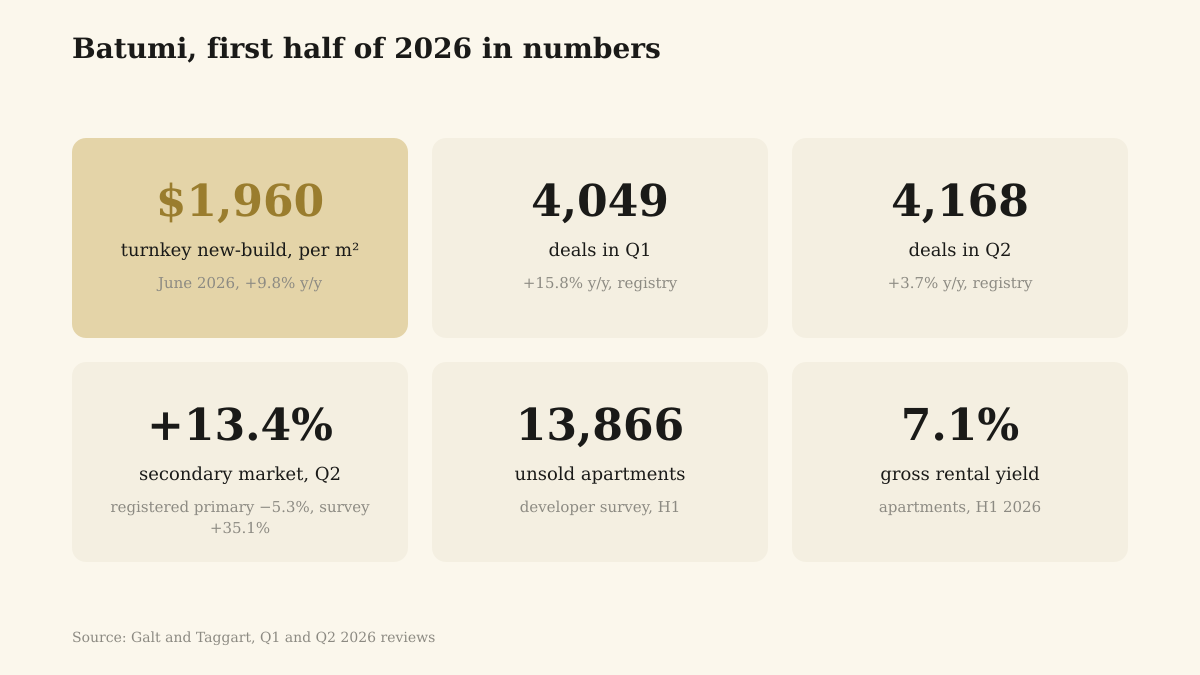
- June 2026: USD 1,960 per sqm, up 9.8% on June 2025 (Galt and Taggart, Q2 2026 review)
This is where the phrase "growth of up to 25% over three years," found in market descriptions, comes from: from 2023 to June 2026, a square meter on the primary market rose in price by almost 25%, from USD 1,569 to USD 1,960. The figure should be read literally: it is a fact of the past period, based on the annual series with a June data point, not a pace that can be carried over to the next three years.
Now to the forecast. In March, Galt and Taggart expected primary market price growth to slow to 4-6% in 2026, and the gap between the primary and secondary markets to stop widening (Galt and Taggart, 2025 review, 6 March 2026). At the half-year mark, growth is running almost twice as fast as forecast, and the analysts themselves warn that sustaining this pace will be difficult given the wide gap between the primary and secondary markets, the large volume of projects under construction and gradually declining rental yields. Newly built apartments on the secondary market cost an average of USD 1,497 per sqm in June 2026, up 6.5% year on year (Galt and Taggart, Q2 2026 review).
Costs hold prices up from below: construction costs in Georgia rose 9.8% in 2025, and construction wages rose 29.3% (Geostat, as calculated by Galt and Taggart, December 2025). That is why the analysts' forecast speaks of slower growth rather than falling primary market prices; completed housing on the secondary market, meanwhile, costs noticeably less than a new-build. The price series for past years and a district breakdown are in the article on Batumi property prices.
Deals: the market is growing, and the secondary market has become a notable share of turnover
The year 2025 closed with 17,478 apartment deals, up 15% on 2024: 9,485 on the primary market and 7,993 on the secondary market. Market volume reached about USD 1.3 billion, up 23.8% year on year (Galt and Taggart, 2025 review, 6 March 2026).
Growth continued in 2026. In the first quarter, 4,049 deals were registered, up 15.8% year on year, with the primary market up 21.1% and the secondary market up 10.1% (Galt and Taggart, Q1 2026 review). The second quarter saw 4,168 deals, up 3.7%: the secondary market grew 13.4% to 2,200 apartments, while registered primary market deals fell 5.3%. The analysts' own caveat: registration of primary market deals in the registry lags behind, and according to the developer survey, primary market sales rose 35.1% in the quarter and 47.9% in the half-year (Galt and Taggart, Q2 2026 review). About 30% of apartments bought on the primary market are resold within two years (Galt and Taggart, Batumi trends review, October 2025): the secondary market in Batumi is the turnover of completed housing, not a sell-off. Exiting a property is possible, but the speed and price of the exit depend on the liquidity of the specific unit: standard studios in later construction phases take longer to sell than apartments in completed buildings by the sea.
Who is buying in 2026
Georgian citizens account for between a third and a half of sales, depending on the quarter; the rest are foreigners. The sales breakdown in projects by established developers:
| Buyers | 2024 | 2025 | Q1 2026 |
|---|---|---|---|
| Georgian citizens | 38% | 48% | 37% |
| Europe | 18% | 13% | 18% |
| Israel | 14% | 13% | 10% |
| Ukraine, Belarus and other post-Soviet countries | 14% | 11% | 16% |
| Turkey | 5% | 3% | 4% |
| Other countries | 13% | 11% | 15% |
Source: Galt and Taggart, developer survey, 2025 review and Q1 2026 review; totals may not add up to 100% due to rounding.
The foreign share differs between sources because the base differs: 52% for 2025 according to the registry, and 63% in the first quarter of 2026 and about 45% for the half-year according to the developer survey, which covers about 40% of the primary market (Galt and Taggart, 2026). This means the foreign share in the survey fell noticeably in the second quarter, which coincides with an external factor: visits from Israel to Georgia fell 17.5% in the first quarter (Georgian National Tourism Administration, Q1 2026), and the share of Israeli buyers dropped to 10%. Galt and Taggart call Israeli demand a near-term risk but expect the opposite effect in the medium term: in unstable periods, Israeli buyers look for a familiar, calm asset (Galt and Taggart, 2025 review, 6 March 2026). Europe returned to 18% after a dip in 2025.
The motive is almost always investment: 85% of purchases in Batumi are made for investment purposes, and the city accounts for about 21% of Georgia's primary market (TBC Capital, February 2026); according to Galt and Taggart, 80% of purchases are for investment, while Europeans buy a vacation home in roughly 40% of cases (Galt and Taggart, October 2025).
Districts: where prices are rising and where the deals are
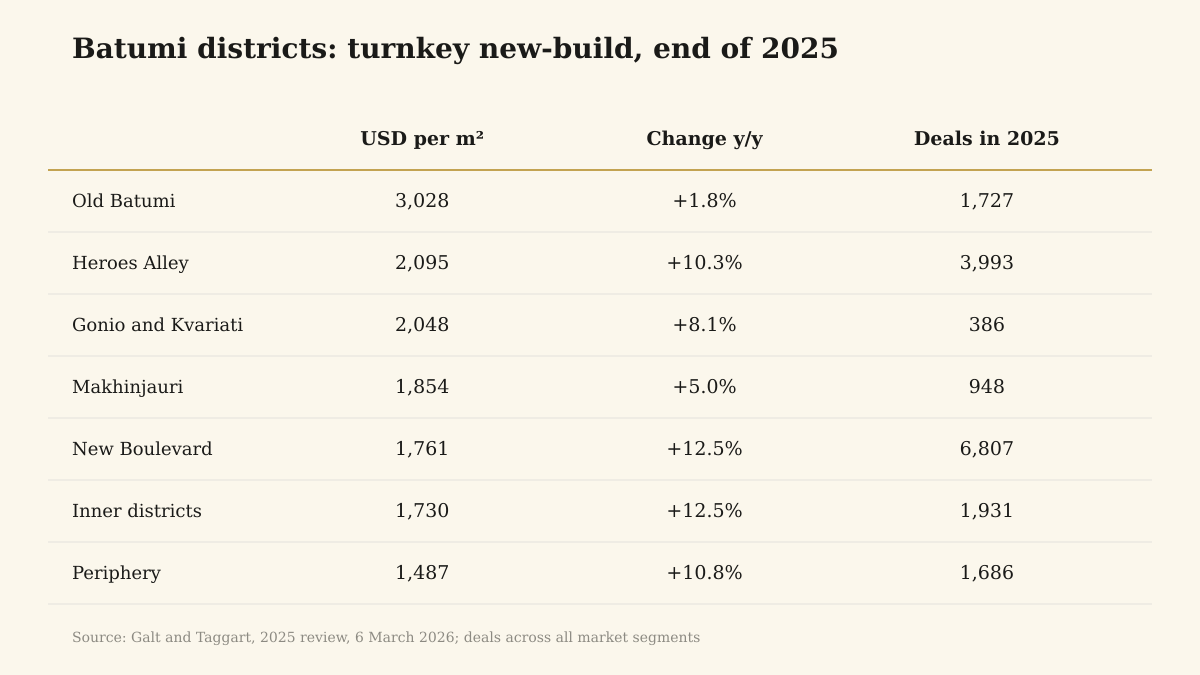
The citywide average hides a twofold spread. Here is the turnkey primary market price at the end of 2025, price growth over the year and the number of deals in 2025 across all market segments:
| District | Price per m2, USD | Growth over the year | Deals in 2025 |
|---|---|---|---|
| Old Batumi | 3,028 | +1.8% | 1,727 |
| Heroes Alley | 2,095 | +10.3% | 3,993 |
| Gonio and Kvariati | 2,048 | +8.1% | 386 |
| Makhinjauri | 1,854 | +5.0% | 948 |
| New Boulevard | 1,761 | +12.5% | 6,807 |
| Inner districts | 1,730 | +12.5% | 1,931 |
| Periphery | 1,487 | +10.8% | 1,686 |
Source: Galt and Taggart, 2025 review, 6 March 2026.
The engine of the market is New Boulevard: 6,807 deals in the year, up 23% on 2024, with the fastest price growth. Old Batumi barely rose in price in 2025, but the number of deals there grew 77%: buyers came to the established center at an already high price. In the first quarter of 2026 the price leaders were the same: Old Batumi at about USD 3,146 per sqm, Heroes Alley at about 2,081, Gonio and Kvariati at about 2,075, while New Boulevard led on deals with 1,671 in the quarter (Galt and Taggart, Q1 2026 review). More in the Batumi districts guide.
Supply: how much will be built and how much is already sold
About 58,000 apartments are being built in Batumi in 2025-2029, of which 46,300 are investment units and 11,400 are residential (Galt and Taggart, Batumi trends review, October 2025). Unsold stock in projects by established developers rose 13.9% in 2025 to about 12,400 apartments, and according to the developer survey for the first half of 2026 it reached 13,866, with an absorption period of about 24 months; the survey covers about 40% of the primary market (Galt and Taggart, 2025 review and Q2 2026 review).
The distribution within this volume matters more than the total. Projects due for completion in 2026 are about 70% sold, and those due in 2027-2029 are 51-56% sold (Galt and Taggart, developer surveys, January and August 2026): competition for buyers is concentrated in the later phases. More than half of the investment supply consists of identical mid-market studios, while the residential segment is balanced: demand for apartments to live in, about 2,300 a year, roughly matches the supply for the next five years (Galt and Taggart, October 2025).
How to read the overhang for a specific project: the developer can answer three questions, namely what share of apartments in your phase is sold, when completion is due and how the property differs from the mass-market studios nearby. If less than half is sold and completion is after 2027, this is the most competitive part of the market, where resale before completion is hardest.
Rentals and tourism: where the income comes from
Yields in Batumi rest on tourist flows, and in 2026 those flows were put to a stress test. In 2025 the city received 2.6 million international visits, up 5% on 2024 (Georgian National Tourism Administration, 2025), and Batumi airport handled 1,230,200 passengers, up 29% year on year (Georgian Civil Aviation Agency, 2025).
The first half of 2026 proved harder: visits by international travelers to Georgia fell 3.3%, and tourism revenue came to USD 1.9 billion, down 2%, due to countries affected by regional conflicts; at the same time, revenue from tourists from the EU and the UK hit a record USD 335.7 million, up 21.2% (Georgian National Tourism Administration, first half of 2026). For rentals, this means a change in the guest mix.
Rates responded. The average nightly rate for small apartments in Batumi held at USD 35.6 in 2025 and fell 7.3% year on year in the first quarter of 2026. Gross yield fell from 8.8% in 2024 to 7.4% in 2025 and about 7.1% in the first half of 2026: prices rose faster than rents (Galt and Taggart, 2025 and Q1 and Q2 2026 reviews). In August 2026, Global Property Guide estimates gross yield on Batumi apartments at 7.28%, and about 8.35% for studios (Global Property Guide, August 2026).
Two clarifications. All of this is gross, before tax, vacancy and maintenance: net yield on self-managed short-term rentals comes to around 3% by Galt and Taggart's calculation for 2025 (a worked example is in the article on Batumi rental yields). And the "up to 12%" from advertising refers not to apartments but to rooms in branded apart-hotels run by an operator: this is a different economic model, with revenue sharing and owner costs, and it cannot be compared directly with an apartment's 7% gross (see the analysis in the article on Batumi apart-hotels).
What this means for buyers
If the goal is income. A standard studio without management competes with thousands just like it, and its yield after costs is closer to 3% than to 7%. In 2026 the difference between formats is greater than the difference between districts, so the calculation should be based on the net yield of the specific property, not the citywide average.
If the goal is a residence permit. The threshold is USD 150,000 based on the market valuation of an accredited appraiser, properties can be combined, and eligibility arises after completion and registration of the property, so an apartment under construction does not qualify for a residence permit before completion; the threshold should be confirmed at the time of the deal.
If the goal is to live there. Premium residential projects are in short supply, and the selection criteria differ from an investor's: the line from the sea, the building's engineering systems, off-season infrastructure. A separate guide to choosing a seaside apartment for yourself is devoted to them.
Discuss a district or project
If you would like to check a specific project against the figures in this article, send a message on WhatsApp or book a consultation. The "Georgia Investor Guide 2026," with a full analysis of the market, is available on request.
This material is for reference only and is not investment, legal or tax advice. Figures are given as of the publication date with a reference to their source and may change. Price and yield forecasts are not guaranteed. Confirm thresholds, taxes and rules at the time of the transaction and consult a licensed lawyer and tax advisor in Georgia.
Ready to move from the overview to specifics?
Related reading
Frequently asked questions
How much does a square meter cost in Batumi in 2026?
The average price of a turnkey new-build in June 2026 was about USD 1,960 per sqm, up 9.8% year on year. By district, it ranged from about USD 1,487 on the periphery to about 3,028 in Old Batumi at the end of 2025 (Galt and Taggart, Q2 2026 review and 2025 review).
Are apartment prices in Batumi rising in 2026?
Yes. Growth was 8.7% year on year in March and 9.8% in June, against a forecast of a slowdown to 4-6% for the year. Analysts warn that sustaining this pace will be difficult because of the gap with the secondary market, the volume of construction and declining yields (Galt and Taggart, Q1 and Q2 2026 reviews).
What does "price growth of up to 25% over three years" mean in descriptions of the Batumi market?
It is the Galt and Taggart series for the turnkey primary market: USD 1,569 per sqm in 2023 and USD 1,960 per sqm in June 2026, an increase of almost 25% over the past period, not a forecast for the future (Galt and Taggart, 2023-2026).
Who buys property in Batumi?
Georgian citizens account for a third to a half of sales, depending on the quarter, and the rest are foreigners: Europe about 18%, Ukraine, Belarus and other post-Soviet countries about 16%, Israel about 10% in the first quarter of 2026. About 85% of purchases are made for investment purposes (Galt and Taggart, Q1 2026; TBC Capital, February 2026).
Is the supply overhang in Batumi dangerous?
Unsold stock at established developers stood at 13,866 apartments according to the survey for the first half of 2026, with about 58,000 under construction through 2029. The risk is concentrated in studios in later phases: projects due for completion in 2026 are about 70% sold, and those due in 2027-2029 are 51-56% sold (Galt and Taggart, developer surveys, January and August 2026).
What is the rental yield in Batumi in 2026?
Gross yield on a standard apartment is around 7.1% in the first half and 7.28% by the August estimate, with studios at about 8.35%. Net yield after costs and seasonality is lower, and the "up to 12%" refers to branded apart-hotels under management (Galt and Taggart, Q2 2026; Global Property Guide, August 2026).