A Seaside Apartment in Batumi to Live In: How to Choose a Home You Will Enjoy All Year Round
Line and view, climate and engineering, finish, running costs and year-round districts: how to choose a Batumi apartment for you and your family, with sources.
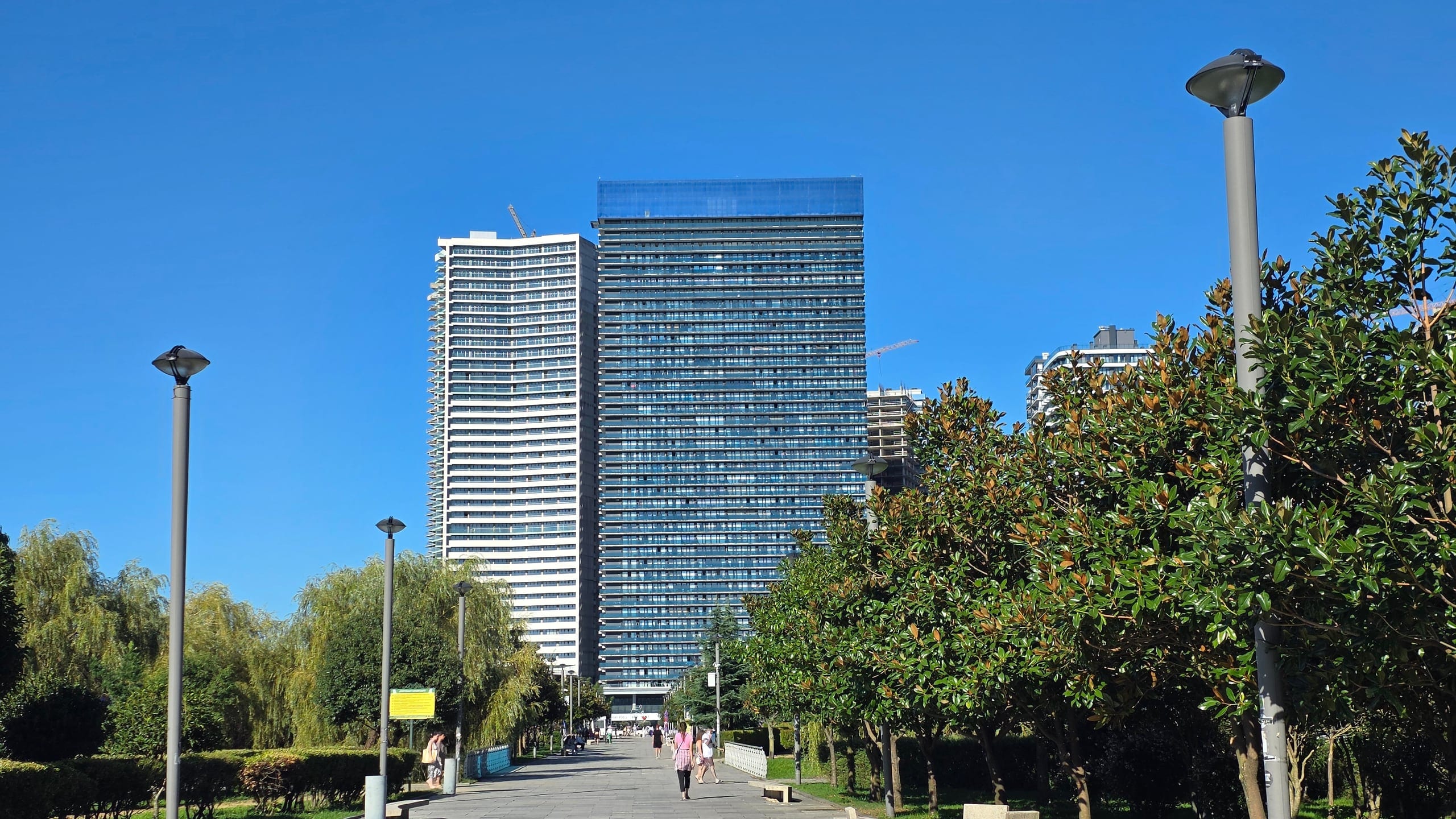
Buying a seaside apartment in Batumi to live in is a different task from buying one to rent out, and most mistakes begin when a buyer approaches it with investment criteria. Yield, occupancy and the "first line" say little about what it is like to live in that apartment in November, when the sea is stormy and the tourist neighbors have left. Below is what to look at if the apartment is for you: line and view, climate and building engineering, the finish condition, running costs, and districts for year-round living.
This article is for those who see Batumi as a seaside home for the season or for the whole year, for themselves and their family, and who want to choose right the first time.
For living and for income: these are different apartments
The Batumi market itself splits housing into two categories. Of the 58,000 apartments in the 2025-2029 construction pipeline, 46,300 are investment units and 11,400 are residential. Investment units stand by the sea and cost on average US$400 per sqm more than residential ones: US$1,904 versus US$1,506 per sqm turnkey in August 2025. Residential units are concentrated in the inner districts and on the periphery; demand for them, about 2,300 apartments a year, roughly matches the supply for five years ahead, and the market is short of premium residential projects (Galt and Taggart, Batumi trends review, October 2025).
For you, this means two things. First, for an "investment" building by the sea you pay a premium for the view and the proximity to the beach, but you get two-week neighbors, seasonal noise and an entrance that works like a hotel in summer. Second, in the residential segment the choice of premium buildings is narrow, and it is worth searching for them in a targeted way, separately from the investment supply: low-rise projects, buildings with large apartments, gated courtyards.
Line, floor and view: what you are paying for
The price per square meter in Batumi varies twofold depending on the district: Old Batumi about US$3,028 per sqm turnkey, Heroes Alley about US$2,095, Gonio and Kvariati about US$2,048, Makhinjauri about US$1,854, New Boulevard about US$1,761, the inner districts about US$1,730, the periphery about US$1,487 (Galt and Taggart, December 2025). Within a district the spread is even wider: in Old Batumi from US$1,650 to US$4,450 per sqm, in Gonio and Kvariati from US$1,350 to US$4,560 (Galt and Taggart, December 2025). The difference comes from line, floor and view.
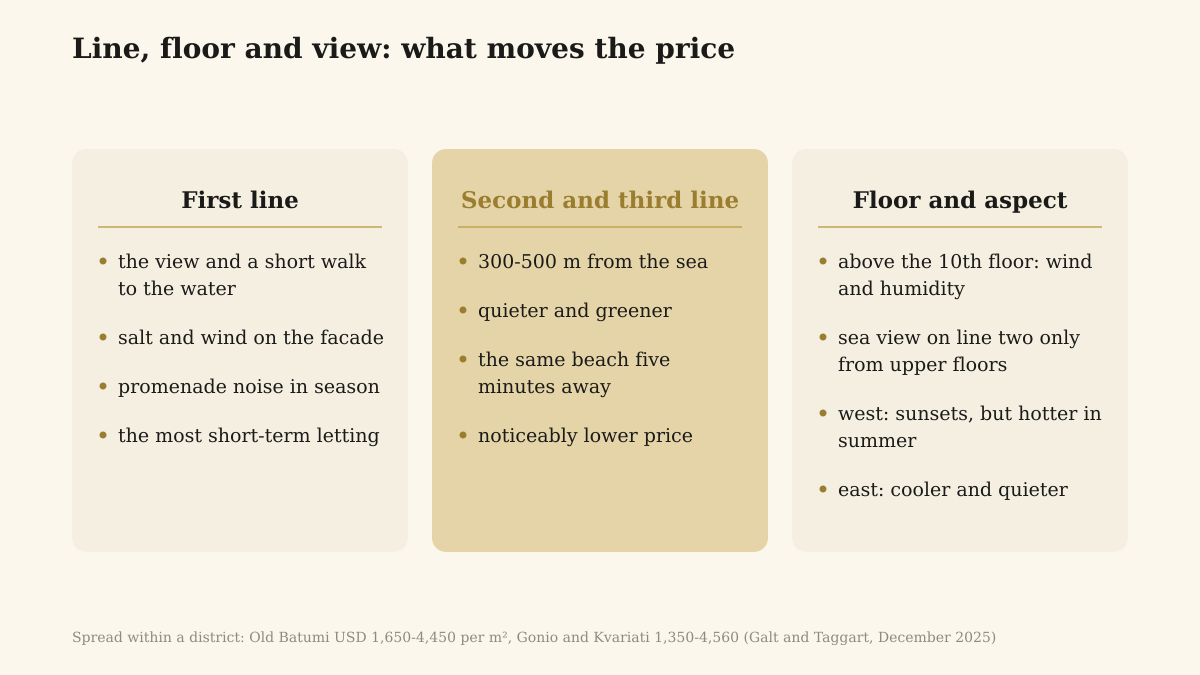
The first line gives you the view and a short walk to the water, but with them come salt and wind on the facade, promenade noise in season and the highest concentration of short-term rentals. The second and third lines, 300-500 meters from the sea, often win for living: quieter, greener, with the same beach five minutes away and a noticeably lower price. Choose the floor with two things in mind: above the tenth floor, wind and humidity on the balcony are more noticeable, and in second-line buildings the sea view opens up only from the upper floors. Orientation matters too: west-facing facades look out to the sea and the sunset but heat up more in summer, while east-facing ones are cooler and quieter.
A practical tip: view the apartment twice, in the daytime and in the evening, and be sure to see it off-season if you can. How to choose a district in general is covered in the Batumi districts guide.
Climate and building engineering
Batumi has a humid subtropical climate: 2,400-2,500 mm of rainfall a year, with November the wettest month and May the driest, air humidity of 70-80%, and an average temperature of about 5°C in January and about 22°C in August (1981-2010 climate normals, approximate). Winters are mild but damp, and that is the main thing that sets choosing a home here apart from choosing one in a dry city.
New-builds in Batumi have no central heating: heating and cooling come from air conditioners with a heating mode, heat pumps or electric boilers, and electricity costs in winter and summer are a noticeable line in the budget. So it is worth asking the developer specifically:
- what heating and cooling system is provided and who installs it;
- what class of double-glazed windows is used and whether there is supply ventilation, otherwise the windows will have to be kept open;
- how the facade is insulated and how the balconies and terraces are waterproofed;
- what exterior finishing materials are used and how they stand up to salt and wind;
- whether the building has backup power and its own well or water storage tanks.
This is a standard set of questions for a subtropical coast, and the answers separate a home for living from a building for seasonal letting. Put them to the developer before the viewing, in writing.
Finish, running costs and payments
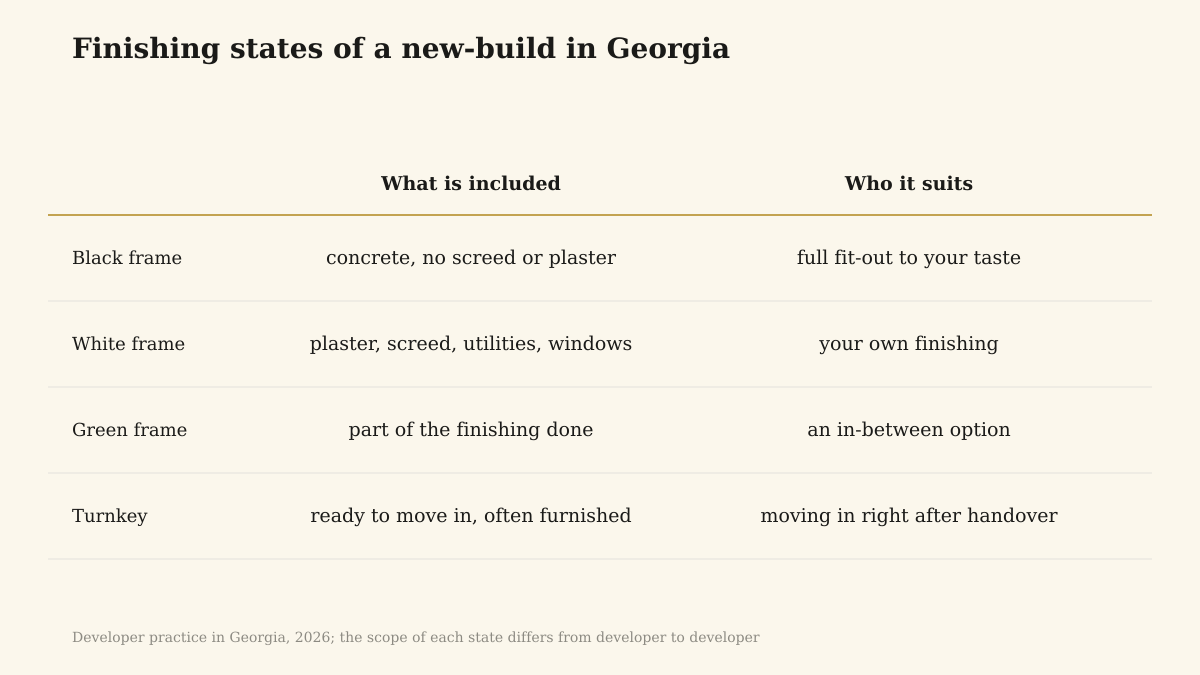
In Georgia, a new-build is sold in one of four conditions, and the contract needs to state it precisely:
| Condition | What is included | Who it suits |
|---|---|---|
| Black frame | Concrete walls and floor slabs, no screed or plaster | Full fit-out to your own design |
| White frame | Plaster, screed, utilities routed, windows | Your own final finishing |
| Green frame | Part of the final finishing done | An intermediate option with some developers |
| Turnkey | Ready to move in, often with furniture and appliances | Moving in right after handover |
Source: Georgian developer practice, 2026; the scope of work in each condition differs from developer to developer.
For an apartment for your own use, buyers more often choose white frame and their own finishing: you get a layout and materials to your own taste. A benchmark from developer offers in 2025-2026: a turnkey finishing package with furniture, appliances and plumbing fixtures costs US$600-700 per sqm. This is a benchmark, not a standard: package contents and material quality vary, so it is worth comparing the finishing specification, not just the price per meter.
Every building has a management company and a service charge for the common areas, elevators, security and the pool, if there is one. In buildings with resort-level amenities the charge is higher, and for an apartment for your own use it is worth assessing soberly whether you need these services year-round. Request the charge and the list of services before signing and build them into your budget together with utility bills. Parking in the center and on the first line is scarce, so when buying to live in, your own space or underground parking in the building matters more than it does for a rental. Property tax for an individual is 0-1% of the value and depends on household income, and on a sale after two years of ownership there is no capital gains tax (PwC Tax Summaries, Georgia, September 2026). Owner taxes are covered in detail in the article on property taxes in Georgia.
All year round: what Batumi offers off-season
The city does not live only in summer. In 2025 Batumi received 2.6 million international visits, up 5% on 2024 (Georgian National Tourism Administration, 2025), the airport handled 1,230,200 passengers, up 29% (Georgian Civil Aviation Agency, 2025), and the schedule includes direct flights to Tel Aviv, Istanbul and a number of European cities, although the winter schedule is noticeably shorter than the summer one (airline schedules, August 2026).
Two points deserve to be stated plainly. Batumi has, in effect, no full international school, only English-oriented and bilingual programs, and the choice is noticeably narrower than in Tbilisi (ExpatHub, 2026), so families with school-age children should compare the two cities before buying. Private healthcare in Batumi is of a good standard for everyday needs, but complex cases more often go to Tbilisi. For many buyers the solution is simple: Batumi as a seaside home for most of the year, and Tbilisi, about an hour's flight or five to six hours' drive away, for schools and clinics. The comparison of the two cities for relocation will help with this decision.
Districts for year-round living
Old Batumi means a walkable setting, cafes and architecture, the most expensive address in the city and the liveliest off-season. The inner districts behind the boulevard offer residential development, schools, markets and a price of about US$1,730 per sqm turnkey, with growth of 12.5% in 2025 (Galt and Taggart, December 2025). Makhinjauri to the north means quiet hillsides with a view of the bay and ten minutes to the center. Gonio and Kvariati to the south mean clean sea, pines and new projects, comfortable for living in summer, though in winter the infrastructure is quieter. New Boulevard and Heroes Alley offer the best views and beaches, but this is where short-term rentals concentrate, and for living here it is worth choosing buildings with a residential rather than a hotel profile.
What follows from this
A seaside apartment for yourself is chosen by how it feels to live in it in November, not by how it rents in August: the second line instead of the first, the building's engineering instead of the view in the rendering, a residential building profile instead of a hotel one, and a clear budget for finishing and running costs. Batumi has fewer such buildings than investment ones, and they have to be searched for separately from the investment supply. The overall picture of the 2026 market is in the article on the Batumi property market.
The deal can be completed remotely under a notarized power of attorney, with video viewings and title registration in the Public Registry, and a new-build can be paid for on the construction schedule with a 0% developer installment plan. A purchase of US$150,000 or more, based on the market valuation of an accredited appraiser, gives grounds to apply for a residence permit for you, your spouse and your minor children; the grounds arise after the completed property is handed over and registered, and the threshold should be confirmed at the time of the deal (legal.ge, 2026). How a remote purchase works and how the residence permit is obtained are covered in separate articles.
Discuss a building or district
If you would like to discuss a specific building or district against the criteria in this article, send a message on WhatsApp or book a consultation. The "Georgia Investor Guide 2026" is available on request.
This material is for reference only and is not investment, legal or tax advice. Figures are given as of the publication date with their source and may change. Confirm thresholds, taxes and rules at the time of the deal and consult a licensed lawyer and tax advisor in Georgia.
Ready to move from the overview to specifics?
Related reading
Frequently asked questions
Which Batumi district is best for year-round living?
Old Batumi for its walkable setting and off-season life, the inner districts for residential development and schools, Makhinjauri for quiet and the view of the bay. The first line and New Boulevard are a short-term rental zone; for living there, buyers choose buildings with a residential profile (Galt and Taggart, October and December 2025).
Which line and floor should you choose for a seaside apartment?
For living, the second or third line, 300-500 meters from the sea, often wins: quieter, cheaper, with the beach close by. Above the tenth floor, wind and humidity are more noticeable, and in second-line buildings the sea view opens up from the upper floors. How much line, floor and view change the price shows in the spread within a district: in Old Batumi from US$1,650 to US$4,450 per sqm (Galt and Taggart, December 2025).
What is Batumi's climate like in winter?
Mild and damp: 2,400-2,500 mm of rainfall a year, with November the wettest month, and an average January temperature of about 5°C with humidity of 70-80%. New-builds have no central heating; homes are heated with air conditioners and heat pumps (1981-2010 climate normals, approximate).
In what condition are new-builds in Batumi sold?
In one of four: black frame, white frame, green frame or turnkey. For an apartment for your own use, buyers more often take white frame and do their own finishing; the scope of work and of the finishing package differs with each developer, so compare the specification, not only the price (Georgian developer practice, 2026).
Are there international schools in Batumi?
The city has, in effect, no full international school, only English-oriented and bilingual programs, and the choice is noticeably narrower than in Tbilisi. Families with school-age children should compare the two cities before buying or consider Batumi as a seaside home for part of the year (ExpatHub, 2026).
Can you buy an apartment for yourself remotely and get a residence permit?
Yes, the deal is completed under a notarized power of attorney with title registration in the Public Registry. A purchase of US$150,000 or more based on market valuation gives grounds to apply for a residence permit for you, your spouse and your minor children after the property is handed over and registered; the threshold should be confirmed at the time of the deal (legal.ge, 2026).